

11 Experimental Study and Modelling of Particle …
397
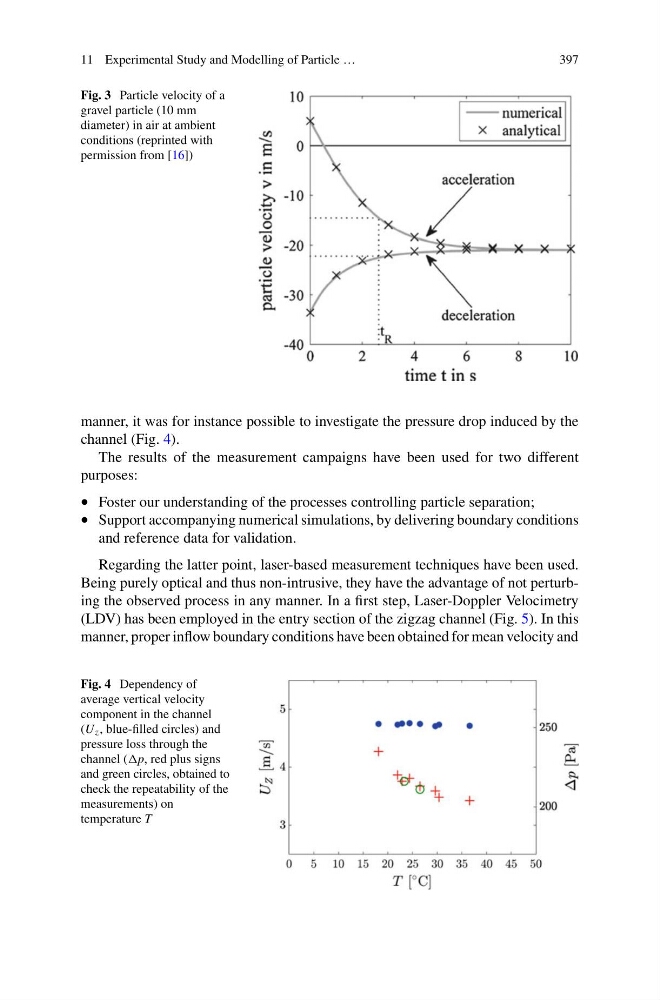
Fig. 3 Particle velocity of a
gravel particle (10 mm
diameter) in air at ambient
conditions (reprinted with
permission from [16])
manner, it was for instance possible to investigate the pressure drop induced by the
channel (Fig. 4).
The results of the measurement campaigns have been used for two different
purposes:
• Foster our understanding of the processes controlling particle separation;
• Support accompanying numerical simulations, by delivering boundary conditions
and reference data for validation.
Regarding the latter point, laser-based measurement techniques have been used.
Being purely optical and thus non-intrusive, they have the advantage of not perturbing the observed process in any manner. In a first step, Laser-Doppler Velocimetry
(LDV) has been employed in the entry section of the zigzag channel (Fig. 5). In this
manner, proper inflow boundary conditions have been obtained for mean velocity and
Fig. 4 Dependency of
average vertical velocity
component in the channel
(U z , blue-filled circles) and
pressure loss through the
channel (p, red plus signs
and green circles, obtained to
check the repeatability of the
measurements) on
temperature T
397
Fig. 3 Particle velocity of a
gravel particle (10 mm
diameter) in air at ambient
conditions (reprinted with
permission from [16])
manner, it was for instance possible to investigate the pressure drop induced by the
channel (Fig. 4).
The results of the measurement campaigns have been used for two different
purposes:
• Foster our understanding of the processes controlling particle separation;
• Support accompanying numerical simulations, by delivering boundary conditions
and reference data for validation.
Regarding the latter point, laser-based measurement techniques have been used.
Being purely optical and thus non-intrusive, they have the advantage of not perturbing the observed process in any manner. In a first step, Laser-Doppler Velocimetry
(LDV) has been employed in the entry section of the zigzag channel (Fig. 5). In this
manner, proper inflow boundary conditions have been obtained for mean velocity and
Fig. 4 Dependency of
average vertical velocity
component in the channel
(U z , blue-filled circles) and
pressure loss through the
channel (p, red plus signs
and green circles, obtained to
check the repeatability of the
measurements) on
temperature T