

396
E. Lukas et al.
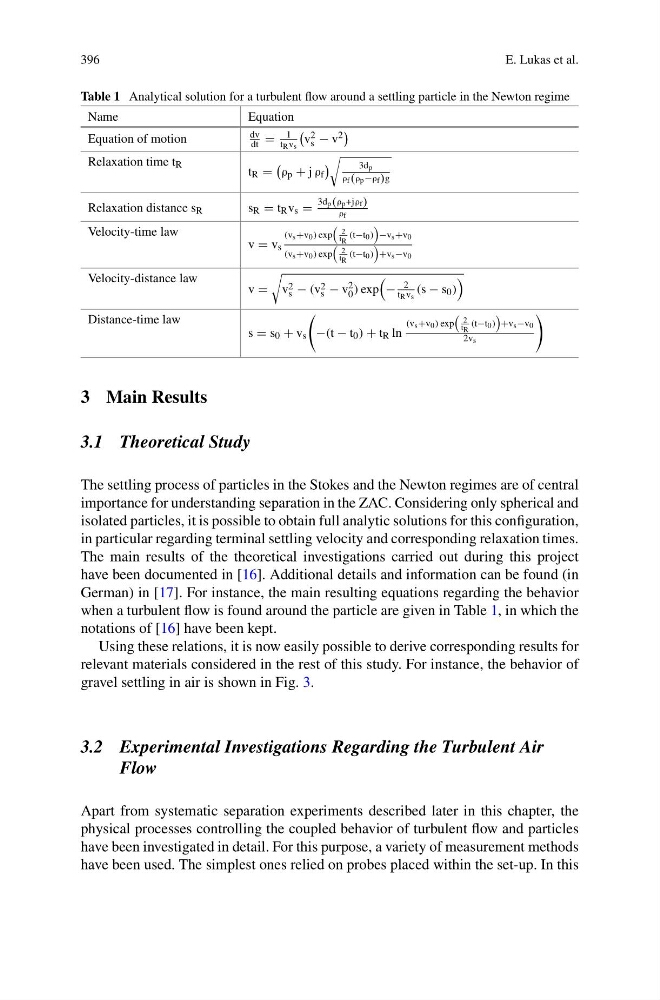
Table 1 Analytical solution for a turbulent flow around a settling particle in the Newton regime
Name
Equation
Equation of motion
dv
dt =
1
tRvs
v 2
s − v 2
Relaxation time t R
t R =
ρ p + j ρ f
3dp
ρf(ρp−ρf)g
Relaxation distance s R
s R = t R v s =
3dp(ρp+jρf)
ρf
Velocity-time law
v = v s
(vs+v0) exp
2
t R
(t−t0)
−vs+v0
(vs+v0) exp
2
t R
(t−t0)
+vs−v0
Velocity-distance law
v =
v 2
s − (v 2
s − v 2
0 ) exp
−
2
tRvs (s − s 0 )
Distance-time law
s = s 0 + v s
−(t − t 0 ) + t R ln
(vs+v0) exp
2
t R
(t−t0)
+vs−v0
2vs
3 Main Results
3.1 Theoretical Study
The settling process of particles in the Stokes and the Newton regimes are of central
importance for understanding separation in the ZAC. Considering only spherical and
isolated particles, it is possible to obtain full analytic solutions for this configuration,
in particular regarding terminal settling velocity and corresponding relaxation times.
The main results of the theoretical investigations carried out during this project
have been documented in [16]. Additional details and information can be found (in
German) in [17]. For instance, the main resulting equations regarding the behavior
when a turbulent flow is found around the particle are given in Table 1, in which the
notations of [16] have been kept.
Using these relations, it is now easily possible to derive corresponding results for
relevant materials considered in the rest of this study. For instance, the behavior of
gravel settling in air is shown in Fig. 3.
3.2 Experimental Investigations Regarding the Turbulent Air
Flow
Apart from systematic separation experiments described later in this chapter, the
physical processes controlling the coupled behavior of turbulent flow and particles
have been investigated in detail. For this purpose, a variety of measurement methods
have been used. The simplest ones relied on probes placed within the set-up. In this
E. Lukas et al.
Table 1 Analytical solution for a turbulent flow around a settling particle in the Newton regime
Name
Equation
Equation of motion
dv
dt =
1
tRvs
v 2
s − v 2
Relaxation time t R
t R =
ρ p + j ρ f
3dp
ρf(ρp−ρf)g
Relaxation distance s R
s R = t R v s =
3dp(ρp+jρf)
ρf
Velocity-time law
v = v s
(vs+v0) exp
2
t R
(t−t0)
−vs+v0
(vs+v0) exp
2
t R
(t−t0)
+vs−v0
Velocity-distance law
v =
v 2
s − (v 2
s − v 2
0 ) exp
−
2
tRvs (s − s 0 )
Distance-time law
s = s 0 + v s
−(t − t 0 ) + t R ln
(vs+v0) exp
2
t R
(t−t0)
+vs−v0
2vs
3 Main Results
3.1 Theoretical Study
The settling process of particles in the Stokes and the Newton regimes are of central
importance for understanding separation in the ZAC. Considering only spherical and
isolated particles, it is possible to obtain full analytic solutions for this configuration,
in particular regarding terminal settling velocity and corresponding relaxation times.
The main results of the theoretical investigations carried out during this project
have been documented in [16]. Additional details and information can be found (in
German) in [17]. For instance, the main resulting equations regarding the behavior
when a turbulent flow is found around the particle are given in Table 1, in which the
notations of [16] have been kept.
Using these relations, it is now easily possible to derive corresponding results for
relevant materials considered in the rest of this study. For instance, the behavior of
gravel settling in air is shown in Fig. 3.
3.2 Experimental Investigations Regarding the Turbulent Air
Flow
Apart from systematic separation experiments described later in this chapter, the
physical processes controlling the coupled behavior of turbulent flow and particles
have been investigated in detail. For this purpose, a variety of measurement methods
have been used. The simplest ones relied on probes placed within the set-up. In this