

10 Dynamics of Separation Characteristics of Sieving and Flow …
381
movement. It performs a linear, frequency- and amplitude-dependent movement in
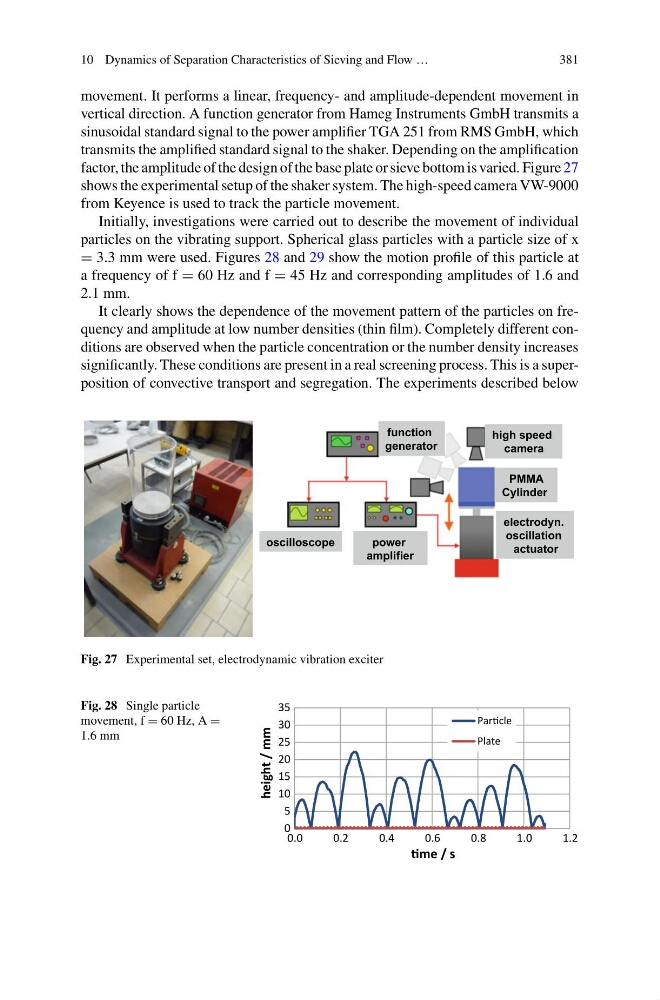
vertical direction. A function generator from Hameg Instruments GmbH transmits a
sinusoidal standard signal to the power amplifier TGA 251 from RMS GmbH, which
transmits the amplified standard signal to the shaker. Depending on the amplification
factor, the amplitude of the design of the base plate or sieve bottom is varied. Figure 27
shows the experimental setup of the shaker system. The high-speed camera VW-9000
from Keyence is used to track the particle movement.
Initially, investigations were carried out to describe the movement of individual
particles on the vibrating support. Spherical glass particles with a particle size of x
= 3.3 mm were used. Figures 28 and 29 show the motion profile of this particle at
a frequency of f = 60 Hz and f = 45 Hz and corresponding amplitudes of 1.6 and
2.1 mm.
It clearly shows the dependence of the movement pattern of the particles on frequency and amplitude at low number densities (thin film). Completely different conditions are observed when the particle concentration or the number density increases
significantly. These conditions are present in a real screening process. This is a superposition of convective transport and segregation. The experiments described below
function
generator
high speed
camera
PMMA
Cylinder
electrodyn.
oscillation
actuator
oscilloscope
power
amplifier
Fig. 27 Experimental set, electrodynamic vibration exciter
Fig. 28 Single particle
movement, f = 60 Hz, A =
1.6 mm
0.0
0.2
0.4
0.6
0.8
1.0
1.2
0
5
10
15
20
25
30
35
Ɵme / s
height / mm
ParƟcle
Plate
381
movement. It performs a linear, frequency- and amplitude-dependent movement in
vertical direction. A function generator from Hameg Instruments GmbH transmits a
sinusoidal standard signal to the power amplifier TGA 251 from RMS GmbH, which
transmits the amplified standard signal to the shaker. Depending on the amplification
factor, the amplitude of the design of the base plate or sieve bottom is varied. Figure 27
shows the experimental setup of the shaker system. The high-speed camera VW-9000
from Keyence is used to track the particle movement.
Initially, investigations were carried out to describe the movement of individual
particles on the vibrating support. Spherical glass particles with a particle size of x
= 3.3 mm were used. Figures 28 and 29 show the motion profile of this particle at
a frequency of f = 60 Hz and f = 45 Hz and corresponding amplitudes of 1.6 and
2.1 mm.
It clearly shows the dependence of the movement pattern of the particles on frequency and amplitude at low number densities (thin film). Completely different conditions are observed when the particle concentration or the number density increases
significantly. These conditions are present in a real screening process. This is a superposition of convective transport and segregation. The experiments described below
function
generator
high speed
camera
PMMA
Cylinder
electrodyn.
oscillation
actuator
oscilloscope
power
amplifier
Fig. 27 Experimental set, electrodynamic vibration exciter
Fig. 28 Single particle
movement, f = 60 Hz, A =
1.6 mm
0.0
0.2
0.4
0.6
0.8
1.0
1.2
0
5
10
15
20
25
30
35
Ɵme / s
height / mm
ParƟcle
Plate