

380
M. Weers et al.
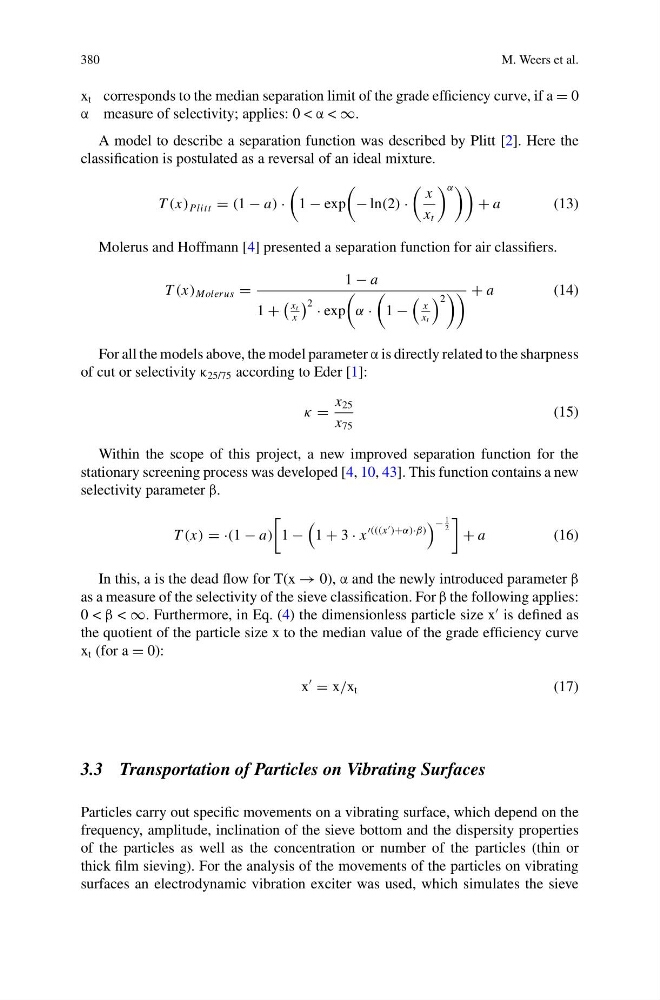
x t corresponds to the median separation limit of the grade efficiency curve, if a = 0
α measure of selectivity; applies: 0 < α < ∞.
A model to describe a separation function was described by Plitt [2]. Here the
classification is postulated as a reversal of an ideal mixture.
T (x) Plitt = (1 − a) ·
1 − exp
− ln(2) ·
x
x t
α
+ a
(13)
Molerus and Hoffmann [4] presented a separation function for air classifiers.
T (x) Molerus =
1 − a
1 +
x t
x
2 · exp
α ·
1 −
x
x t
2
+ a
(14)
For all the models above, the model parameter α is directly related to the sharpness
of cut or selectivity κ 25/75 according to Eder [1]:
κ =
x 25
x 75
(15)
Within the scope of this project, a new improved separation function for the
stationary screening process was developed [4, 10, 43]. This function contains a new
selectivity parameter β.
T (x) = ·(1 − a)
1 −
1 + 3 · x
(((x
)+α)·β)
−
1
2
+ a
(16)
In this, a is the dead flow for T(x → 0), α and the newly introduced parameter β
as a measure of the selectivity of the sieve classification. For β the following applies:
0 < β < ∞. Furthermore, in Eq. (4) the dimensionless particle size x
is defined as
the quotient of the particle size x to the median value of the grade efficiency curve
x t (for a = 0):
x
= x/x t
(17)
3.3 Transportation of Particles on Vibrating Surfaces
Particles carry out specific movements on a vibrating surface, which depend on the
frequency, amplitude, inclination of the sieve bottom and the dispersity properties
of the particles as well as the concentration or number of the particles (thin or
thick film sieving). For the analysis of the movements of the particles on vibrating
surfaces an electrodynamic vibration exciter was used, which simulates the sieve
M. Weers et al.
x t corresponds to the median separation limit of the grade efficiency curve, if a = 0
α measure of selectivity; applies: 0 < α < ∞.
A model to describe a separation function was described by Plitt [2]. Here the
classification is postulated as a reversal of an ideal mixture.
T (x) Plitt = (1 − a) ·
1 − exp
− ln(2) ·
x
x t
α
+ a
(13)
Molerus and Hoffmann [4] presented a separation function for air classifiers.
T (x) Molerus =
1 − a
1 +
x t
x
2 · exp
α ·
1 −
x
x t
2
+ a
(14)
For all the models above, the model parameter α is directly related to the sharpness
of cut or selectivity κ 25/75 according to Eder [1]:
κ =
x 25
x 75
(15)
Within the scope of this project, a new improved separation function for the
stationary screening process was developed [4, 10, 43]. This function contains a new
selectivity parameter β.
T (x) = ·(1 − a)
1 −
1 + 3 · x
(((x
)+α)·β)
−
1
2
+ a
(16)
In this, a is the dead flow for T(x → 0), α and the newly introduced parameter β
as a measure of the selectivity of the sieve classification. For β the following applies:
0 < β < ∞. Furthermore, in Eq. (4) the dimensionless particle size x
is defined as
the quotient of the particle size x to the median value of the grade efficiency curve
x t (for a = 0):
x
= x/x t
(17)
3.3 Transportation of Particles on Vibrating Surfaces
Particles carry out specific movements on a vibrating surface, which depend on the
frequency, amplitude, inclination of the sieve bottom and the dispersity properties
of the particles as well as the concentration or number of the particles (thin or
thick film sieving). For the analysis of the movements of the particles on vibrating
surfaces an electrodynamic vibration exciter was used, which simulates the sieve