

10 Dynamics of Separation Characteristics of Sieving and Flow …
379
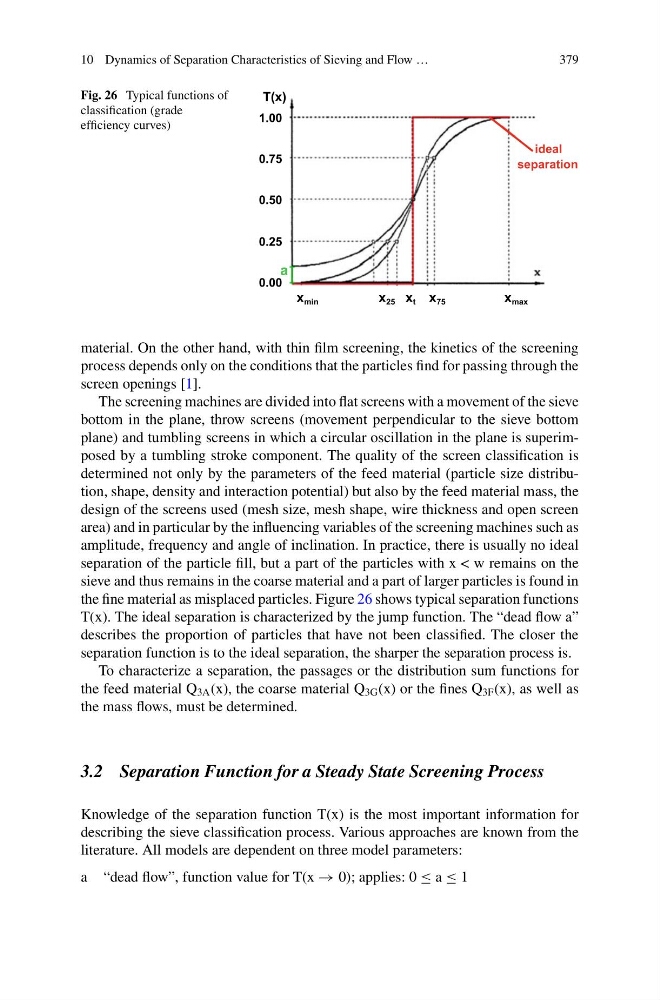
Fig. 26 Typical functions of
classification (grade
efficiency curves)
x min
x 25 x t x 75
x max
ideal
separation
T(x)
1.00
0.75
0.50
0.25
0.00
a
material. On the other hand, with thin film screening, the kinetics of the screening
process depends only on the conditions that the particles find for passing through the
screen openings [1].
The screening machines are divided into flat screens with a movement of the sieve
bottom in the plane, throw screens (movement perpendicular to the sieve bottom
plane) and tumbling screens in which a circular oscillation in the plane is superimposed by a tumbling stroke component. The quality of the screen classification is
determined not only by the parameters of the feed material (particle size distribution, shape, density and interaction potential) but also by the feed material mass, the
design of the screens used (mesh size, mesh shape, wire thickness and open screen
area) and in particular by the influencing variables of the screening machines such as
amplitude, frequency and angle of inclination. In practice, there is usually no ideal
separation of the particle fill, but a part of the particles with x < w remains on the
sieve and thus remains in the coarse material and a part of larger particles is found in
the fine material as misplaced particles. Figure 26 shows typical separation functions
T(x). The ideal separation is characterized by the jump function. The “dead flow a”
describes the proportion of particles that have not been classified. The closer the
separation function is to the ideal separation, the sharper the separation process is.
To characterize a separation, the passages or the distribution sum functions for
the feed material Q 3A (x), the coarse material Q 3G (x) or the fines Q 3F (x), as well as
the mass flows, must be determined.
3.2 Separation Function for a Steady State Screening Process
Knowledge of the separation function T(x) is the most important information for
describing the sieve classification process. Various approaches are known from the
literature. All models are dependent on three model parameters:
a “dead flow”, function value for T(x → 0); applies: 0 ≤ a ≤ 1
379
Fig. 26 Typical functions of
classification (grade
efficiency curves)
x min
x 25 x t x 75
x max
ideal
separation
T(x)
1.00
0.75
0.50
0.25
0.00
a
material. On the other hand, with thin film screening, the kinetics of the screening
process depends only on the conditions that the particles find for passing through the
screen openings [1].
The screening machines are divided into flat screens with a movement of the sieve
bottom in the plane, throw screens (movement perpendicular to the sieve bottom
plane) and tumbling screens in which a circular oscillation in the plane is superimposed by a tumbling stroke component. The quality of the screen classification is
determined not only by the parameters of the feed material (particle size distribution, shape, density and interaction potential) but also by the feed material mass, the
design of the screens used (mesh size, mesh shape, wire thickness and open screen
area) and in particular by the influencing variables of the screening machines such as
amplitude, frequency and angle of inclination. In practice, there is usually no ideal
separation of the particle fill, but a part of the particles with x < w remains on the
sieve and thus remains in the coarse material and a part of larger particles is found in
the fine material as misplaced particles. Figure 26 shows typical separation functions
T(x). The ideal separation is characterized by the jump function. The “dead flow a”
describes the proportion of particles that have not been classified. The closer the
separation function is to the ideal separation, the sharper the separation process is.
To characterize a separation, the passages or the distribution sum functions for
the feed material Q 3A (x), the coarse material Q 3G (x) or the fines Q 3F (x), as well as
the mass flows, must be determined.
3.2 Separation Function for a Steady State Screening Process
Knowledge of the separation function T(x) is the most important information for
describing the sieve classification process. Various approaches are known from the
literature. All models are dependent on three model parameters:
a “dead flow”, function value for T(x → 0); applies: 0 ≤ a ≤ 1