

1 Process Modeling for Dynamic Disperse Particle Separation …
31
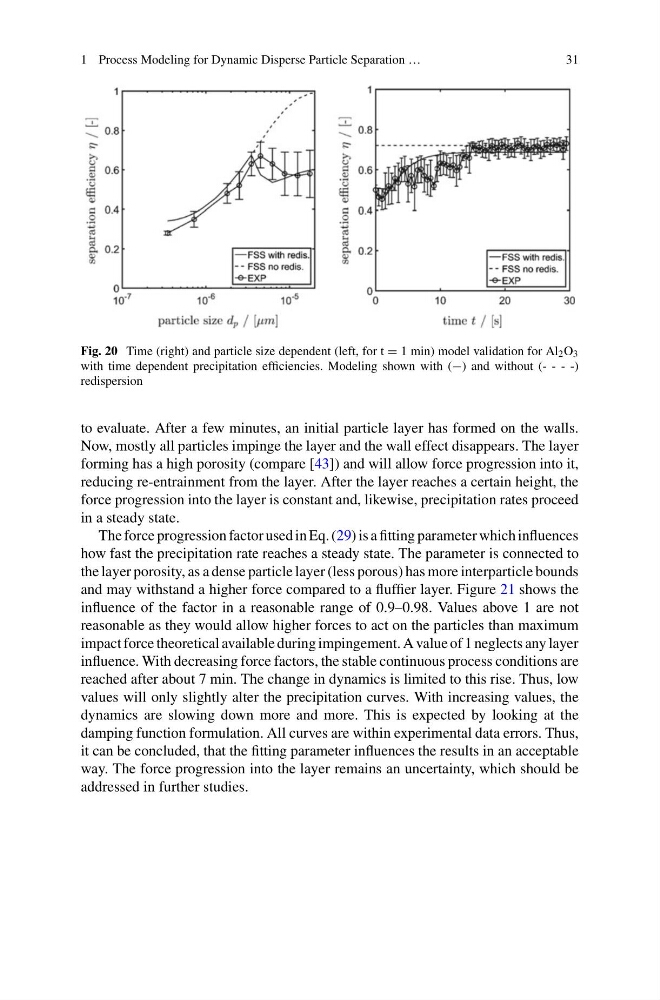
Fig. 20 Time (right) and particle size dependent (left, for t = 1 min) model validation for Al 2 O 3
with time dependent precipitation efficiencies. Modeling shown with (−) and without (- - - -)
redispersion
to evaluate. After a few minutes, an initial particle layer has formed on the walls.
Now, mostly all particles impinge the layer and the wall effect disappears. The layer
forming has a high porosity (compare [43]) and will allow force progression into it,
reducing re-entrainment from the layer. After the layer reaches a certain height, the
force progression into the layer is constant and, likewise, precipitation rates proceed
in a steady state.
The force progression factor used in Eq. (29) is a fitting parameter which influences
how fast the precipitation rate reaches a steady state. The parameter is connected to
the layer porosity, as a dense particle layer (less porous) has more interparticle bounds
and may withstand a higher force compared to a fluffier layer. Figure 21 shows the
influence of the factor in a reasonable range of 0.9–0.98. Values above 1 are not
reasonable as they would allow higher forces to act on the particles than maximum
impact force theoretical available during impingement. A value of 1 neglects any layer
influence. With decreasing force factors, the stable continuous process conditions are
reached after about 7 min. The change in dynamics is limited to this rise. Thus, low
values will only slightly alter the precipitation curves. With increasing values, the
dynamics are slowing down more and more. This is expected by looking at the
damping function formulation. All curves are within experimental data errors. Thus,
it can be concluded, that the fitting parameter influences the results in an acceptable
way. The force progression into the layer remains an uncertainty, which should be
addressed in further studies.
31
Fig. 20 Time (right) and particle size dependent (left, for t = 1 min) model validation for Al 2 O 3
with time dependent precipitation efficiencies. Modeling shown with (−) and without (- - - -)
redispersion
to evaluate. After a few minutes, an initial particle layer has formed on the walls.
Now, mostly all particles impinge the layer and the wall effect disappears. The layer
forming has a high porosity (compare [43]) and will allow force progression into it,
reducing re-entrainment from the layer. After the layer reaches a certain height, the
force progression into the layer is constant and, likewise, precipitation rates proceed
in a steady state.
The force progression factor used in Eq. (29) is a fitting parameter which influences
how fast the precipitation rate reaches a steady state. The parameter is connected to
the layer porosity, as a dense particle layer (less porous) has more interparticle bounds
and may withstand a higher force compared to a fluffier layer. Figure 21 shows the
influence of the factor in a reasonable range of 0.9–0.98. Values above 1 are not
reasonable as they would allow higher forces to act on the particles than maximum
impact force theoretical available during impingement. A value of 1 neglects any layer
influence. With decreasing force factors, the stable continuous process conditions are
reached after about 7 min. The change in dynamics is limited to this rise. Thus, low
values will only slightly alter the precipitation curves. With increasing values, the
dynamics are slowing down more and more. This is expected by looking at the
damping function formulation. All curves are within experimental data errors. Thus,
it can be concluded, that the fitting parameter influences the results in an acceptable
way. The force progression into the layer remains an uncertainty, which should be
addressed in further studies.