

32
S. Sander et al.
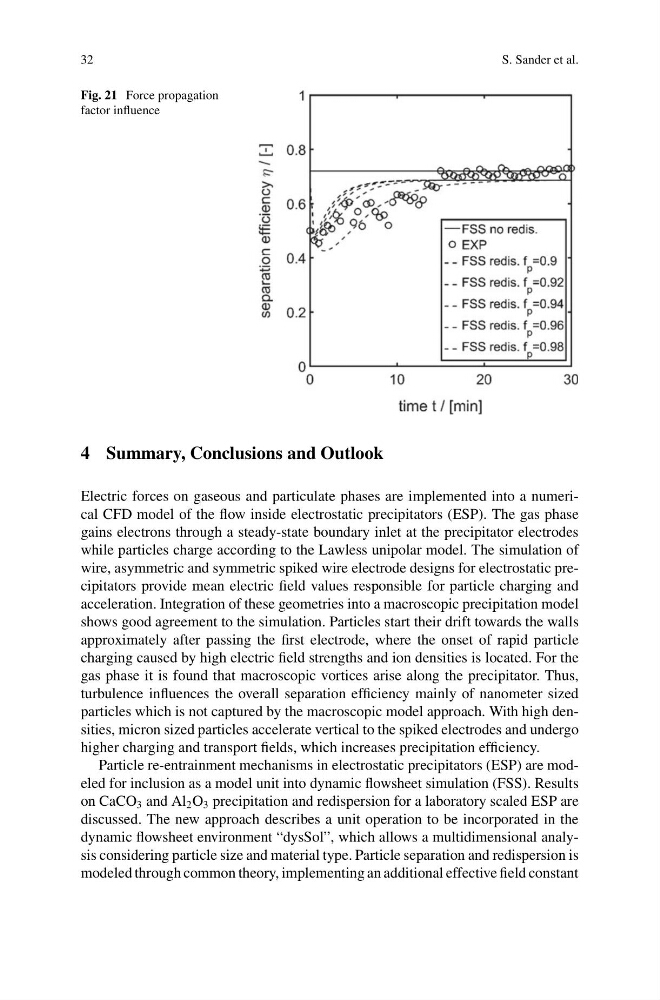
Fig. 21 Force propagation
factor influence
4 Summary, Conclusions and Outlook
Electric forces on gaseous and particulate phases are implemented into a numerical CFD model of the flow inside electrostatic precipitators (ESP). The gas phase
gains electrons through a steady-state boundary inlet at the precipitator electrodes
while particles charge according to the Lawless unipolar model. The simulation of
wire, asymmetric and symmetric spiked wire electrode designs for electrostatic precipitators provide mean electric field values responsible for particle charging and
acceleration. Integration of these geometries into a macroscopic precipitation model
shows good agreement to the simulation. Particles start their drift towards the walls
approximately after passing the first electrode, where the onset of rapid particle
charging caused by high electric field strengths and ion densities is located. For the
gas phase it is found that macroscopic vortices arise along the precipitator. Thus,
turbulence influences the overall separation efficiency mainly of nanometer sized
particles which is not captured by the macroscopic model approach. With high densities, micron sized particles accelerate vertical to the spiked electrodes and undergo
higher charging and transport fields, which increases precipitation efficiency.
Particle re-entrainment mechanisms in electrostatic precipitators (ESP) are modeled for inclusion as a model unit into dynamic flowsheet simulation (FSS). Results
on CaCO 3 and Al 2 O 3 precipitation and redispersion for a laboratory scaled ESP are
discussed. The new approach describes a unit operation to be incorporated in the
dynamic flowsheet environment “dysSol”, which allows a multidimensional analysis considering particle size and material type. Particle separation and redispersion is
modeled through common theory, implementing an additional effective field constant
S. Sander et al.
Fig. 21 Force propagation
factor influence
4 Summary, Conclusions and Outlook
Electric forces on gaseous and particulate phases are implemented into a numerical CFD model of the flow inside electrostatic precipitators (ESP). The gas phase
gains electrons through a steady-state boundary inlet at the precipitator electrodes
while particles charge according to the Lawless unipolar model. The simulation of
wire, asymmetric and symmetric spiked wire electrode designs for electrostatic precipitators provide mean electric field values responsible for particle charging and
acceleration. Integration of these geometries into a macroscopic precipitation model
shows good agreement to the simulation. Particles start their drift towards the walls
approximately after passing the first electrode, where the onset of rapid particle
charging caused by high electric field strengths and ion densities is located. For the
gas phase it is found that macroscopic vortices arise along the precipitator. Thus,
turbulence influences the overall separation efficiency mainly of nanometer sized
particles which is not captured by the macroscopic model approach. With high densities, micron sized particles accelerate vertical to the spiked electrodes and undergo
higher charging and transport fields, which increases precipitation efficiency.
Particle re-entrainment mechanisms in electrostatic precipitators (ESP) are modeled for inclusion as a model unit into dynamic flowsheet simulation (FSS). Results
on CaCO 3 and Al 2 O 3 precipitation and redispersion for a laboratory scaled ESP are
discussed. The new approach describes a unit operation to be incorporated in the
dynamic flowsheet environment “dysSol”, which allows a multidimensional analysis considering particle size and material type. Particle separation and redispersion is
modeled through common theory, implementing an additional effective field constant