

10 Dynamics of Separation Characteristics of Sieving and Flow …
377
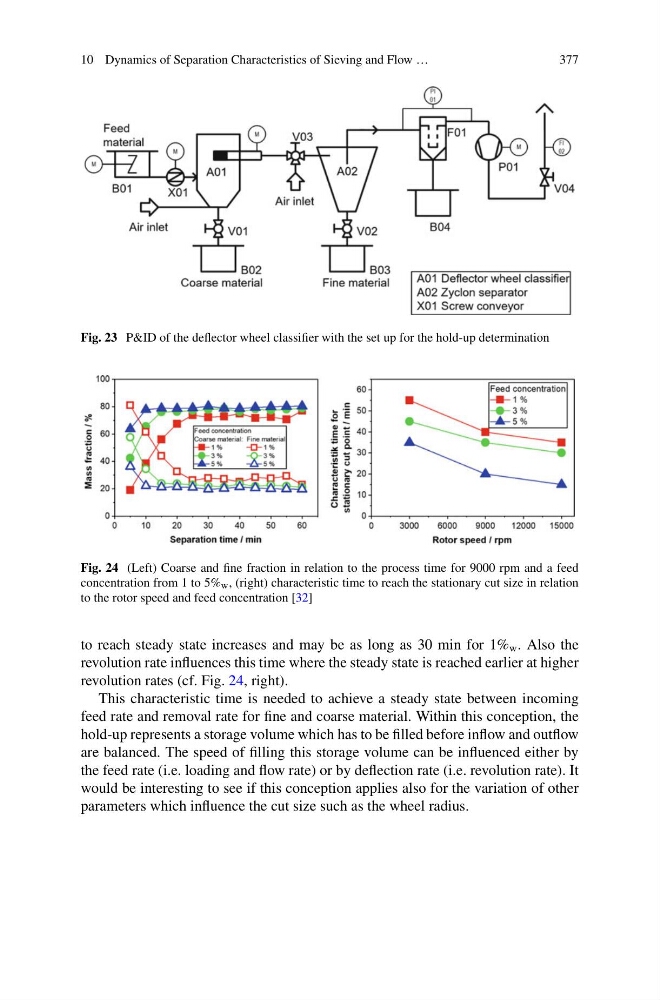
Fig. 23 P&ID of the deflector wheel classifier with the set up for the hold-up determination
Fig. 24 (Left) Coarse and fine fraction in relation to the process time for 9000 rpm and a feed
concentration from 1 to 5% w , (right) characteristic time to reach the stationary cut size in relation
to the rotor speed and feed concentration [32]
to reach steady state increases and may be as long as 30 min for 1% w . Also the
revolution rate influences this time where the steady state is reached earlier at higher
revolution rates (cf. Fig. 24, right).
This characteristic time is needed to achieve a steady state between incoming
feed rate and removal rate for fine and coarse material. Within this conception, the
hold-up represents a storage volume which has to be filled before inflow and outflow
are balanced. The speed of filling this storage volume can be influenced either by
the feed rate (i.e. loading and flow rate) or by deflection rate (i.e. revolution rate). It
would be interesting to see if this conception applies also for the variation of other
parameters which influence the cut size such as the wheel radius.
377
Fig. 23 P&ID of the deflector wheel classifier with the set up for the hold-up determination
Fig. 24 (Left) Coarse and fine fraction in relation to the process time for 9000 rpm and a feed
concentration from 1 to 5% w , (right) characteristic time to reach the stationary cut size in relation
to the rotor speed and feed concentration [32]
to reach steady state increases and may be as long as 30 min for 1% w . Also the
revolution rate influences this time where the steady state is reached earlier at higher
revolution rates (cf. Fig. 24, right).
This characteristic time is needed to achieve a steady state between incoming
feed rate and removal rate for fine and coarse material. Within this conception, the
hold-up represents a storage volume which has to be filled before inflow and outflow
are balanced. The speed of filling this storage volume can be influenced either by
the feed rate (i.e. loading and flow rate) or by deflection rate (i.e. revolution rate). It
would be interesting to see if this conception applies also for the variation of other
parameters which influence the cut size such as the wheel radius.