

10 Dynamics of Separation Characteristics of Sieving and Flow …
375
Rotor speed
/ rpm
Characteristic feature
xt
/
µm
κ
/ -
3000
Experiment
120 0.57
Cubic particle
100 0.43
Cubic p. weighted
137 0.74
Tetrahedral particle
112 0.42
Tetrahedral p. weighted
155 0.75
9000
Experiment
25
0.59
Cubic particle
29
0.35
Cubic p. weighted
40
0.82
Tetrahedral particle
33
33
Tetrahedral p. weighted
45
0.82
15000
Experiment
12
0.50
Cubic particle
10
0.58
Cubic p. weighted
16
0.59
Tetrahedral particle
11
0.58
Tetrahedral p. weighted
18
0.58
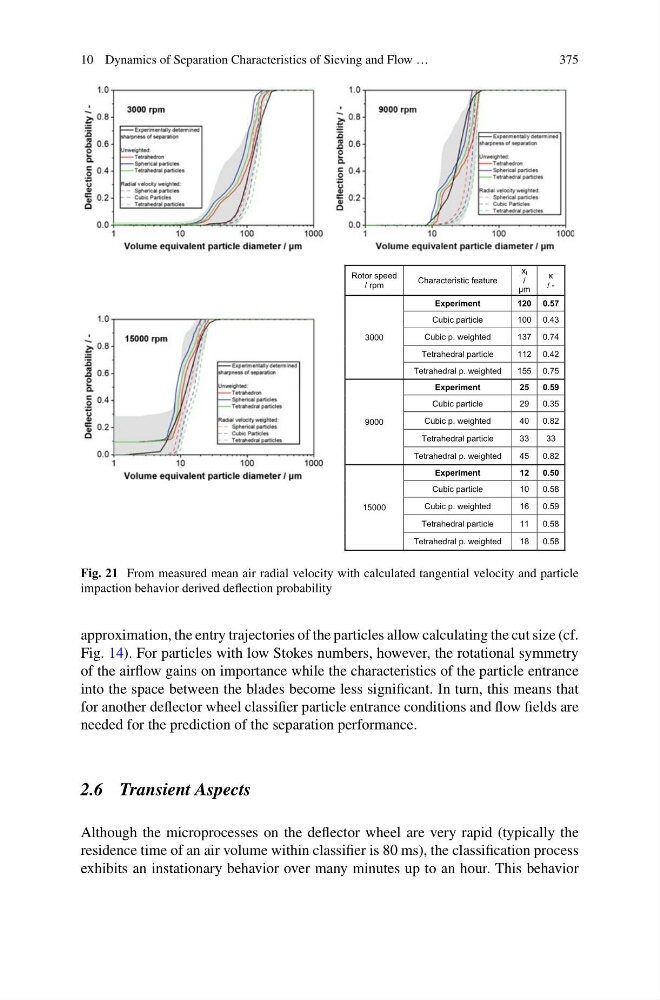
Fig. 21 From measured mean air radial velocity with calculated tangential velocity and particle
impaction behavior derived deflection probability
approximation, the entry trajectories of the particles allow calculating the cut size (cf.
Fig. 14). For particles with low Stokes numbers, however, the rotational symmetry
of the airflow gains on importance while the characteristics of the particle entrance
into the space between the blades become less significant. In turn, this means that
for another deflector wheel classifier particle entrance conditions and flow fields are
needed for the prediction of the separation performance.
2.6 Transient Aspects
Although the microprocesses on the deflector wheel are very rapid (typically the
residence time of an air volume within classifier is 80 ms), the classification process
exhibits an instationary behavior over many minutes up to an hour. This behavior
375
Rotor speed
/ rpm
Characteristic feature
xt
/
µm
κ
/ -
3000
Experiment
120 0.57
Cubic particle
100 0.43
Cubic p. weighted
137 0.74
Tetrahedral particle
112 0.42
Tetrahedral p. weighted
155 0.75
9000
Experiment
25
0.59
Cubic particle
29
0.35
Cubic p. weighted
40
0.82
Tetrahedral particle
33
33
Tetrahedral p. weighted
45
0.82
15000
Experiment
12
0.50
Cubic particle
10
0.58
Cubic p. weighted
16
0.59
Tetrahedral particle
11
0.58
Tetrahedral p. weighted
18
0.58
Fig. 21 From measured mean air radial velocity with calculated tangential velocity and particle
impaction behavior derived deflection probability
approximation, the entry trajectories of the particles allow calculating the cut size (cf.
Fig. 14). For particles with low Stokes numbers, however, the rotational symmetry
of the airflow gains on importance while the characteristics of the particle entrance
into the space between the blades become less significant. In turn, this means that
for another deflector wheel classifier particle entrance conditions and flow fields are
needed for the prediction of the separation performance.
2.6 Transient Aspects
Although the microprocesses on the deflector wheel are very rapid (typically the
residence time of an air volume within classifier is 80 ms), the classification process
exhibits an instationary behavior over many minutes up to an hour. This behavior