

374
M. Weers et al.
Rotor speed
/ rpm
Characteristic feature
xt
/
µm
κ
/ -
3000
Experiment
120 0.57
Cubic particle
100 0.50
Cubic p. weighted
122 0.74
Tetrahedral particle
113 0.49
Tetrahedral p. weighted
138 0.74
9000
Experiment
25
0.59
Cubic particle
46
0.47
Cubic p. weighted
52
0.70
Tetrahedral particle
51
0.46
Tetrahedral p. weighted
58
0.69
15000
Experiment
12
0.50
Cubic particle
14
0.55
Cubic p. weighted
17
0.70
Tetrahedral particle
16
0.54
Tetrahedral p. weighted
18
0.70
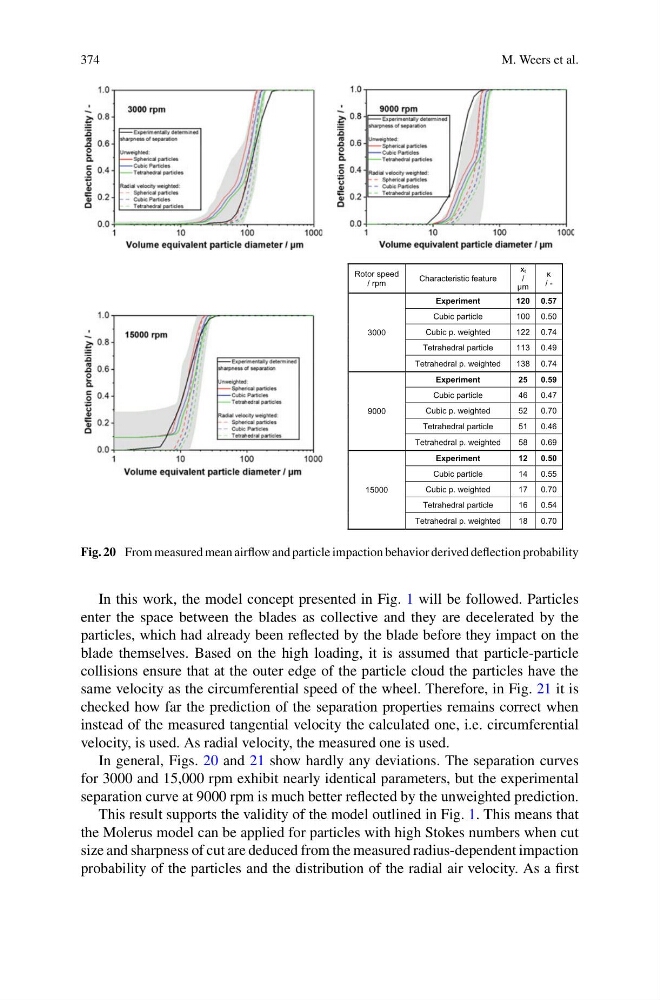
Fig. 20 From measured mean airflow and particle impaction behavior derived deflection probability
In this work, the model concept presented in Fig. 1 will be followed. Particles
enter the space between the blades as collective and they are decelerated by the
particles, which had already been reflected by the blade before they impact on the
blade themselves. Based on the high loading, it is assumed that particle-particle
collisions ensure that at the outer edge of the particle cloud the particles have the
same velocity as the circumferential speed of the wheel. Therefore, in Fig. 21 it is
checked how far the prediction of the separation properties remains correct when
instead of the measured tangential velocity the calculated one, i.e. circumferential
velocity, is used. As radial velocity, the measured one is used.
In general, Figs. 20 and 21 show hardly any deviations. The separation curves
for 3000 and 15,000 rpm exhibit nearly identical parameters, but the experimental
separation curve at 9000 rpm is much better reflected by the unweighted prediction.
This result supports the validity of the model outlined in Fig. 1. This means that
the Molerus model can be applied for particles with high Stokes numbers when cut
size and sharpness of cut are deduced from the measured radius-dependent impaction
probability of the particles and the distribution of the radial air velocity. As a first
M. Weers et al.
Rotor speed
/ rpm
Characteristic feature
xt
/
µm
κ
/ -
3000
Experiment
120 0.57
Cubic particle
100 0.50
Cubic p. weighted
122 0.74
Tetrahedral particle
113 0.49
Tetrahedral p. weighted
138 0.74
9000
Experiment
25
0.59
Cubic particle
46
0.47
Cubic p. weighted
52
0.70
Tetrahedral particle
51
0.46
Tetrahedral p. weighted
58
0.69
15000
Experiment
12
0.50
Cubic particle
14
0.55
Cubic p. weighted
17
0.70
Tetrahedral particle
16
0.54
Tetrahedral p. weighted
18
0.70
Fig. 20 From measured mean airflow and particle impaction behavior derived deflection probability
In this work, the model concept presented in Fig. 1 will be followed. Particles
enter the space between the blades as collective and they are decelerated by the
particles, which had already been reflected by the blade before they impact on the
blade themselves. Based on the high loading, it is assumed that particle-particle
collisions ensure that at the outer edge of the particle cloud the particles have the
same velocity as the circumferential speed of the wheel. Therefore, in Fig. 21 it is
checked how far the prediction of the separation properties remains correct when
instead of the measured tangential velocity the calculated one, i.e. circumferential
velocity, is used. As radial velocity, the measured one is used.
In general, Figs. 20 and 21 show hardly any deviations. The separation curves
for 3000 and 15,000 rpm exhibit nearly identical parameters, but the experimental
separation curve at 9000 rpm is much better reflected by the unweighted prediction.
This result supports the validity of the model outlined in Fig. 1. This means that
the Molerus model can be applied for particles with high Stokes numbers when cut
size and sharpness of cut are deduced from the measured radius-dependent impaction
probability of the particles and the distribution of the radial air velocity. As a first