

10 Dynamics of Separation Characteristics of Sieving and Flow …
367
Rotor speed
/ rpm
Characteristic feature
xt
/
μm
κ
/ -
3000
Experiment
120 0.57
Cubic particle
101 0.72
Tetrahedral particle
113 0.72
6000
Experiment
39
0.55
Cubic particle
41
0.74
Tetrahedral particle
45
0.73
9000
Experiment
25
0.59
Cubic particle
25
0.74
Tetrahedral particle
27
0.74
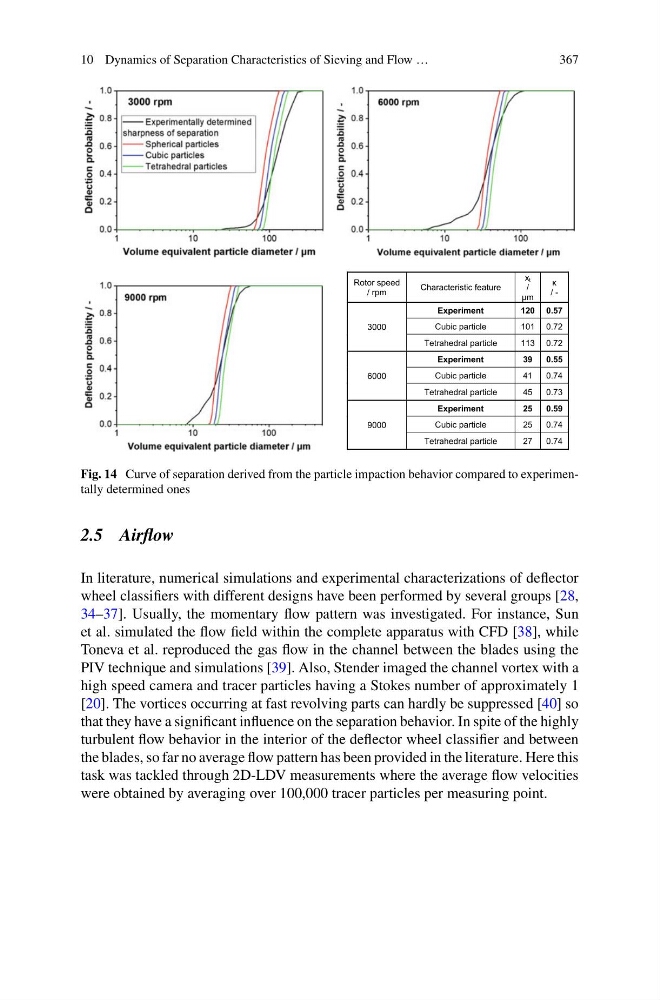
Fig. 14 Curve of separation derived from the particle impaction behavior compared to experimentally determined ones
2.5 Airflow
In literature, numerical simulations and experimental characterizations of deflector
wheel classifiers with different designs have been performed by several groups [28,
34–37]. Usually, the momentary flow pattern was investigated. For instance, Sun
et al. simulated the flow field within the complete apparatus with CFD [38], while
Toneva et al. reproduced the gas flow in the channel between the blades using the
PIV technique and simulations [39]. Also, Stender imaged the channel vortex with a
high speed camera and tracer particles having a Stokes number of approximately 1
[20]. The vortices occurring at fast revolving parts can hardly be suppressed [40] so
that they have a significant influence on the separation behavior. In spite of the highly
turbulent flow behavior in the interior of the deflector wheel classifier and between
the blades, so far no average flow pattern has been provided in the literature. Here this
task was tackled through 2D-LDV measurements where the average flow velocities
were obtained by averaging over 100,000 tracer particles per measuring point.
367
Rotor speed
/ rpm
Characteristic feature
xt
/
μm
κ
/ -
3000
Experiment
120 0.57
Cubic particle
101 0.72
Tetrahedral particle
113 0.72
6000
Experiment
39
0.55
Cubic particle
41
0.74
Tetrahedral particle
45
0.73
9000
Experiment
25
0.59
Cubic particle
25
0.74
Tetrahedral particle
27
0.74
Fig. 14 Curve of separation derived from the particle impaction behavior compared to experimentally determined ones
2.5 Airflow
In literature, numerical simulations and experimental characterizations of deflector
wheel classifiers with different designs have been performed by several groups [28,
34–37]. Usually, the momentary flow pattern was investigated. For instance, Sun
et al. simulated the flow field within the complete apparatus with CFD [38], while
Toneva et al. reproduced the gas flow in the channel between the blades using the
PIV technique and simulations [39]. Also, Stender imaged the channel vortex with a
high speed camera and tracer particles having a Stokes number of approximately 1
[20]. The vortices occurring at fast revolving parts can hardly be suppressed [40] so
that they have a significant influence on the separation behavior. In spite of the highly
turbulent flow behavior in the interior of the deflector wheel classifier and between
the blades, so far no average flow pattern has been provided in the literature. Here this
task was tackled through 2D-LDV measurements where the average flow velocities
were obtained by averaging over 100,000 tracer particles per measuring point.