

366
M. Weers et al.
where ρ air and ρ p are the densities of air and the particle, respectively, v rad is the radial
velocity and v tan the circumferential velocity, R the radial distance to the rotation
axis and c D the drag coefficient [33]:
c D =
24
Re
(1+0.15 Re
0.687
)
(12)
where Re is the particle Reynolds number.
For non-spherical particles, the usual definition of the particle diameter is not
constructive, so that the volume equivalent diameter will be used in the following.
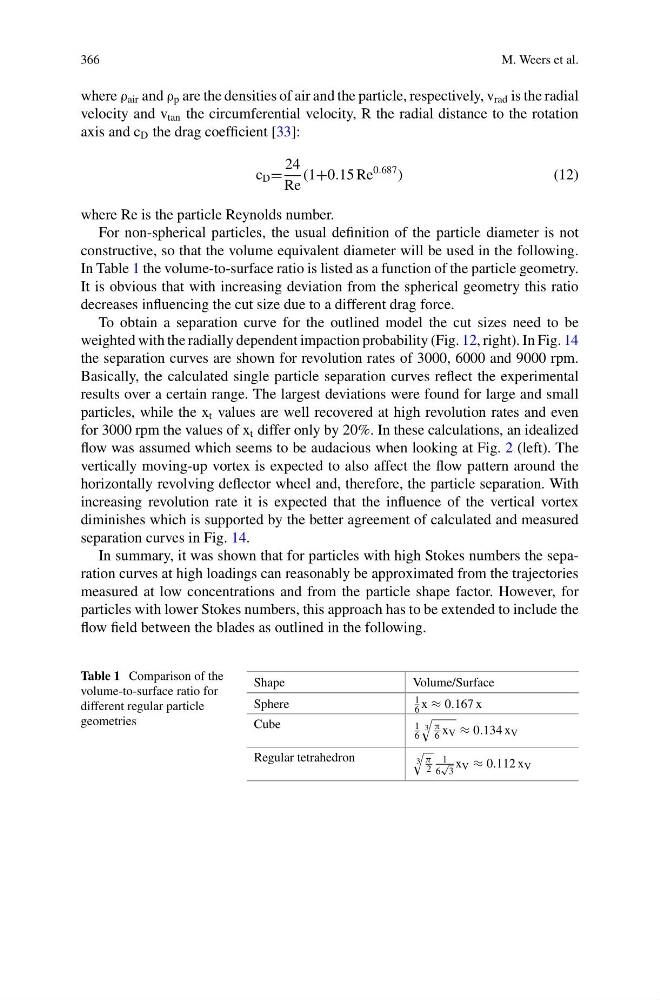
In Table 1 the volume-to-surface ratio is listed as a function of the particle geometry.
It is obvious that with increasing deviation from the spherical geometry this ratio
decreases influencing the cut size due to a different drag force.
To obtain a separation curve for the outlined model the cut sizes need to be
weighted with the radially dependent impaction probability (Fig. 12, right). In Fig. 14
the separation curves are shown for revolution rates of 3000, 6000 and 9000 rpm.
Basically, the calculated single particle separation curves reflect the experimental
results over a certain range. The largest deviations were found for large and small
particles, while the x t values are well recovered at high revolution rates and even
for 3000 rpm the values of x t differ only by 20%. In these calculations, an idealized
flow was assumed which seems to be audacious when looking at Fig. 2 (left). The
vertically moving-up vortex is expected to also affect the flow pattern around the
horizontally revolving deflector wheel and, therefore, the particle separation. With
increasing revolution rate it is expected that the influence of the vertical vortex
diminishes which is supported by the better agreement of calculated and measured
separation curves in Fig. 14.
In summary, it was shown that for particles with high Stokes numbers the separation curves at high loadings can reasonably be approximated from the trajectories
measured at low concentrations and from the particle shape factor. However, for
particles with lower Stokes numbers, this approach has to be extended to include the
flow field between the blades as outlined in the following.
Table 1 Comparison of the
volume-to-surface ratio for
different regular particle
geometries
Shape
Volume/Surface
Sphere
1
6 x ≈ 0.167 x
Cube
1
6
3
π
6 x V ≈ 0.134 x V
Regular tetrahedron
3
π
2
1
6
√
3
x V ≈ 0.112 x V
M. Weers et al.
where ρ air and ρ p are the densities of air and the particle, respectively, v rad is the radial
velocity and v tan the circumferential velocity, R the radial distance to the rotation
axis and c D the drag coefficient [33]:
c D =
24
Re
(1+0.15 Re
0.687
)
(12)
where Re is the particle Reynolds number.
For non-spherical particles, the usual definition of the particle diameter is not
constructive, so that the volume equivalent diameter will be used in the following.
In Table 1 the volume-to-surface ratio is listed as a function of the particle geometry.
It is obvious that with increasing deviation from the spherical geometry this ratio
decreases influencing the cut size due to a different drag force.
To obtain a separation curve for the outlined model the cut sizes need to be
weighted with the radially dependent impaction probability (Fig. 12, right). In Fig. 14
the separation curves are shown for revolution rates of 3000, 6000 and 9000 rpm.
Basically, the calculated single particle separation curves reflect the experimental
results over a certain range. The largest deviations were found for large and small
particles, while the x t values are well recovered at high revolution rates and even
for 3000 rpm the values of x t differ only by 20%. In these calculations, an idealized
flow was assumed which seems to be audacious when looking at Fig. 2 (left). The
vertically moving-up vortex is expected to also affect the flow pattern around the
horizontally revolving deflector wheel and, therefore, the particle separation. With
increasing revolution rate it is expected that the influence of the vertical vortex
diminishes which is supported by the better agreement of calculated and measured
separation curves in Fig. 14.
In summary, it was shown that for particles with high Stokes numbers the separation curves at high loadings can reasonably be approximated from the trajectories
measured at low concentrations and from the particle shape factor. However, for
particles with lower Stokes numbers, this approach has to be extended to include the
flow field between the blades as outlined in the following.
Table 1 Comparison of the
volume-to-surface ratio for
different regular particle
geometries
Shape
Volume/Surface
Sphere
1
6 x ≈ 0.167 x
Cube
1
6
3
π
6 x V ≈ 0.134 x V
Regular tetrahedron
3
π
2
1
6
√
3
x V ≈ 0.112 x V