

10 Dynamics of Separation Characteristics of Sieving and Flow …
365
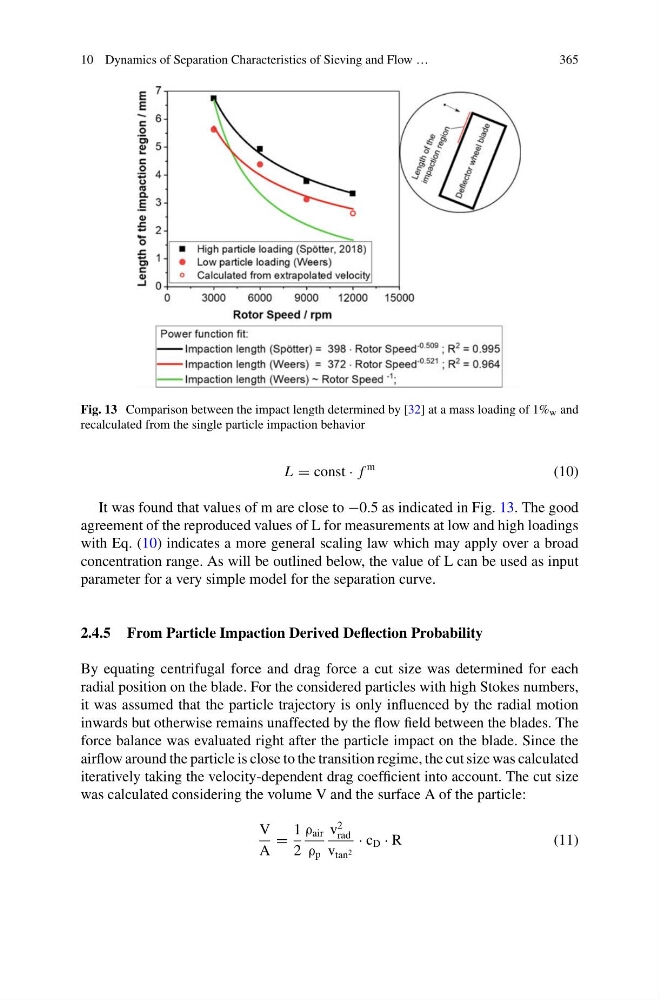
Fig. 13 Comparison between the impact length determined by [32] at a mass loading of 1% w and
recalculated from the single particle impaction behavior
L = const · f
m
(10)
It was found that values of m are close to −0.5 as indicated in Fig. 13. The good
agreement of the reproduced values of L for measurements at low and high loadings
with Eq. (10) indicates a more general scaling law which may apply over a broad
concentration range. As will be outlined below, the value of L can be used as input
parameter for a very simple model for the separation curve.
2.4.5 From Particle Impaction Derived Deflection Probability
By equating centrifugal force and drag force a cut size was determined for each
radial position on the blade. For the considered particles with high Stokes numbers,
it was assumed that the particle trajectory is only influenced by the radial motion
inwards but otherwise remains unaffected by the flow field between the blades. The
force balance was evaluated right after the particle impact on the blade. Since the
airflow around the particle is close to the transition regime, the cut size was calculated
iteratively taking the velocity-dependent drag coefficient into account. The cut size
was calculated considering the volume V and the surface A of the particle:
V
A
=
1
2
ρ air
ρ p
v
2
rad
v tan 2
· c D · R
(11)
365
Fig. 13 Comparison between the impact length determined by [32] at a mass loading of 1% w and
recalculated from the single particle impaction behavior
L = const · f
m
(10)
It was found that values of m are close to −0.5 as indicated in Fig. 13. The good
agreement of the reproduced values of L for measurements at low and high loadings
with Eq. (10) indicates a more general scaling law which may apply over a broad
concentration range. As will be outlined below, the value of L can be used as input
parameter for a very simple model for the separation curve.
2.4.5 From Particle Impaction Derived Deflection Probability
By equating centrifugal force and drag force a cut size was determined for each
radial position on the blade. For the considered particles with high Stokes numbers,
it was assumed that the particle trajectory is only influenced by the radial motion
inwards but otherwise remains unaffected by the flow field between the blades. The
force balance was evaluated right after the particle impact on the blade. Since the
airflow around the particle is close to the transition regime, the cut size was calculated
iteratively taking the velocity-dependent drag coefficient into account. The cut size
was calculated considering the volume V and the surface A of the particle:
V
A
=
1
2
ρ air
ρ p
v
2
rad
v tan 2
· c D · R
(11)