

364
M. Weers et al.
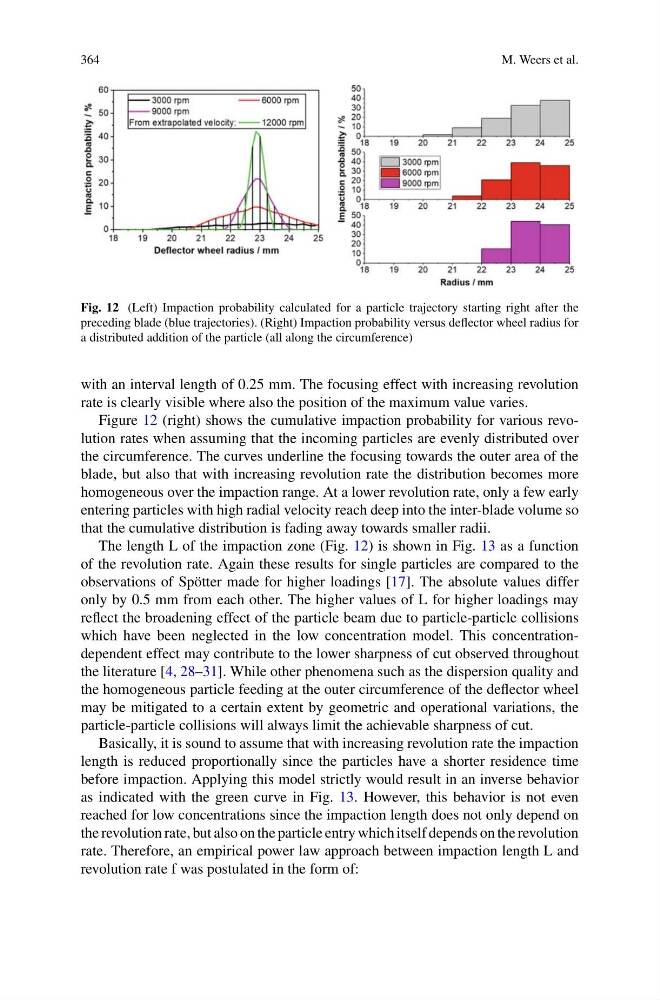
Fig. 12 (Left) Impaction probability calculated for a particle trajectory starting right after the
preceding blade (blue trajectories). (Right) Impaction probability versus deflector wheel radius for
a distributed addition of the particle (all along the circumference)
with an interval length of 0.25 mm. The focusing effect with increasing revolution
rate is clearly visible where also the position of the maximum value varies.
Figure 12 (right) shows the cumulative impaction probability for various revolution rates when assuming that the incoming particles are evenly distributed over
the circumference. The curves underline the focusing towards the outer area of the
blade, but also that with increasing revolution rate the distribution becomes more
homogeneous over the impaction range. At a lower revolution rate, only a few early
entering particles with high radial velocity reach deep into the inter-blade volume so
that the cumulative distribution is fading away towards smaller radii.
The length L of the impaction zone (Fig. 12) is shown in Fig. 13 as a function
of the revolution rate. Again these results for single particles are compared to the
observations of Spötter made for higher loadings [17]. The absolute values differ
only by 0.5 mm from each other. The higher values of L for higher loadings may
reflect the broadening effect of the particle beam due to particle-particle collisions
which have been neglected in the low concentration model. This concentrationdependent effect may contribute to the lower sharpness of cut observed throughout
the literature [4, 28–31]. While other phenomena such as the dispersion quality and
the homogeneous particle feeding at the outer circumference of the deflector wheel
may be mitigated to a certain extent by geometric and operational variations, the
particle-particle collisions will always limit the achievable sharpness of cut.
Basically, it is sound to assume that with increasing revolution rate the impaction
length is reduced proportionally since the particles have a shorter residence time
before impaction. Applying this model strictly would result in an inverse behavior
as indicated with the green curve in Fig. 13. However, this behavior is not even
reached for low concentrations since the impaction length does not only depend on
the revolution rate, but also on the particle entry which itself depends on the revolution
rate. Therefore, an empirical power law approach between impaction length L and
revolution rate f was postulated in the form of:
M. Weers et al.
Fig. 12 (Left) Impaction probability calculated for a particle trajectory starting right after the
preceding blade (blue trajectories). (Right) Impaction probability versus deflector wheel radius for
a distributed addition of the particle (all along the circumference)
with an interval length of 0.25 mm. The focusing effect with increasing revolution
rate is clearly visible where also the position of the maximum value varies.
Figure 12 (right) shows the cumulative impaction probability for various revolution rates when assuming that the incoming particles are evenly distributed over
the circumference. The curves underline the focusing towards the outer area of the
blade, but also that with increasing revolution rate the distribution becomes more
homogeneous over the impaction range. At a lower revolution rate, only a few early
entering particles with high radial velocity reach deep into the inter-blade volume so
that the cumulative distribution is fading away towards smaller radii.
The length L of the impaction zone (Fig. 12) is shown in Fig. 13 as a function
of the revolution rate. Again these results for single particles are compared to the
observations of Spötter made for higher loadings [17]. The absolute values differ
only by 0.5 mm from each other. The higher values of L for higher loadings may
reflect the broadening effect of the particle beam due to particle-particle collisions
which have been neglected in the low concentration model. This concentrationdependent effect may contribute to the lower sharpness of cut observed throughout
the literature [4, 28–31]. While other phenomena such as the dispersion quality and
the homogeneous particle feeding at the outer circumference of the deflector wheel
may be mitigated to a certain extent by geometric and operational variations, the
particle-particle collisions will always limit the achievable sharpness of cut.
Basically, it is sound to assume that with increasing revolution rate the impaction
length is reduced proportionally since the particles have a shorter residence time
before impaction. Applying this model strictly would result in an inverse behavior
as indicated with the green curve in Fig. 13. However, this behavior is not even
reached for low concentrations since the impaction length does not only depend on
the revolution rate, but also on the particle entry which itself depends on the revolution
rate. Therefore, an empirical power law approach between impaction length L and
revolution rate f was postulated in the form of: