

360
M. Weers et al.
were performed with a Fastcam SA-X2 type 1080K-M2 high speed camera (Photron)
equipped with a Nikon AF Nikkor 50 mm with an aperture opening of f# = 1.8. The
used light system was a dedocool D2 (Dedotec Inc.). The frame rate was 20,000 fps
and the shutter speed 1/20,670 s
−1 .
In position b the camera was oriented in the direction of the rotation axis. Here a
Keyence VW-600 M high speed camera with a Keyence VW-Z2 Macroobjective was
employed. The recording rate was 230,000 fps with a shutter speed of 1/230,000 s
−1 .
The illumination system was again the dedocool D2.
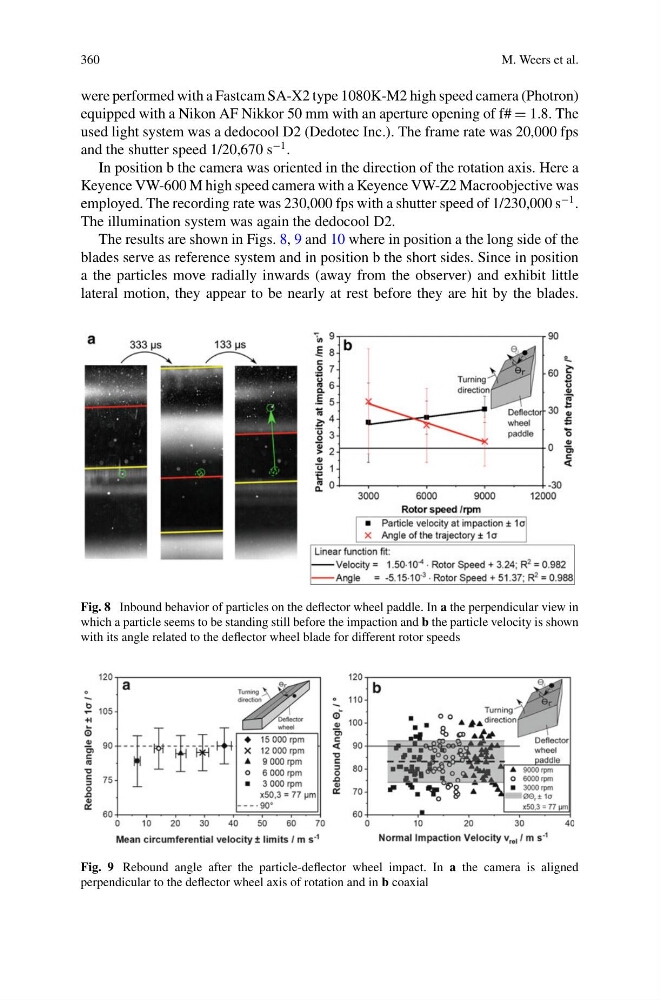
The results are shown in Figs. 8, 9 and 10 where in position a the long side of the
blades serve as reference system and in position b the short sides. Since in position
a the particles move radially inwards (away from the observer) and exhibit little
lateral motion, they appear to be nearly at rest before they are hit by the blades.
Fig. 8 Inbound behavior of particles on the deflector wheel paddle. In a the perpendicular view in
which a particle seems to be standing still before the impaction and b the particle velocity is shown
with its angle related to the deflector wheel blade for different rotor speeds
Fig. 9 Rebound angle after the particle-deflector wheel impact. In a the camera is aligned
perpendicular to the deflector wheel axis of rotation and in b coaxial
M. Weers et al.
were performed with a Fastcam SA-X2 type 1080K-M2 high speed camera (Photron)
equipped with a Nikon AF Nikkor 50 mm with an aperture opening of f# = 1.8. The
used light system was a dedocool D2 (Dedotec Inc.). The frame rate was 20,000 fps
and the shutter speed 1/20,670 s
−1 .
In position b the camera was oriented in the direction of the rotation axis. Here a
Keyence VW-600 M high speed camera with a Keyence VW-Z2 Macroobjective was
employed. The recording rate was 230,000 fps with a shutter speed of 1/230,000 s
−1 .
The illumination system was again the dedocool D2.
The results are shown in Figs. 8, 9 and 10 where in position a the long side of the
blades serve as reference system and in position b the short sides. Since in position
a the particles move radially inwards (away from the observer) and exhibit little
lateral motion, they appear to be nearly at rest before they are hit by the blades.
Fig. 8 Inbound behavior of particles on the deflector wheel paddle. In a the perpendicular view in
which a particle seems to be standing still before the impaction and b the particle velocity is shown
with its angle related to the deflector wheel blade for different rotor speeds
Fig. 9 Rebound angle after the particle-deflector wheel impact. In a the camera is aligned
perpendicular to the deflector wheel axis of rotation and in b coaxial