

10 Dynamics of Separation Characteristics of Sieving and Flow …
361
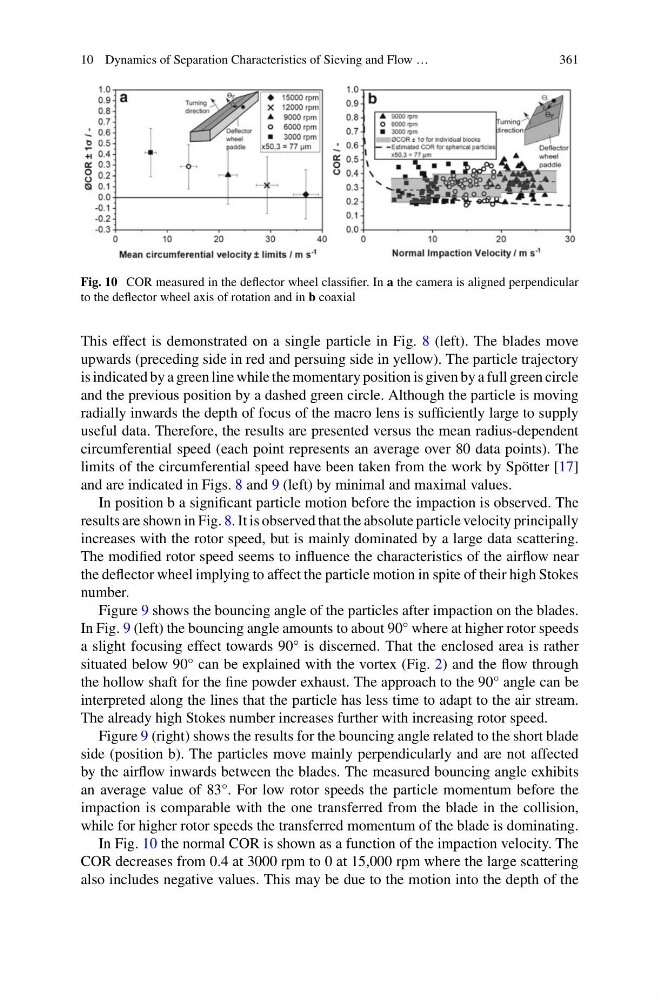
Fig. 10 COR measured in the deflector wheel classifier. In a the camera is aligned perpendicular
to the deflector wheel axis of rotation and in b coaxial
This effect is demonstrated on a single particle in Fig. 8 (left). The blades move
upwards (preceding side in red and persuing side in yellow). The particle trajectory
is indicated by a green line while the momentary position is given by a full green circle
and the previous position by a dashed green circle. Although the particle is moving
radially inwards the depth of focus of the macro lens is sufficiently large to supply
useful data. Therefore, the results are presented versus the mean radius-dependent
circumferential speed (each point represents an average over 80 data points). The
limits of the circumferential speed have been taken from the work by Spötter [17]
and are indicated in Figs. 8 and 9 (left) by minimal and maximal values.
In position b a significant particle motion before the impaction is observed. The
results are shown in Fig. 8. It is observed that the absolute particle velocity principally
increases with the rotor speed, but is mainly dominated by a large data scattering.
The modified rotor speed seems to influence the characteristics of the airflow near
the deflector wheel implying to affect the particle motion in spite of their high Stokes
number.
Figure 9 shows the bouncing angle of the particles after impaction on the blades.
In Fig. 9 (left) the bouncing angle amounts to about 90° where at higher rotor speeds
a slight focusing effect towards 90° is discerned. That the enclosed area is rather
situated below 90° can be explained with the vortex (Fig. 2) and the flow through
the hollow shaft for the fine powder exhaust. The approach to the 90° angle can be
interpreted along the lines that the particle has less time to adapt to the air stream.
The already high Stokes number increases further with increasing rotor speed.
Figure 9 (right) shows the results for the bouncing angle related to the short blade
side (position b). The particles move mainly perpendicularly and are not affected
by the airflow inwards between the blades. The measured bouncing angle exhibits
an average value of 83°. For low rotor speeds the particle momentum before the
impaction is comparable with the one transferred from the blade in the collision,
while for higher rotor speeds the transferred momentum of the blade is dominating.
In Fig. 10 the normal COR is shown as a function of the impaction velocity. The
COR decreases from 0.4 at 3000 rpm to 0 at 15,000 rpm where the large scattering
also includes negative values. This may be due to the motion into the depth of the
361
Fig. 10 COR measured in the deflector wheel classifier. In a the camera is aligned perpendicular
to the deflector wheel axis of rotation and in b coaxial
This effect is demonstrated on a single particle in Fig. 8 (left). The blades move
upwards (preceding side in red and persuing side in yellow). The particle trajectory
is indicated by a green line while the momentary position is given by a full green circle
and the previous position by a dashed green circle. Although the particle is moving
radially inwards the depth of focus of the macro lens is sufficiently large to supply
useful data. Therefore, the results are presented versus the mean radius-dependent
circumferential speed (each point represents an average over 80 data points). The
limits of the circumferential speed have been taken from the work by Spötter [17]
and are indicated in Figs. 8 and 9 (left) by minimal and maximal values.
In position b a significant particle motion before the impaction is observed. The
results are shown in Fig. 8. It is observed that the absolute particle velocity principally
increases with the rotor speed, but is mainly dominated by a large data scattering.
The modified rotor speed seems to influence the characteristics of the airflow near
the deflector wheel implying to affect the particle motion in spite of their high Stokes
number.
Figure 9 shows the bouncing angle of the particles after impaction on the blades.
In Fig. 9 (left) the bouncing angle amounts to about 90° where at higher rotor speeds
a slight focusing effect towards 90° is discerned. That the enclosed area is rather
situated below 90° can be explained with the vortex (Fig. 2) and the flow through
the hollow shaft for the fine powder exhaust. The approach to the 90° angle can be
interpreted along the lines that the particle has less time to adapt to the air stream.
The already high Stokes number increases further with increasing rotor speed.
Figure 9 (right) shows the results for the bouncing angle related to the short blade
side (position b). The particles move mainly perpendicularly and are not affected
by the airflow inwards between the blades. The measured bouncing angle exhibits
an average value of 83°. For low rotor speeds the particle momentum before the
impaction is comparable with the one transferred from the blade in the collision,
while for higher rotor speeds the transferred momentum of the blade is dominating.
In Fig. 10 the normal COR is shown as a function of the impaction velocity. The
COR decreases from 0.4 at 3000 rpm to 0 at 15,000 rpm where the large scattering
also includes negative values. This may be due to the motion into the depth of the