

10 Dynamics of Separation Characteristics of Sieving and Flow …
359
model of Thornton et al. the expected behavior of spherical limestone particles was
included using literature material values.
The measured values refer to the projection area equivalent diameter where within
the investigated size range between 30 and 70 μm no velocity dependence was
observed. However, for a broader size range, this dependence should be taken into
account. In general, the measured COR follows the expectation values where the
scattering due to the non-spherical particle shape is superimposed. In addition, in
the low velocity range, the average value does not follow the model trend. In the
model, spherical particles hardly experience plastic deformation in this regime, but
the impaction energy is nearly completely transferred into elastic deformation which
is recovered with some dissipation in the rebound process. In contrast, for the real nonspherical particles a higher number of multiple collisions due to excentric impaction
and a higher fraction of plastic deformation is expected, in particular, when the
particles are impacting on their edges or corners (cf. Fig. 2, right).
2.4.3 Particle Impaction Behavior in the Classifier
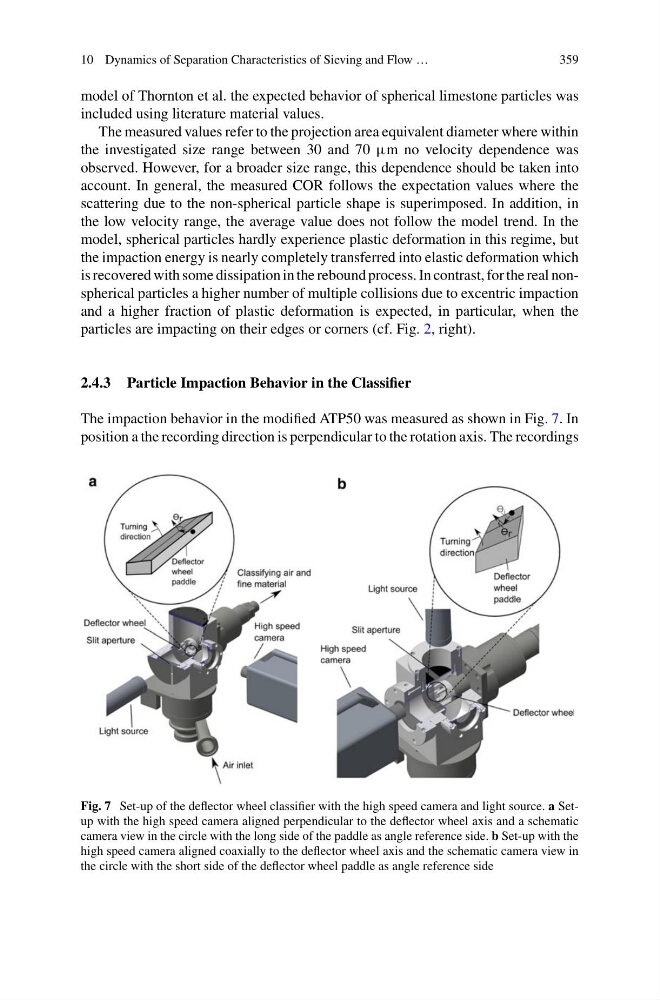
The impaction behavior in the modified ATP50 was measured as shown in Fig. 7. In
position a the recording direction is perpendicular to the rotation axis. The recordings
Fig. 7 Set-up of the deflector wheel classifier with the high speed camera and light source. a Setup with the high speed camera aligned perpendicular to the deflector wheel axis and a schematic
camera view in the circle with the long side of the paddle as angle reference side. b Set-up with the
high speed camera aligned coaxially to the deflector wheel axis and the schematic camera view in
the circle with the short side of the deflector wheel paddle as angle reference side
359
model of Thornton et al. the expected behavior of spherical limestone particles was
included using literature material values.
The measured values refer to the projection area equivalent diameter where within
the investigated size range between 30 and 70 μm no velocity dependence was
observed. However, for a broader size range, this dependence should be taken into
account. In general, the measured COR follows the expectation values where the
scattering due to the non-spherical particle shape is superimposed. In addition, in
the low velocity range, the average value does not follow the model trend. In the
model, spherical particles hardly experience plastic deformation in this regime, but
the impaction energy is nearly completely transferred into elastic deformation which
is recovered with some dissipation in the rebound process. In contrast, for the real nonspherical particles a higher number of multiple collisions due to excentric impaction
and a higher fraction of plastic deformation is expected, in particular, when the
particles are impacting on their edges or corners (cf. Fig. 2, right).
2.4.3 Particle Impaction Behavior in the Classifier
The impaction behavior in the modified ATP50 was measured as shown in Fig. 7. In
position a the recording direction is perpendicular to the rotation axis. The recordings
Fig. 7 Set-up of the deflector wheel classifier with the high speed camera and light source. a Setup with the high speed camera aligned perpendicular to the deflector wheel axis and a schematic
camera view in the circle with the long side of the paddle as angle reference side. b Set-up with the
high speed camera aligned coaxially to the deflector wheel axis and the schematic camera view in
the circle with the short side of the deflector wheel paddle as angle reference side