

358
M. Weers et al.
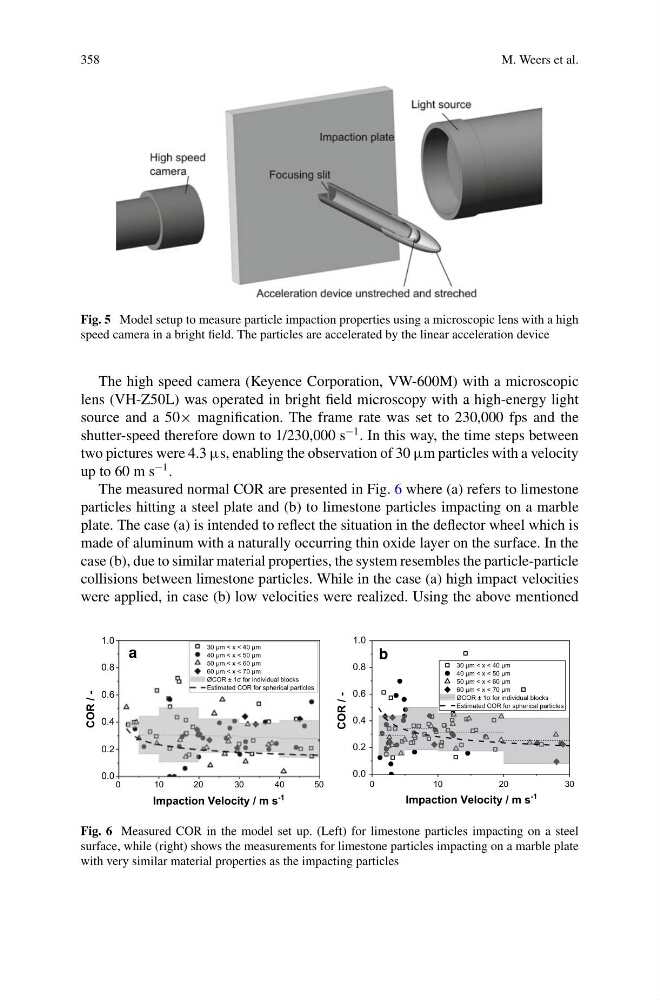
Fig. 5 Model setup to measure particle impaction properties using a microscopic lens with a high
speed camera in a bright field. The particles are accelerated by the linear acceleration device
The high speed camera (Keyence Corporation, VW-600M) with a microscopic
lens (VH-Z50L) was operated in bright field microscopy with a high-energy light
source and a 50× magnification. The frame rate was set to 230,000 fps and the
shutter-speed therefore down to 1/230,000 s
−1 . In this way, the time steps between
two pictures were 4.3 μs, enabling the observation of 30 μm particles with a velocity
up to 60 m s
−1 .
The measured normal COR are presented in Fig. 6 where (a) refers to limestone
particles hitting a steel plate and (b) to limestone particles impacting on a marble
plate. The case (a) is intended to reflect the situation in the deflector wheel which is
made of aluminum with a naturally occurring thin oxide layer on the surface. In the
case (b), due to similar material properties, the system resembles the particle-particle
collisions between limestone particles. While in the case (a) high impact velocities
were applied, in case (b) low velocities were realized. Using the above mentioned
a
30 μm < x < 40 μm
40 μm < x < 50 μm
50 μm < x < 60 μm
60 μm < x < 70 μm
ØCOR ± 1σ for individual blocks
Estimated COR for spherical particles
0
1 0
2 0
3 0
0.0
0.2
0.4
0.6
0.8
1.0
COR / -
Impaction Velocity / m s
-1
b
30 μm < x < 40 μm
40 μm < x < 50 μm
50 μm < x < 60 μm
60 μm < x < 70 μm
ØCOR ± 1σ for individual blocks
Estimated COR for spherical particles
0.0
0.2
0.4
0.6
0.8
1.0
COR / -
0
1 0
2 0
3 0
4 0
5 0
Impaction Velocity / m s
-1
Fig. 6 Measured COR in the model set up. (Left) for limestone particles impacting on a steel
surface, while (right) shows the measurements for limestone particles impacting on a marble plate
with very similar material properties as the impacting particles
M. Weers et al.
Fig. 5 Model setup to measure particle impaction properties using a microscopic lens with a high
speed camera in a bright field. The particles are accelerated by the linear acceleration device
The high speed camera (Keyence Corporation, VW-600M) with a microscopic
lens (VH-Z50L) was operated in bright field microscopy with a high-energy light
source and a 50× magnification. The frame rate was set to 230,000 fps and the
shutter-speed therefore down to 1/230,000 s
−1 . In this way, the time steps between
two pictures were 4.3 μs, enabling the observation of 30 μm particles with a velocity
up to 60 m s
−1 .
The measured normal COR are presented in Fig. 6 where (a) refers to limestone
particles hitting a steel plate and (b) to limestone particles impacting on a marble
plate. The case (a) is intended to reflect the situation in the deflector wheel which is
made of aluminum with a naturally occurring thin oxide layer on the surface. In the
case (b), due to similar material properties, the system resembles the particle-particle
collisions between limestone particles. While in the case (a) high impact velocities
were applied, in case (b) low velocities were realized. Using the above mentioned
a
30 μm < x < 40 μm
40 μm < x < 50 μm
50 μm < x < 60 μm
60 μm < x < 70 μm
ØCOR ± 1σ for individual blocks
Estimated COR for spherical particles
0
1 0
2 0
3 0
0.0
0.2
0.4
0.6
0.8
1.0
COR / -
Impaction Velocity / m s
-1
b
30 μm < x < 40 μm
40 μm < x < 50 μm
50 μm < x < 60 μm
60 μm < x < 70 μm
ØCOR ± 1σ for individual blocks
Estimated COR for spherical particles
0.0
0.2
0.4
0.6
0.8
1.0
COR / -
0
1 0
2 0
3 0
4 0
5 0
Impaction Velocity / m s
-1
Fig. 6 Measured COR in the model set up. (Left) for limestone particles impacting on a steel
surface, while (right) shows the measurements for limestone particles impacting on a marble plate
with very similar material properties as the impacting particles