

1 Process Modeling for Dynamic Disperse Particle Separation …
29
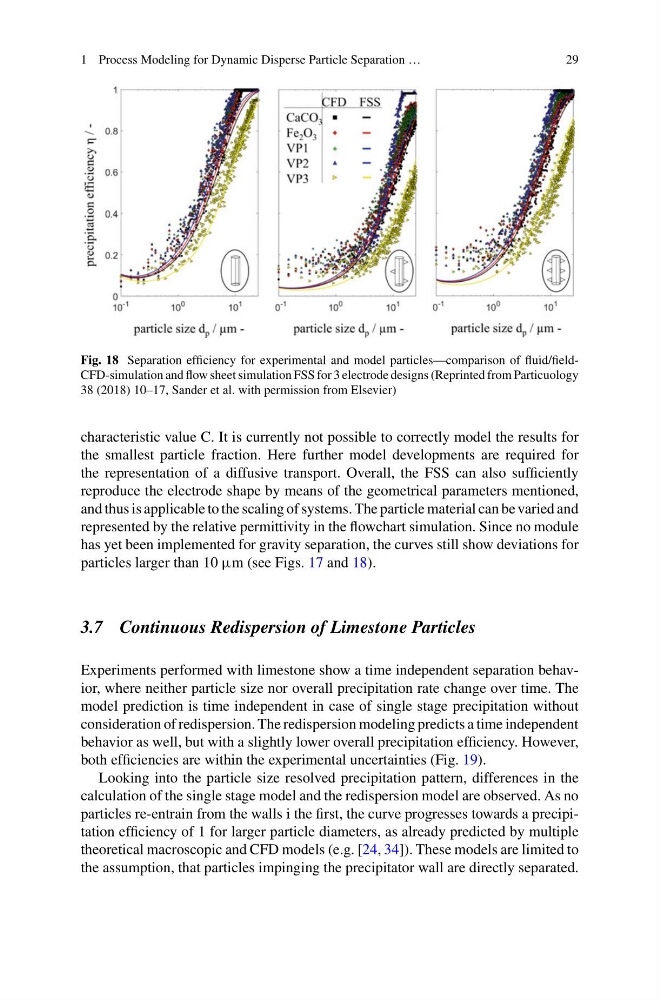
Fig. 18 Separation efficiency for experimental and model particles—comparison of fluid/fieldCFD-simulation and flow sheet simulation FSS for 3 electrode designs (Reprinted from Particuology
38 (2018) 10–17, Sander et al. with permission from Elsevier)
characteristic value C. It is currently not possible to correctly model the results for
the smallest particle fraction. Here further model developments are required for
the representation of a diffusive transport. Overall, the FSS can also sufficiently
reproduce the electrode shape by means of the geometrical parameters mentioned,
and thus is applicable to the scaling of systems. The particle material can be varied and
represented by the relative permittivity in the flowchart simulation. Since no module
has yet been implemented for gravity separation, the curves still show deviations for
particles larger than 10 μm (see Figs. 17 and 18).
3.7 Continuous Redispersion of Limestone Particles
Experiments performed with limestone show a time independent separation behavior, where neither particle size nor overall precipitation rate change over time. The
model prediction is time independent in case of single stage precipitation without
consideration of redispersion. The redispersion modeling predicts a time independent
behavior as well, but with a slightly lower overall precipitation efficiency. However,
both efficiencies are within the experimental uncertainties (Fig. 19).
Looking into the particle size resolved precipitation pattern, differences in the
calculation of the single stage model and the redispersion model are observed. As no
particles re-entrain from the walls i the first, the curve progresses towards a precipitation efficiency of 1 for larger particle diameters, as already predicted by multiple
theoretical macroscopic and CFD models (e.g. [24, 34]). These models are limited to
the assumption, that particles impinging the precipitator wall are directly separated.
29
Fig. 18 Separation efficiency for experimental and model particles—comparison of fluid/fieldCFD-simulation and flow sheet simulation FSS for 3 electrode designs (Reprinted from Particuology
38 (2018) 10–17, Sander et al. with permission from Elsevier)
characteristic value C. It is currently not possible to correctly model the results for
the smallest particle fraction. Here further model developments are required for
the representation of a diffusive transport. Overall, the FSS can also sufficiently
reproduce the electrode shape by means of the geometrical parameters mentioned,
and thus is applicable to the scaling of systems. The particle material can be varied and
represented by the relative permittivity in the flowchart simulation. Since no module
has yet been implemented for gravity separation, the curves still show deviations for
particles larger than 10 μm (see Figs. 17 and 18).
3.7 Continuous Redispersion of Limestone Particles
Experiments performed with limestone show a time independent separation behavior, where neither particle size nor overall precipitation rate change over time. The
model prediction is time independent in case of single stage precipitation without
consideration of redispersion. The redispersion modeling predicts a time independent
behavior as well, but with a slightly lower overall precipitation efficiency. However,
both efficiencies are within the experimental uncertainties (Fig. 19).
Looking into the particle size resolved precipitation pattern, differences in the
calculation of the single stage model and the redispersion model are observed. As no
particles re-entrain from the walls i the first, the curve progresses towards a precipitation efficiency of 1 for larger particle diameters, as already predicted by multiple
theoretical macroscopic and CFD models (e.g. [24, 34]). These models are limited to
the assumption, that particles impinging the precipitator wall are directly separated.