

28
S. Sander et al.
multi-scale turbulence effects with increasing potentials play a greater role. These
effects cannot be properly described in 2d simulations.
3.6 Electrode Geometry and Material Variation
One of the main reasons for the high degree of complexity in the design of an
electro-deposition process with the help of a macro-model is the variety of electrode
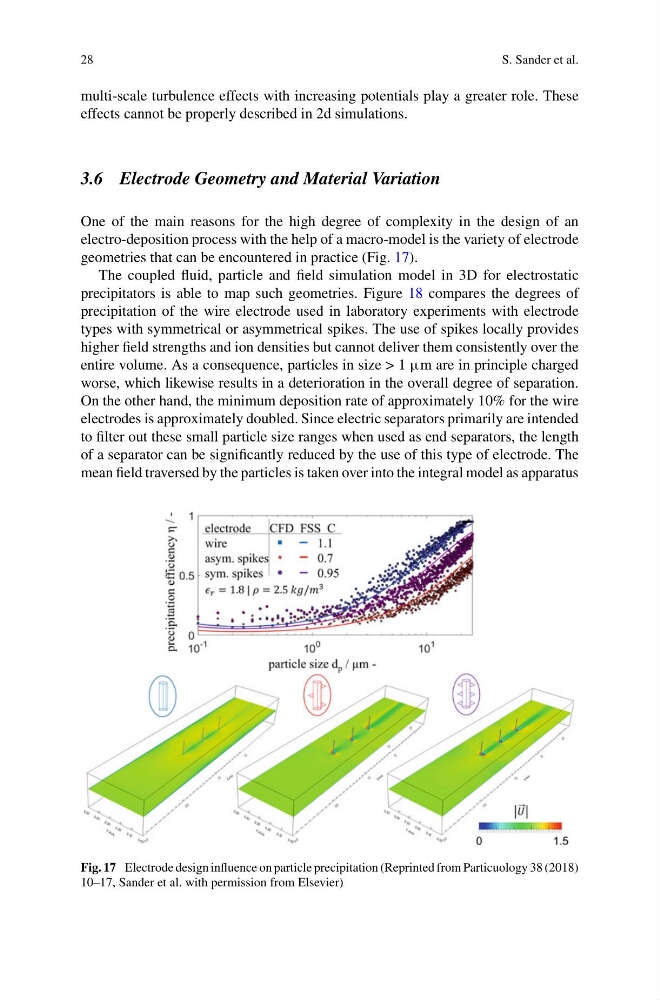
geometries that can be encountered in practice (Fig. 17).
The coupled fluid, particle and field simulation model in 3D for electrostatic
precipitators is able to map such geometries. Figure 18 compares the degrees of
precipitation of the wire electrode used in laboratory experiments with electrode
types with symmetrical or asymmetrical spikes. The use of spikes locally provides
higher field strengths and ion densities but cannot deliver them consistently over the
entire volume. As a consequence, particles in size > 1 μm are in principle charged
worse, which likewise results in a deterioration in the overall degree of separation.
On the other hand, the minimum deposition rate of approximately 10% for the wire
electrodes is approximately doubled. Since electric separators primarily are intended
to filter out these small particle size ranges when used as end separators, the length
of a separator can be significantly reduced by the use of this type of electrode. The
mean field traversed by the particles is taken over into the integral model as apparatus
Fig. 17 Electrode design influence on particle precipitation (Reprinted from Particuology 38 (2018)
10–17, Sander et al. with permission from Elsevier)
S. Sander et al.
multi-scale turbulence effects with increasing potentials play a greater role. These
effects cannot be properly described in 2d simulations.
3.6 Electrode Geometry and Material Variation
One of the main reasons for the high degree of complexity in the design of an
electro-deposition process with the help of a macro-model is the variety of electrode
geometries that can be encountered in practice (Fig. 17).
The coupled fluid, particle and field simulation model in 3D for electrostatic
precipitators is able to map such geometries. Figure 18 compares the degrees of
precipitation of the wire electrode used in laboratory experiments with electrode
types with symmetrical or asymmetrical spikes. The use of spikes locally provides
higher field strengths and ion densities but cannot deliver them consistently over the
entire volume. As a consequence, particles in size > 1 μm are in principle charged
worse, which likewise results in a deterioration in the overall degree of separation.
On the other hand, the minimum deposition rate of approximately 10% for the wire
electrodes is approximately doubled. Since electric separators primarily are intended
to filter out these small particle size ranges when used as end separators, the length
of a separator can be significantly reduced by the use of this type of electrode. The
mean field traversed by the particles is taken over into the integral model as apparatus
Fig. 17 Electrode design influence on particle precipitation (Reprinted from Particuology 38 (2018)
10–17, Sander et al. with permission from Elsevier)