

10 Dynamics of Separation Characteristics of Sieving and Flow …
355
2.2 Deflector Wheel Classifier
The used deflector wheel classifier is a modified ATP50 from Hosokawa-Alpine
(Fig. 2, left). The optical access to the wheel was achieved by changing the two-sides
bearing to a one-sided bearing while the flow and classifying conditions remained
unchanged [20]. To keep the front side particle-free, a special sheath air system was
installed. The illumination was kept versatile by installing windows on the top and
the two sides of the impeller chamber. In addition, the cover plate could be replaced
by an insert sleeve.
The following section comprises a short description of the powder system, followed by investigations of the particle collision behavior and the characterization
of the airflow within the deflector wheel. From these results, separation curves are
derived and compared with experimental ones. Then, a sensitivity analysis is performed and the instationary separation process is commented. Finally, the gained
insights are summarized and implemented into a new model.
2.3 Material Characteristics
As powder mainly limestone of different fractions (SH Minerals) was used. Saxolith
40 exhibits a mass-weighted mean particle size x 50,3 of 44 μm and Saxolith 70 an
x 50,3 of 77 μm, respectively. The Particle Size Distributions (PSD) were measured
with a laser diffraction instrument (HELOS, Sympatec) while the powders were
dispersed with a dry disperser (RODOS, Sympatec). A SEM micrograph of Saxolith
40 particles is shown in Fig. 2 (right).
Since the particle sphericity is expected to have a significant influence on the
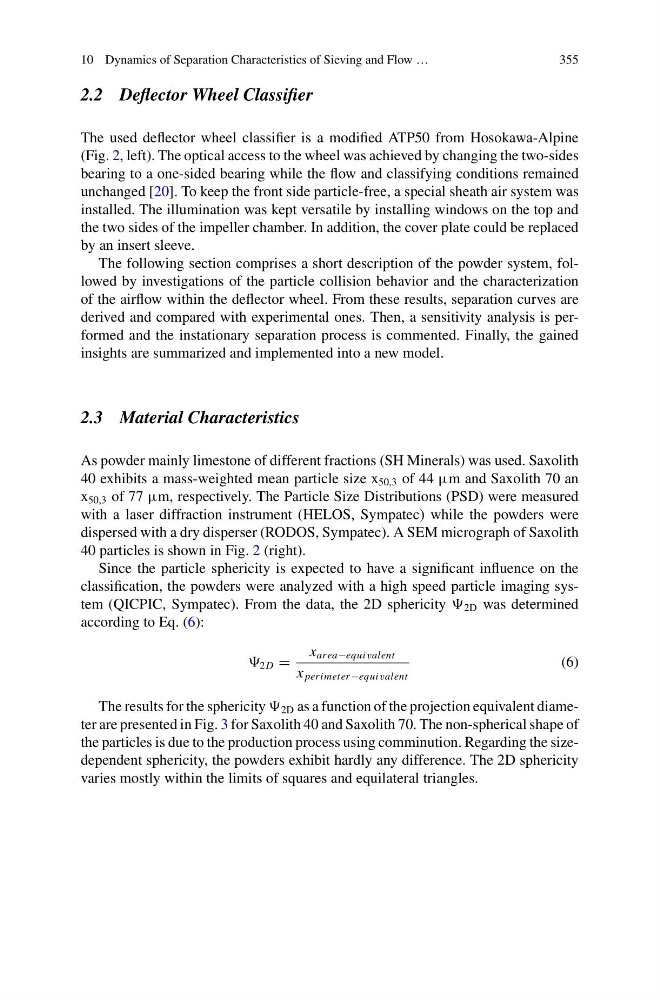
classification, the powders were analyzed with a high speed particle imaging system (QICPIC, Sympatec). From the data, the 2D sphericity 2D was determined
according to Eq. (6):
2D =
x area−equivalent
x perimeter−equivalent
(6)
The results for the sphericity 2D as a function of the projection equivalent diameter are presented in Fig. 3 for Saxolith 40 and Saxolith 70. The non-spherical shape of
the particles is due to the production process using comminution. Regarding the sizedependent sphericity, the powders exhibit hardly any difference. The 2D sphericity
varies mostly within the limits of squares and equilateral triangles.
355
2.2 Deflector Wheel Classifier
The used deflector wheel classifier is a modified ATP50 from Hosokawa-Alpine
(Fig. 2, left). The optical access to the wheel was achieved by changing the two-sides
bearing to a one-sided bearing while the flow and classifying conditions remained
unchanged [20]. To keep the front side particle-free, a special sheath air system was
installed. The illumination was kept versatile by installing windows on the top and
the two sides of the impeller chamber. In addition, the cover plate could be replaced
by an insert sleeve.
The following section comprises a short description of the powder system, followed by investigations of the particle collision behavior and the characterization
of the airflow within the deflector wheel. From these results, separation curves are
derived and compared with experimental ones. Then, a sensitivity analysis is performed and the instationary separation process is commented. Finally, the gained
insights are summarized and implemented into a new model.
2.3 Material Characteristics
As powder mainly limestone of different fractions (SH Minerals) was used. Saxolith
40 exhibits a mass-weighted mean particle size x 50,3 of 44 μm and Saxolith 70 an
x 50,3 of 77 μm, respectively. The Particle Size Distributions (PSD) were measured
with a laser diffraction instrument (HELOS, Sympatec) while the powders were
dispersed with a dry disperser (RODOS, Sympatec). A SEM micrograph of Saxolith
40 particles is shown in Fig. 2 (right).
Since the particle sphericity is expected to have a significant influence on the
classification, the powders were analyzed with a high speed particle imaging system (QICPIC, Sympatec). From the data, the 2D sphericity 2D was determined
according to Eq. (6):
2D =
x area−equivalent
x perimeter−equivalent
(6)
The results for the sphericity 2D as a function of the projection equivalent diameter are presented in Fig. 3 for Saxolith 40 and Saxolith 70. The non-spherical shape of
the particles is due to the production process using comminution. Regarding the sizedependent sphericity, the powders exhibit hardly any difference. The 2D sphericity
varies mostly within the limits of squares and equilateral triangles.