

342
A. Strobel et al.
effects as one of the primary causes for size reduction. Thus, despite the relatively low
impact velocities, comminution can take place. For k 1 comminution at any given
velocity will take place, and W m,min ~ 0 holds true. The energy from these impacts
with rather low energy adds up to an overall energy input, which, in consequence, is
sufficient to induce breakage of the particle.
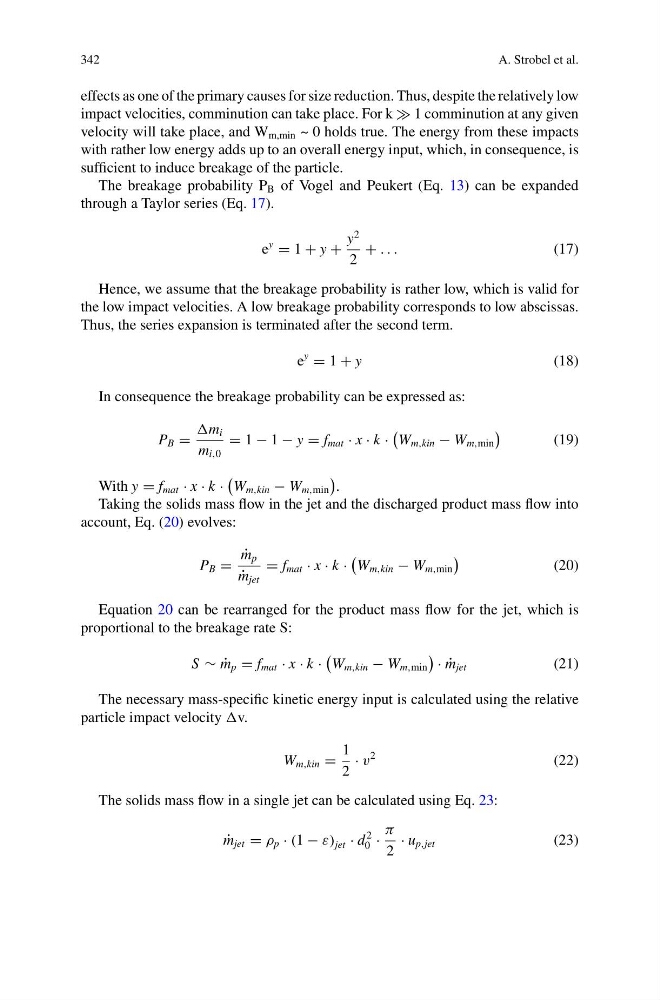
The breakage probability P B of Vogel and Peukert (Eq. 13) can be expanded
through a Taylor series (Eq. 17).
e
y
= 1 + y +
y
2
2
+ . . .
(17)
Hence, we assume that the breakage probability is rather low, which is valid for
the low impact velocities. A low breakage probability corresponds to low abscissas.
Thus, the series expansion is terminated after the second term.
e
y
= 1 + y
(18)
In consequence the breakage probability can be expressed as:
P B =
m i
m i,0
= 1 − 1 − y = f mat · x · k ·
W m,kin − W m,min
(19)
With y = f mat · x · k ·
W m,kin − W m,min
.
Taking the solids mass flow in the jet and the discharged product mass flow into
account, Eq. (20) evolves:
P B =
˙
m p
˙
m jet
= f mat · x · k ·
W m,kin − W m,min
(20)
Equation 20 can be rearranged for the product mass flow for the jet, which is
proportional to the breakage rate S:
S ∼ ˙
m p = f mat · x · k ·
W m,kin − W m,min
· ˙
m jet
(21)
The necessary mass-specific kinetic energy input is calculated using the relative
particle impact velocity v.
W m,kin =
1
2
· v
2
(22)
The solids mass flow in a single jet can be calculated using Eq. 23:
˙
m jet = ρ p · (1 − ε) jet · d
2
0 ·
π
2
· u p,jet
(23)
A. Strobel et al.
effects as one of the primary causes for size reduction. Thus, despite the relatively low
impact velocities, comminution can take place. For k 1 comminution at any given
velocity will take place, and W m,min ~ 0 holds true. The energy from these impacts
with rather low energy adds up to an overall energy input, which, in consequence, is
sufficient to induce breakage of the particle.
The breakage probability P B of Vogel and Peukert (Eq. 13) can be expanded
through a Taylor series (Eq. 17).
e
y
= 1 + y +
y
2
2
+ . . .
(17)
Hence, we assume that the breakage probability is rather low, which is valid for
the low impact velocities. A low breakage probability corresponds to low abscissas.
Thus, the series expansion is terminated after the second term.
e
y
= 1 + y
(18)
In consequence the breakage probability can be expressed as:
P B =
m i
m i,0
= 1 − 1 − y = f mat · x · k ·
W m,kin − W m,min
(19)
With y = f mat · x · k ·
W m,kin − W m,min
.
Taking the solids mass flow in the jet and the discharged product mass flow into
account, Eq. (20) evolves:
P B =
˙
m p
˙
m jet
= f mat · x · k ·
W m,kin − W m,min
(20)
Equation 20 can be rearranged for the product mass flow for the jet, which is
proportional to the breakage rate S:
S ∼ ˙
m p = f mat · x · k ·
W m,kin − W m,min
· ˙
m jet
(21)
The necessary mass-specific kinetic energy input is calculated using the relative
particle impact velocity v.
W m,kin =
1
2
· v
2
(22)
The solids mass flow in a single jet can be calculated using Eq. 23:
˙
m jet = ρ p · (1 − ε) jet · d
2
0 ·
π
2
· u p,jet
(23)