

9 Impact Comminution in Jet Mills
341
For solid-to-air flow ratios below 0.1 particle-particle interactions are minimized and
single impact conditions prevail [56].
Mean velocities of 231 and 274 m s
−1 were measured for particles with x 1,2 of
17.3 and 4.7 μm, respectively. The distributions are desirably narrow as indicate
by the small boxes. To visualize the behaviour of the particles entering the impact
chamber, the solid load was drastically increased. Obviously, turbulences do not
interfere with particle impacts on the plate which occur with an angle between 85.8°
and 90°. Taking into account the previously determined relative low particle impact
velocities (Sect. 3.3.2), product PSDs and morphologies (Sect. 3.1.1), the device
provides a sufficient way do determine breakage probabilities for a wide range of
materials down to lower micron-size range.
3.7 Modelling Product Mass Flow
Combining all the previously made observations, a simplified model for the product
mass flow on the basis of the data for constant mass flow in the jets was introduced
by Köninger, based on several assumptions for the boundary conditions: All solids
that are added at a particular time step are comminuted. A shift of the particle sizes
in the intermediate range is neglected since almost no more changes in the Sauter
diameter are observed for process times greater than 40 min. For a constant holdup
and PSD in the mill, the product mass flow equals the breakage rate of the added
solid material. The breakage rate S is calculated using the breakage probability P B
and the mass flow in the jet area:
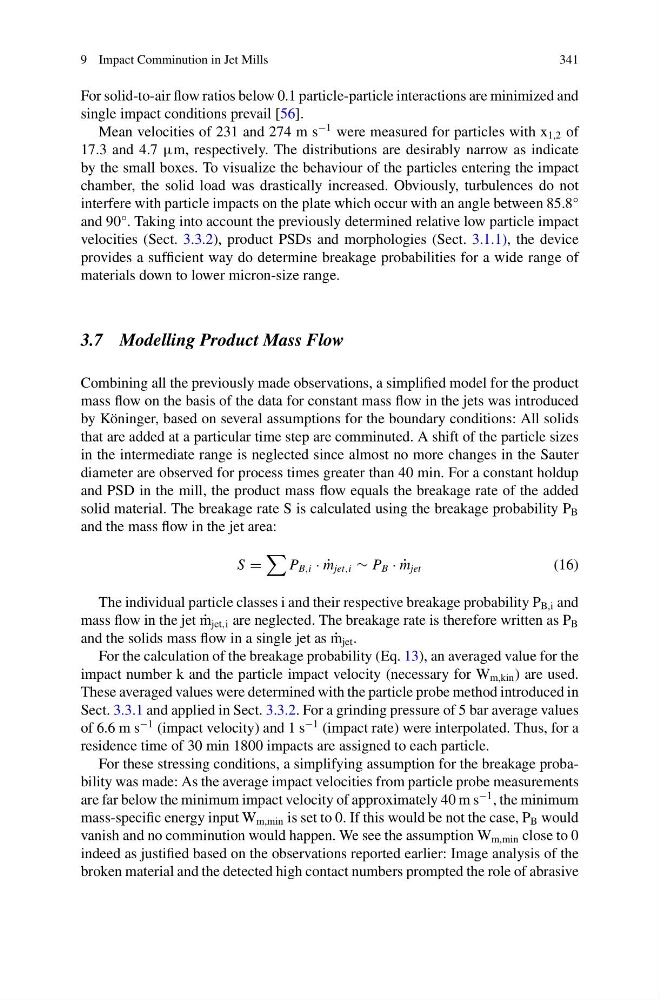
S =
P B,i · ˙
m jet,i ∼ P B · ˙
m jet
(16)
The individual particle classes i and their respective breakage probability P B,i and
mass flow in the jet ˙
m jet,i are neglected. The breakage rate is therefore written as P B
and the solids mass flow in a single jet as ˙
m jet .
For the calculation of the breakage probability (Eq. 13), an averaged value for the
impact number k and the particle impact velocity (necessary for W m,kin ) are used.
These averaged values were determined with the particle probe method introduced in
Sect. 3.3.1 and applied in Sect. 3.3.2. For a grinding pressure of 5 bar average values
of 6.6 m s
−1 (impact velocity) and 1 s
−1 (impact rate) were interpolated. Thus, for a
residence time of 30 min 1800 impacts are assigned to each particle.
For these stressing conditions, a simplifying assumption for the breakage probability was made: As the average impact velocities from particle probe measurements
are far below the minimum impact velocity of approximately 40 m s
−1 , the minimum
mass-specific energy input W m,min is set to 0. If this would be not the case, P B would
vanish and no comminution would happen. We see the assumption W m,min close to 0
indeed as justified based on the observations reported earlier: Image analysis of the
broken material and the detected high contact numbers prompted the role of abrasive
341
For solid-to-air flow ratios below 0.1 particle-particle interactions are minimized and
single impact conditions prevail [56].
Mean velocities of 231 and 274 m s
−1 were measured for particles with x 1,2 of
17.3 and 4.7 μm, respectively. The distributions are desirably narrow as indicate
by the small boxes. To visualize the behaviour of the particles entering the impact
chamber, the solid load was drastically increased. Obviously, turbulences do not
interfere with particle impacts on the plate which occur with an angle between 85.8°
and 90°. Taking into account the previously determined relative low particle impact
velocities (Sect. 3.3.2), product PSDs and morphologies (Sect. 3.1.1), the device
provides a sufficient way do determine breakage probabilities for a wide range of
materials down to lower micron-size range.
3.7 Modelling Product Mass Flow
Combining all the previously made observations, a simplified model for the product
mass flow on the basis of the data for constant mass flow in the jets was introduced
by Köninger, based on several assumptions for the boundary conditions: All solids
that are added at a particular time step are comminuted. A shift of the particle sizes
in the intermediate range is neglected since almost no more changes in the Sauter
diameter are observed for process times greater than 40 min. For a constant holdup
and PSD in the mill, the product mass flow equals the breakage rate of the added
solid material. The breakage rate S is calculated using the breakage probability P B
and the mass flow in the jet area:
S =
P B,i · ˙
m jet,i ∼ P B · ˙
m jet
(16)
The individual particle classes i and their respective breakage probability P B,i and
mass flow in the jet ˙
m jet,i are neglected. The breakage rate is therefore written as P B
and the solids mass flow in a single jet as ˙
m jet .
For the calculation of the breakage probability (Eq. 13), an averaged value for the
impact number k and the particle impact velocity (necessary for W m,kin ) are used.
These averaged values were determined with the particle probe method introduced in
Sect. 3.3.1 and applied in Sect. 3.3.2. For a grinding pressure of 5 bar average values
of 6.6 m s
−1 (impact velocity) and 1 s
−1 (impact rate) were interpolated. Thus, for a
residence time of 30 min 1800 impacts are assigned to each particle.
For these stressing conditions, a simplifying assumption for the breakage probability was made: As the average impact velocities from particle probe measurements
are far below the minimum impact velocity of approximately 40 m s
−1 , the minimum
mass-specific energy input W m,min is set to 0. If this would be not the case, P B would
vanish and no comminution would happen. We see the assumption W m,min close to 0
indeed as justified based on the observations reported earlier: Image analysis of the
broken material and the detected high contact numbers prompted the role of abrasive