

340
A. Strobel et al.
leads to a higher acceleration a of the particles in the jets.
a ∼
F W
m particle
∼
c w
x
(14)
Equation 14 shows the dependency of the acceleration on the mass-specific drag
force F W /m particle , which depends on the drag coefficient c w and the inverse particle
size. From Haider and Levenspiel [55] a relation between the drag coefficient and
the sphericity is known:
c w = 69.44 · e
−5.16ψ
(15)
Both during the grinding process and the single particle experiments, the particle
size and sphericity decrease. Based on Eq. 15, the drag coefficient will increase
with decreasing sphericity. With a continuous increase in the drag coefficient and
reduction of the particle size during comminution, the acceleration of the individual
particles will increase significantly according to Eq. 14. Thus, the fragmentation
process is self-enhancing, at least until intermediate fineness. Since smaller and
smaller fragments are produced throughout the process—many of them close to the
single-digit micrometre cut size—the impact behaviour of these particles should not
be neglected. However, with their increased drag coefficient, the testing should be
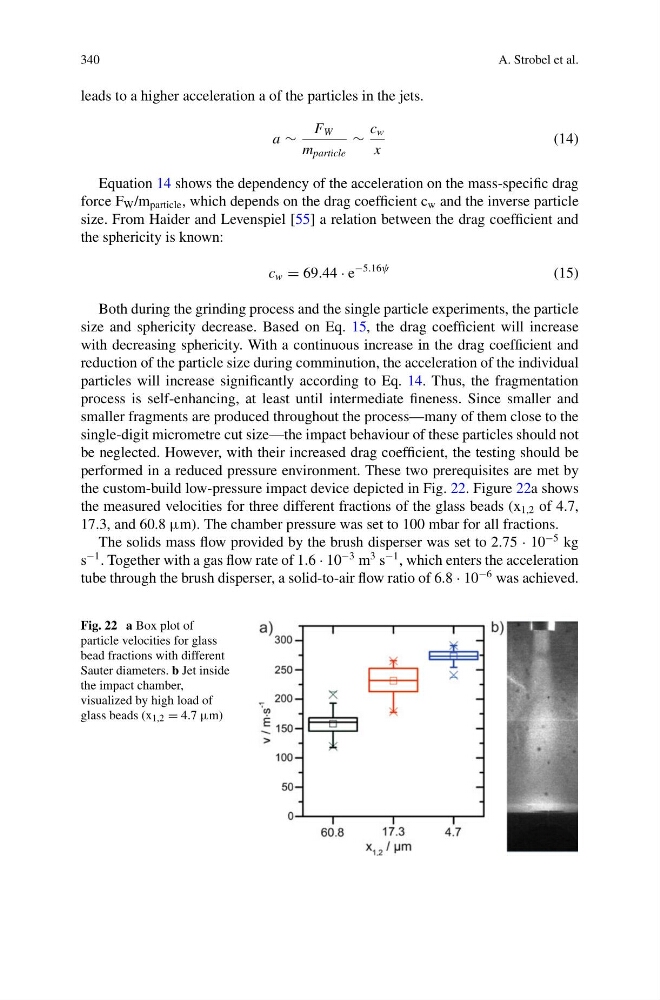
performed in a reduced pressure environment. These two prerequisites are met by
the custom-build low-pressure impact device depicted in Fig. 22. Figure 22a shows
the measured velocities for three different fractions of the glass beads (x 1,2 of 4.7,
17.3, and 60.8 μm). The chamber pressure was set to 100 mbar for all fractions.
The solids mass flow provided by the brush disperser was set to 2.75 · 10
−5 kg
s
−1 . Together with a gas flow rate of 1.6 · 10
−3 m
3 s
−1 , which enters the acceleration
tube through the brush disperser, a solid-to-air flow ratio of 6.8 · 10
−6 was achieved.
Fig. 22 a Box plot of
particle velocities for glass
bead fractions with different
Sauter diameters. b Jet inside
the impact chamber,
visualized by high load of
glass beads (x 1,2 = 4.7 μm)
A. Strobel et al.
leads to a higher acceleration a of the particles in the jets.
a ∼
F W
m particle
∼
c w
x
(14)
Equation 14 shows the dependency of the acceleration on the mass-specific drag
force F W /m particle , which depends on the drag coefficient c w and the inverse particle
size. From Haider and Levenspiel [55] a relation between the drag coefficient and
the sphericity is known:
c w = 69.44 · e
−5.16ψ
(15)
Both during the grinding process and the single particle experiments, the particle
size and sphericity decrease. Based on Eq. 15, the drag coefficient will increase
with decreasing sphericity. With a continuous increase in the drag coefficient and
reduction of the particle size during comminution, the acceleration of the individual
particles will increase significantly according to Eq. 14. Thus, the fragmentation
process is self-enhancing, at least until intermediate fineness. Since smaller and
smaller fragments are produced throughout the process—many of them close to the
single-digit micrometre cut size—the impact behaviour of these particles should not
be neglected. However, with their increased drag coefficient, the testing should be
performed in a reduced pressure environment. These two prerequisites are met by
the custom-build low-pressure impact device depicted in Fig. 22. Figure 22a shows
the measured velocities for three different fractions of the glass beads (x 1,2 of 4.7,
17.3, and 60.8 μm). The chamber pressure was set to 100 mbar for all fractions.
The solids mass flow provided by the brush disperser was set to 2.75 · 10
−5 kg
s
−1 . Together with a gas flow rate of 1.6 · 10
−3 m
3 s
−1 , which enters the acceleration
tube through the brush disperser, a solid-to-air flow ratio of 6.8 · 10
−6 was achieved.
Fig. 22 a Box plot of
particle velocities for glass
bead fractions with different
Sauter diameters. b Jet inside
the impact chamber,
visualized by high load of
glass beads (x 1,2 = 4.7 μm)