

9 Impact Comminution in Jet Mills
339
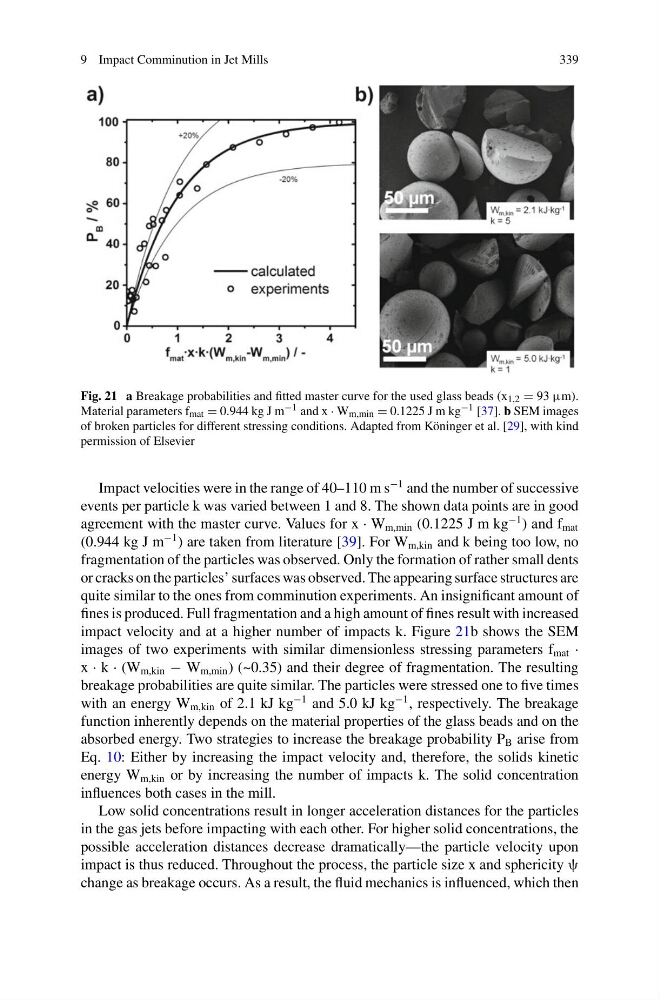
Fig. 21 a Breakage probabilities and fitted master curve for the used glass beads (x 1,2 = 93 μm).
Material parameters f mat = 0.944 kg J m −1 and x · W m,min = 0.1225 J m kg −1 [37]. b SEM images
of broken particles for different stressing conditions. Adapted from Köninger et al. [29], with kind
permission of Elsevier
Impact velocities were in the range of 40–110 m s
−1 and the number of successive
events per particle k was varied between 1 and 8. The shown data points are in good
agreement with the master curve. Values for x · W m,min (0.1225 J m kg
−1 ) and f mat
(0.944 kg J m
−1 ) are taken from literature [39]. For W m,kin and k being too low, no
fragmentation of the particles was observed. Only the formation of rather small dents
or cracks on the particles’ surfaces was observed. The appearing surface structures are
quite similar to the ones from comminution experiments. An insignificant amount of
fines is produced. Full fragmentation and a high amount of fines result with increased
impact velocity and at a higher number of impacts k. Figure 21b shows the SEM
images of two experiments with similar dimensionless stressing parameters f mat ·
x · k · (W m,kin − W m,min ) (~0.35) and their degree of fragmentation. The resulting
breakage probabilities are quite similar. The particles were stressed one to five times
with an energy W m,kin of 2.1 kJ kg
−1 and 5.0 kJ kg
−1 , respectively. The breakage
function inherently depends on the material properties of the glass beads and on the
absorbed energy. Two strategies to increase the breakage probability P B arise from
Eq. 10: Either by increasing the impact velocity and, therefore, the solids kinetic
energy W m,kin or by increasing the number of impacts k. The solid concentration
influences both cases in the mill.
Low solid concentrations result in longer acceleration distances for the particles
in the gas jets before impacting with each other. For higher solid concentrations, the
possible acceleration distances decrease dramatically—the particle velocity upon
impact is thus reduced. Throughout the process, the particle size x and sphericity ψ
change as breakage occurs. As a result, the fluid mechanics is influenced, which then
339
Fig. 21 a Breakage probabilities and fitted master curve for the used glass beads (x 1,2 = 93 μm).
Material parameters f mat = 0.944 kg J m −1 and x · W m,min = 0.1225 J m kg −1 [37]. b SEM images
of broken particles for different stressing conditions. Adapted from Köninger et al. [29], with kind
permission of Elsevier
Impact velocities were in the range of 40–110 m s
−1 and the number of successive
events per particle k was varied between 1 and 8. The shown data points are in good
agreement with the master curve. Values for x · W m,min (0.1225 J m kg
−1 ) and f mat
(0.944 kg J m
−1 ) are taken from literature [39]. For W m,kin and k being too low, no
fragmentation of the particles was observed. Only the formation of rather small dents
or cracks on the particles’ surfaces was observed. The appearing surface structures are
quite similar to the ones from comminution experiments. An insignificant amount of
fines is produced. Full fragmentation and a high amount of fines result with increased
impact velocity and at a higher number of impacts k. Figure 21b shows the SEM
images of two experiments with similar dimensionless stressing parameters f mat ·
x · k · (W m,kin − W m,min ) (~0.35) and their degree of fragmentation. The resulting
breakage probabilities are quite similar. The particles were stressed one to five times
with an energy W m,kin of 2.1 kJ kg
−1 and 5.0 kJ kg
−1 , respectively. The breakage
function inherently depends on the material properties of the glass beads and on the
absorbed energy. Two strategies to increase the breakage probability P B arise from
Eq. 10: Either by increasing the impact velocity and, therefore, the solids kinetic
energy W m,kin or by increasing the number of impacts k. The solid concentration
influences both cases in the mill.
Low solid concentrations result in longer acceleration distances for the particles
in the gas jets before impacting with each other. For higher solid concentrations, the
possible acceleration distances decrease dramatically—the particle velocity upon
impact is thus reduced. Throughout the process, the particle size x and sphericity ψ
change as breakage occurs. As a result, the fluid mechanics is influenced, which then