

26
S. Sander et al.
3.4 ESP CFD-Model and Simulation
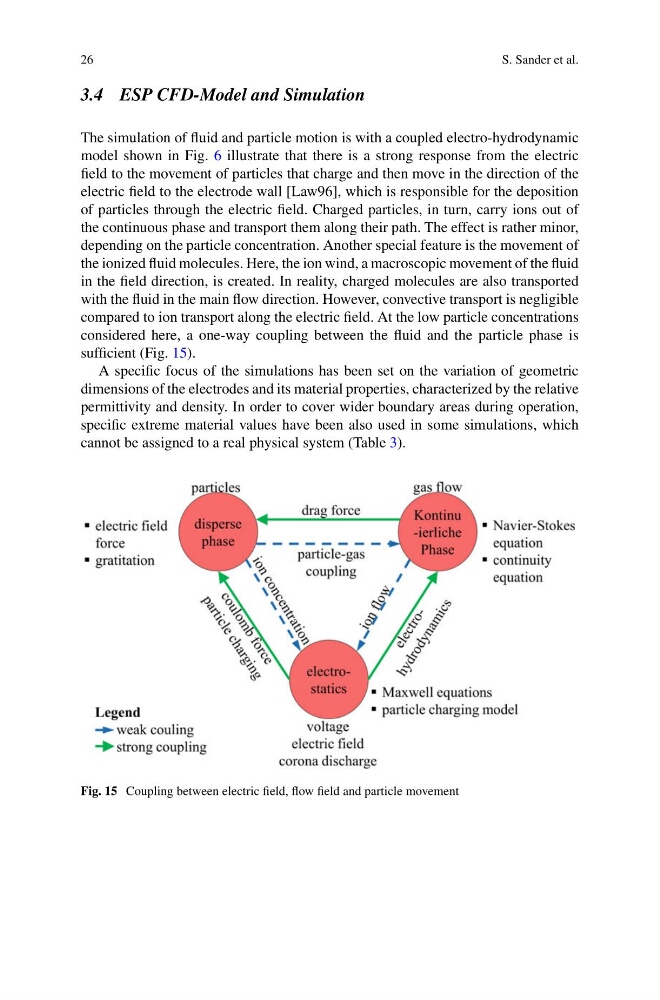
The simulation of fluid and particle motion is with a coupled electro-hydrodynamic
model shown in Fig. 6 illustrate that there is a strong response from the electric
field to the movement of particles that charge and then move in the direction of the
electric field to the electrode wall [Law96], which is responsible for the deposition
of particles through the electric field. Charged particles, in turn, carry ions out of
the continuous phase and transport them along their path. The effect is rather minor,
depending on the particle concentration. Another special feature is the movement of
the ionized fluid molecules. Here, the ion wind, a macroscopic movement of the fluid
in the field direction, is created. In reality, charged molecules are also transported
with the fluid in the main flow direction. However, convective transport is negligible
compared to ion transport along the electric field. At the low particle concentrations
considered here, a one-way coupling between the fluid and the particle phase is
sufficient (Fig. 15).
A specific focus of the simulations has been set on the variation of geometric
dimensions of the electrodes and its material properties, characterized by the relative
permittivity and density. In order to cover wider boundary areas during operation,
specific extreme material values have been also used in some simulations, which
cannot be assigned to a real physical system (Table 3).
Fig. 15 Coupling between electric field, flow field and particle movement
S. Sander et al.
3.4 ESP CFD-Model and Simulation
The simulation of fluid and particle motion is with a coupled electro-hydrodynamic
model shown in Fig. 6 illustrate that there is a strong response from the electric
field to the movement of particles that charge and then move in the direction of the
electric field to the electrode wall [Law96], which is responsible for the deposition
of particles through the electric field. Charged particles, in turn, carry ions out of
the continuous phase and transport them along their path. The effect is rather minor,
depending on the particle concentration. Another special feature is the movement of
the ionized fluid molecules. Here, the ion wind, a macroscopic movement of the fluid
in the field direction, is created. In reality, charged molecules are also transported
with the fluid in the main flow direction. However, convective transport is negligible
compared to ion transport along the electric field. At the low particle concentrations
considered here, a one-way coupling between the fluid and the particle phase is
sufficient (Fig. 15).
A specific focus of the simulations has been set on the variation of geometric
dimensions of the electrodes and its material properties, characterized by the relative
permittivity and density. In order to cover wider boundary areas during operation,
specific extreme material values have been also used in some simulations, which
cannot be assigned to a real physical system (Table 3).
Fig. 15 Coupling between electric field, flow field and particle movement