

318
A. Strobel et al.
processing times (1 min, top image), the number of unbroken feed particles is still
high. After 10 min of processing (lower image) mainly fragments dominate.
The few remaining, almost intact particles exhibit dents on the surface. As such,
the dent formation is seen as an alternate process to chipping, which causes rather
fine fragments. These observations indicate that the feed material is not likely to be
broken by one high energy impact but rather by a higher number of impacts producing
small fragments. The impacts leading to these small fragments are associated with
a high number of impact events at rather low impact velocities. Moderate particle
velocities in high-speed gas jets that were injected into fluidized beds were also found
by Köninger et al. [34] by particle image velocimetry.
Schönert [42] and later Salman et al. [43] quantitatively characterized the morphological changes of glass spheres after impaction on a target: Different fracture and
deformation modes have been assigned to the appearing morphologies whereby each
category corresponds to a specific range of the applied mass-specific kinetic energy
W m,kin . To get a first impression of the grinding conditions in the milling chamber,
the method introduced by Salman et al. [43] was applied to the samples in the first
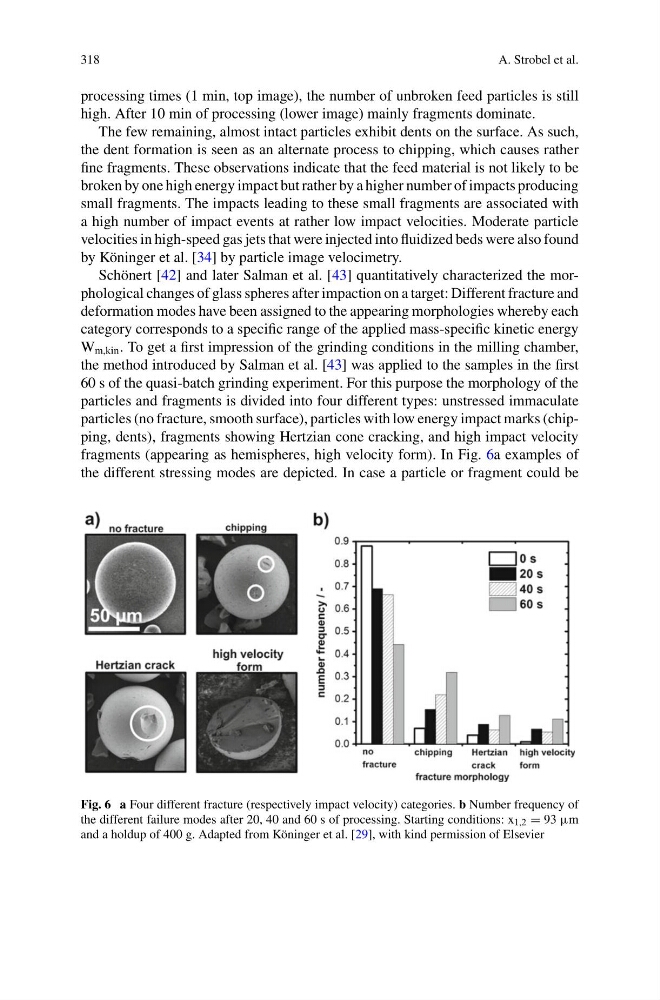
60 s of the quasi-batch grinding experiment. For this purpose the morphology of the
particles and fragments is divided into four different types: unstressed immaculate
particles (no fracture, smooth surface), particles with low energy impact marks (chipping, dents), fragments showing Hertzian cone cracking, and high impact velocity
fragments (appearing as hemispheres, high velocity form). In Fig. 6a examples of
the different stressing modes are depicted. In case a particle or fragment could be
Fig. 6 a Four different fracture (respectively impact velocity) categories. b Number frequency of
the different failure modes after 20, 40 and 60 s of processing. Starting conditions: x 1,2 = 93 μm
and a holdup of 400 g. Adapted from Köninger et al. [29], with kind permission of Elsevier
A. Strobel et al.
processing times (1 min, top image), the number of unbroken feed particles is still
high. After 10 min of processing (lower image) mainly fragments dominate.
The few remaining, almost intact particles exhibit dents on the surface. As such,
the dent formation is seen as an alternate process to chipping, which causes rather
fine fragments. These observations indicate that the feed material is not likely to be
broken by one high energy impact but rather by a higher number of impacts producing
small fragments. The impacts leading to these small fragments are associated with
a high number of impact events at rather low impact velocities. Moderate particle
velocities in high-speed gas jets that were injected into fluidized beds were also found
by Köninger et al. [34] by particle image velocimetry.
Schönert [42] and later Salman et al. [43] quantitatively characterized the morphological changes of glass spheres after impaction on a target: Different fracture and
deformation modes have been assigned to the appearing morphologies whereby each
category corresponds to a specific range of the applied mass-specific kinetic energy
W m,kin . To get a first impression of the grinding conditions in the milling chamber,
the method introduced by Salman et al. [43] was applied to the samples in the first
60 s of the quasi-batch grinding experiment. For this purpose the morphology of the
particles and fragments is divided into four different types: unstressed immaculate
particles (no fracture, smooth surface), particles with low energy impact marks (chipping, dents), fragments showing Hertzian cone cracking, and high impact velocity
fragments (appearing as hemispheres, high velocity form). In Fig. 6a examples of
the different stressing modes are depicted. In case a particle or fragment could be
Fig. 6 a Four different fracture (respectively impact velocity) categories. b Number frequency of
the different failure modes after 20, 40 and 60 s of processing. Starting conditions: x 1,2 = 93 μm
and a holdup of 400 g. Adapted from Köninger et al. [29], with kind permission of Elsevier