

9 Impact Comminution in Jet Mills
317
3 Results and Discussion
3.1 Dynamics of Quasi-Batch Comminution
3.1.1 Size Evolution and Morphology
The generation of a fine product of a few μm in size requires a sufficiently high
classifier speed. The classifier speed was set to 12,500 rpm, which corresponds to
a circumferential classifier velocity v cl of 32.7 m s
−1 and a nominal cut size x T =
4.3 μm at the vanes of the classifier wheel [30].
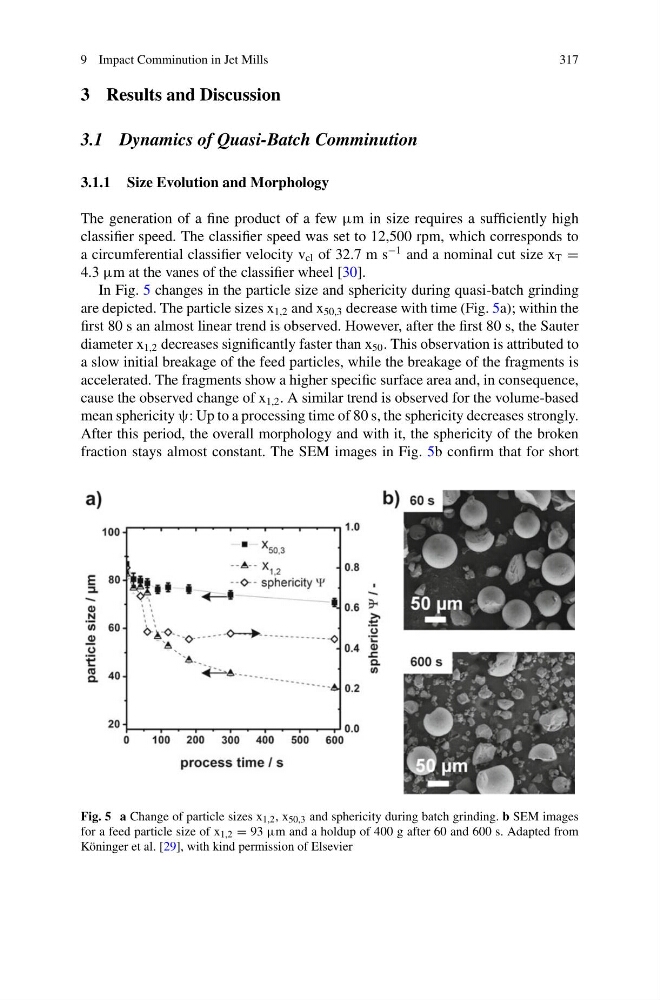
In Fig. 5 changes in the particle size and sphericity during quasi-batch grinding
are depicted. The particle sizes x 1,2 and x 50,3 decrease with time (Fig. 5a); within the
first 80 s an almost linear trend is observed. However, after the first 80 s, the Sauter
diameter x 1,2 decreases significantly faster than x 50 . This observation is attributed to
a slow initial breakage of the feed particles, while the breakage of the fragments is
accelerated. The fragments show a higher specific surface area and, in consequence,
cause the observed change of x 1,2 . A similar trend is observed for the volume-based
mean sphericity ψ: Up to a processing time of 80 s, the sphericity decreases strongly.
After this period, the overall morphology and with it, the sphericity of the broken
fraction stays almost constant. The SEM images in Fig. 5b confirm that for short
Fig. 5 a Change of particle sizes x 1,2 , x 50,3 and sphericity during batch grinding. b SEM images
for a feed particle size of x 1,2 = 93 μm and a holdup of 400 g after 60 and 600 s. Adapted from
Köninger et al. [29], with kind permission of Elsevier
317
3 Results and Discussion
3.1 Dynamics of Quasi-Batch Comminution
3.1.1 Size Evolution and Morphology
The generation of a fine product of a few μm in size requires a sufficiently high
classifier speed. The classifier speed was set to 12,500 rpm, which corresponds to
a circumferential classifier velocity v cl of 32.7 m s
−1 and a nominal cut size x T =
4.3 μm at the vanes of the classifier wheel [30].
In Fig. 5 changes in the particle size and sphericity during quasi-batch grinding
are depicted. The particle sizes x 1,2 and x 50,3 decrease with time (Fig. 5a); within the
first 80 s an almost linear trend is observed. However, after the first 80 s, the Sauter
diameter x 1,2 decreases significantly faster than x 50 . This observation is attributed to
a slow initial breakage of the feed particles, while the breakage of the fragments is
accelerated. The fragments show a higher specific surface area and, in consequence,
cause the observed change of x 1,2 . A similar trend is observed for the volume-based
mean sphericity ψ: Up to a processing time of 80 s, the sphericity decreases strongly.
After this period, the overall morphology and with it, the sphericity of the broken
fraction stays almost constant. The SEM images in Fig. 5b confirm that for short
Fig. 5 a Change of particle sizes x 1,2 , x 50,3 and sphericity during batch grinding. b SEM images
for a feed particle size of x 1,2 = 93 μm and a holdup of 400 g after 60 and 600 s. Adapted from
Köninger et al. [29], with kind permission of Elsevier