

316
A. Strobel et al.
2.4.4 Finite Element Modelling (FEM)
Simulations of the particle-particle as well as the particle-wall impacts were performed using the software package Ansys V.17.2 (Ansys Inc., USA). A 3D model
was used for all simulations. To access the mechanical properties of the used aluminium spheres for simulating the particle-particle impacts in the jet mill, a first set
of simulations for the impact of an aluminium sphere (6 mm) on a steel plate (90°
angle) were performed. Yield strength and tangent modulus of the aluminium sphere
were fitted until a sufficient match of the simulated and experimentally observed
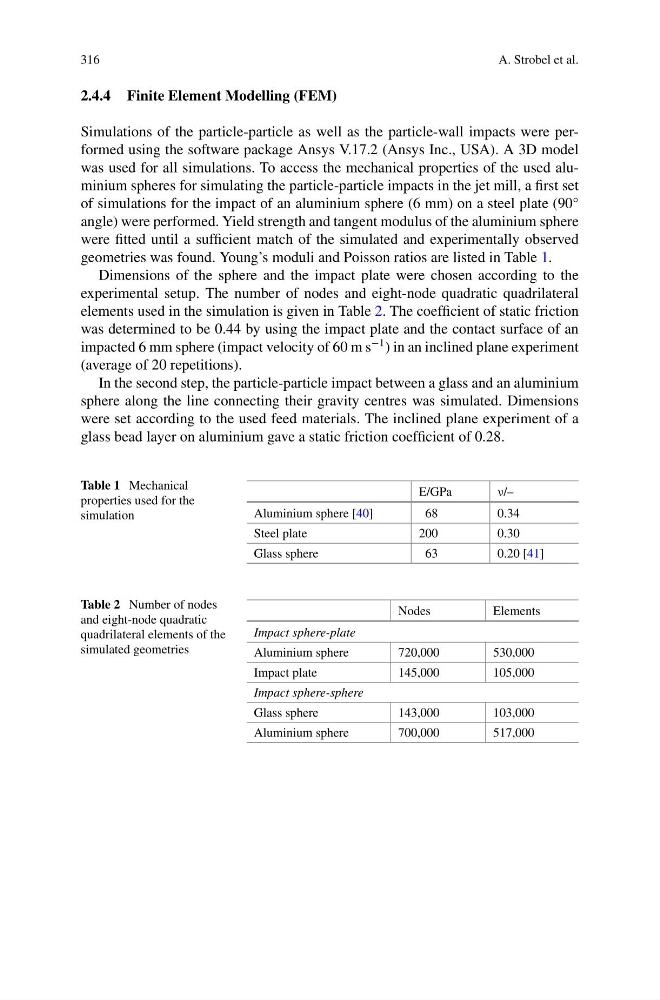
geometries was found. Young’s moduli and Poisson ratios are listed in Table 1.
Dimensions of the sphere and the impact plate were chosen according to the
experimental setup. The number of nodes and eight-node quadratic quadrilateral
elements used in the simulation is given in Table 2. The coefficient of static friction
was determined to be 0.44 by using the impact plate and the contact surface of an
impacted 6 mm sphere (impact velocity of 60 m s
−1 ) in an inclined plane experiment
(average of 20 repetitions).
In the second step, the particle-particle impact between a glass and an aluminium
sphere along the line connecting their gravity centres was simulated. Dimensions
were set according to the used feed materials. The inclined plane experiment of a
glass bead layer on aluminium gave a static friction coefficient of 0.28.
Table 1 Mechanical
properties used for the
simulation
E/GPa
ν/–
Aluminium sphere [40]
68
0.34
Steel plate
200
0.30
Glass sphere
63
0.20 [41]
Table 2 Number of nodes
and eight-node quadratic
quadrilateral elements of the
simulated geometries
Nodes
Elements
Impact sphere-plate
Aluminium sphere
720,000
530,000
Impact plate
145,000
105,000
Impact sphere-sphere
Glass sphere
143,000
103,000
Aluminium sphere
700,000
517,000
A. Strobel et al.
2.4.4 Finite Element Modelling (FEM)
Simulations of the particle-particle as well as the particle-wall impacts were performed using the software package Ansys V.17.2 (Ansys Inc., USA). A 3D model
was used for all simulations. To access the mechanical properties of the used aluminium spheres for simulating the particle-particle impacts in the jet mill, a first set
of simulations for the impact of an aluminium sphere (6 mm) on a steel plate (90°
angle) were performed. Yield strength and tangent modulus of the aluminium sphere
were fitted until a sufficient match of the simulated and experimentally observed
geometries was found. Young’s moduli and Poisson ratios are listed in Table 1.
Dimensions of the sphere and the impact plate were chosen according to the
experimental setup. The number of nodes and eight-node quadratic quadrilateral
elements used in the simulation is given in Table 2. The coefficient of static friction
was determined to be 0.44 by using the impact plate and the contact surface of an
impacted 6 mm sphere (impact velocity of 60 m s
−1 ) in an inclined plane experiment
(average of 20 repetitions).
In the second step, the particle-particle impact between a glass and an aluminium
sphere along the line connecting their gravity centres was simulated. Dimensions
were set according to the used feed materials. The inclined plane experiment of a
glass bead layer on aluminium gave a static friction coefficient of 0.28.
Table 1 Mechanical
properties used for the
simulation
E/GPa
ν/–
Aluminium sphere [40]
68
0.34
Steel plate
200
0.30
Glass sphere
63
0.20 [41]
Table 2 Number of nodes
and eight-node quadratic
quadrilateral elements of the
simulated geometries
Nodes
Elements
Impact sphere-plate
Aluminium sphere
720,000
530,000
Impact plate
145,000
105,000
Impact sphere-sphere
Glass sphere
143,000
103,000
Aluminium sphere
700,000
517,000