

300
M. Michaud et al.
the process temperature to 30 °C the simulated values for the median size and standard
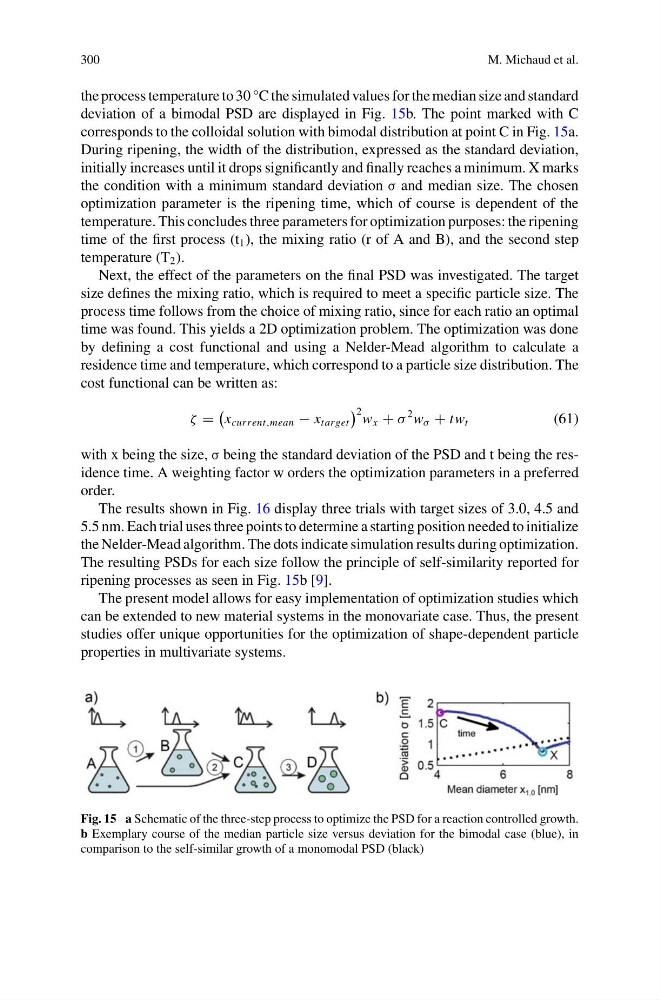
deviation of a bimodal PSD are displayed in Fig. 15b. The point marked with C
corresponds to the colloidal solution with bimodal distribution at point C in Fig. 15a.
During ripening, the width of the distribution, expressed as the standard deviation,
initially increases until it drops significantly and finally reaches a minimum. X marks
the condition with a minimum standard deviation σ and median size. The chosen
optimization parameter is the ripening time, which of course is dependent of the
temperature. This concludes three parameters for optimization purposes: the ripening
time of the first process (t 1 ), the mixing ratio (r of A and B), and the second step
temperature (T 2 ).
Next, the effect of the parameters on the final PSD was investigated. The target
size defines the mixing ratio, which is required to meet a specific particle size. The
process time follows from the choice of mixing ratio, since for each ratio an optimal
time was found. This yields a 2D optimization problem. The optimization was done
by defining a cost functional and using a Nelder-Mead algorithm to calculate a
residence time and temperature, which correspond to a particle size distribution. The
cost functional can be written as:
ζ =
x current,mean − x target
2 w x + σ
2 w σ + tw t
(61)
with x being the size, σ being the standard deviation of the PSD and t being the residence time. A weighting factor w orders the optimization parameters in a preferred
order.
The results shown in Fig. 16 display three trials with target sizes of 3.0, 4.5 and
5.5 nm. Each trial uses three points to determine a starting position needed to initialize
the Nelder-Mead algorithm. The dots indicate simulation results during optimization.
The resulting PSDs for each size follow the principle of self-similarity reported for
ripening processes as seen in Fig. 15b [9].
The present model allows for easy implementation of optimization studies which
can be extended to new material systems in the monovariate case. Thus, the present
studies offer unique opportunities for the optimization of shape-dependent particle
properties in multivariate systems.
Fig. 15 a Schematic of the three-step process to optimize the PSD for a reaction controlled growth.
b Exemplary course of the median particle size versus deviation for the bimodal case (blue), in
comparison to the self-similar growth of a monomodal PSD (black)
M. Michaud et al.
the process temperature to 30 °C the simulated values for the median size and standard
deviation of a bimodal PSD are displayed in Fig. 15b. The point marked with C
corresponds to the colloidal solution with bimodal distribution at point C in Fig. 15a.
During ripening, the width of the distribution, expressed as the standard deviation,
initially increases until it drops significantly and finally reaches a minimum. X marks
the condition with a minimum standard deviation σ and median size. The chosen
optimization parameter is the ripening time, which of course is dependent of the
temperature. This concludes three parameters for optimization purposes: the ripening
time of the first process (t 1 ), the mixing ratio (r of A and B), and the second step
temperature (T 2 ).
Next, the effect of the parameters on the final PSD was investigated. The target
size defines the mixing ratio, which is required to meet a specific particle size. The
process time follows from the choice of mixing ratio, since for each ratio an optimal
time was found. This yields a 2D optimization problem. The optimization was done
by defining a cost functional and using a Nelder-Mead algorithm to calculate a
residence time and temperature, which correspond to a particle size distribution. The
cost functional can be written as:
ζ =
x current,mean − x target
2 w x + σ
2 w σ + tw t
(61)
with x being the size, σ being the standard deviation of the PSD and t being the residence time. A weighting factor w orders the optimization parameters in a preferred
order.
The results shown in Fig. 16 display three trials with target sizes of 3.0, 4.5 and
5.5 nm. Each trial uses three points to determine a starting position needed to initialize
the Nelder-Mead algorithm. The dots indicate simulation results during optimization.
The resulting PSDs for each size follow the principle of self-similarity reported for
ripening processes as seen in Fig. 15b [9].
The present model allows for easy implementation of optimization studies which
can be extended to new material systems in the monovariate case. Thus, the present
studies offer unique opportunities for the optimization of shape-dependent particle
properties in multivariate systems.
Fig. 15 a Schematic of the three-step process to optimize the PSD for a reaction controlled growth.
b Exemplary course of the median particle size versus deviation for the bimodal case (blue), in
comparison to the self-similar growth of a monomodal PSD (black)