

8 Flowsheet Simulation of Integrated Precipitation Processes
299
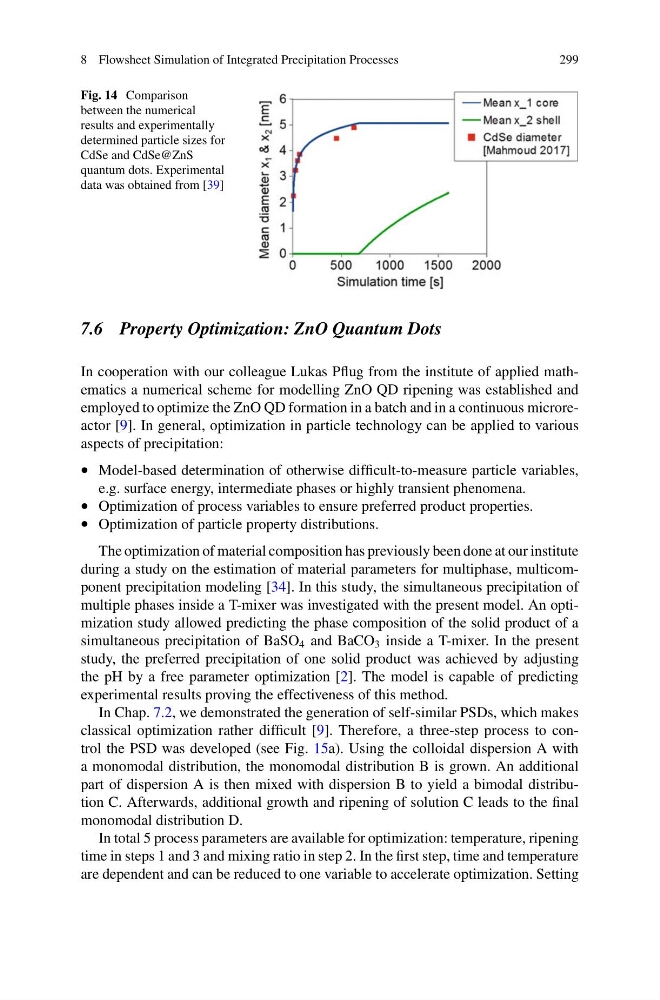
Fig. 14 Comparison
between the numerical
results and experimentally
determined particle sizes for
CdSe and CdSe@ZnS
quantum dots. Experimental
data was obtained from [39]
7.6 Property Optimization: ZnO Quantum Dots
In cooperation with our colleague Lukas Pflug from the institute of applied mathematics a numerical scheme for modelling ZnO QD ripening was established and
employed to optimize the ZnO QD formation in a batch and in a continuous microreactor [9]. In general, optimization in particle technology can be applied to various
aspects of precipitation:
• Model-based determination of otherwise difficult-to-measure particle variables,
e.g. surface energy, intermediate phases or highly transient phenomena.
• Optimization of process variables to ensure preferred product properties.
• Optimization of particle property distributions.
The optimization of material composition has previously been done at our institute
during a study on the estimation of material parameters for multiphase, multicomponent precipitation modeling [34]. In this study, the simultaneous precipitation of
multiple phases inside a T-mixer was investigated with the present model. An optimization study allowed predicting the phase composition of the solid product of a
simultaneous precipitation of BaSO 4 and BaCO 3 inside a T-mixer. In the present
study, the preferred precipitation of one solid product was achieved by adjusting
the pH by a free parameter optimization [2]. The model is capable of predicting
experimental results proving the effectiveness of this method.
In Chap. 7.2, we demonstrated the generation of self-similar PSDs, which makes
classical optimization rather difficult [9]. Therefore, a three-step process to control the PSD was developed (see Fig. 15a). Using the colloidal dispersion A with
a monomodal distribution, the monomodal distribution B is grown. An additional
part of dispersion A is then mixed with dispersion B to yield a bimodal distribution C. Afterwards, additional growth and ripening of solution C leads to the final
monomodal distribution D.
In total 5 process parameters are available for optimization: temperature, ripening
time in steps 1 and 3 and mixing ratio in step 2. In the first step, time and temperature
are dependent and can be reduced to one variable to accelerate optimization. Setting
299
Fig. 14 Comparison
between the numerical
results and experimentally
determined particle sizes for
CdSe and CdSe@ZnS
quantum dots. Experimental
data was obtained from [39]
7.6 Property Optimization: ZnO Quantum Dots
In cooperation with our colleague Lukas Pflug from the institute of applied mathematics a numerical scheme for modelling ZnO QD ripening was established and
employed to optimize the ZnO QD formation in a batch and in a continuous microreactor [9]. In general, optimization in particle technology can be applied to various
aspects of precipitation:
• Model-based determination of otherwise difficult-to-measure particle variables,
e.g. surface energy, intermediate phases or highly transient phenomena.
• Optimization of process variables to ensure preferred product properties.
• Optimization of particle property distributions.
The optimization of material composition has previously been done at our institute
during a study on the estimation of material parameters for multiphase, multicomponent precipitation modeling [34]. In this study, the simultaneous precipitation of
multiple phases inside a T-mixer was investigated with the present model. An optimization study allowed predicting the phase composition of the solid product of a
simultaneous precipitation of BaSO 4 and BaCO 3 inside a T-mixer. In the present
study, the preferred precipitation of one solid product was achieved by adjusting
the pH by a free parameter optimization [2]. The model is capable of predicting
experimental results proving the effectiveness of this method.
In Chap. 7.2, we demonstrated the generation of self-similar PSDs, which makes
classical optimization rather difficult [9]. Therefore, a three-step process to control the PSD was developed (see Fig. 15a). Using the colloidal dispersion A with
a monomodal distribution, the monomodal distribution B is grown. An additional
part of dispersion A is then mixed with dispersion B to yield a bimodal distribution C. Afterwards, additional growth and ripening of solution C leads to the final
monomodal distribution D.
In total 5 process parameters are available for optimization: temperature, ripening
time in steps 1 and 3 and mixing ratio in step 2. In the first step, time and temperature
are dependent and can be reduced to one variable to accelerate optimization. Setting