

8 Flowsheet Simulation of Integrated Precipitation Processes
301
7.7 Coupling to a Separation Process
Typically, particle formation is coupled to other unit operations, most importantly
with separation or even classification. Today, methods of nanoparticle classification
are rare. We have shown that semiconducting nanoparticles such as ZnS can be sizeclassified by antisolvent precipitation [35]. More recently, we introduced nanoparticle chromatography as another possible scalable solution for size-classification. In
particular, results exist for fullerenes [36], ZnS and Au [37] nanoparticles.
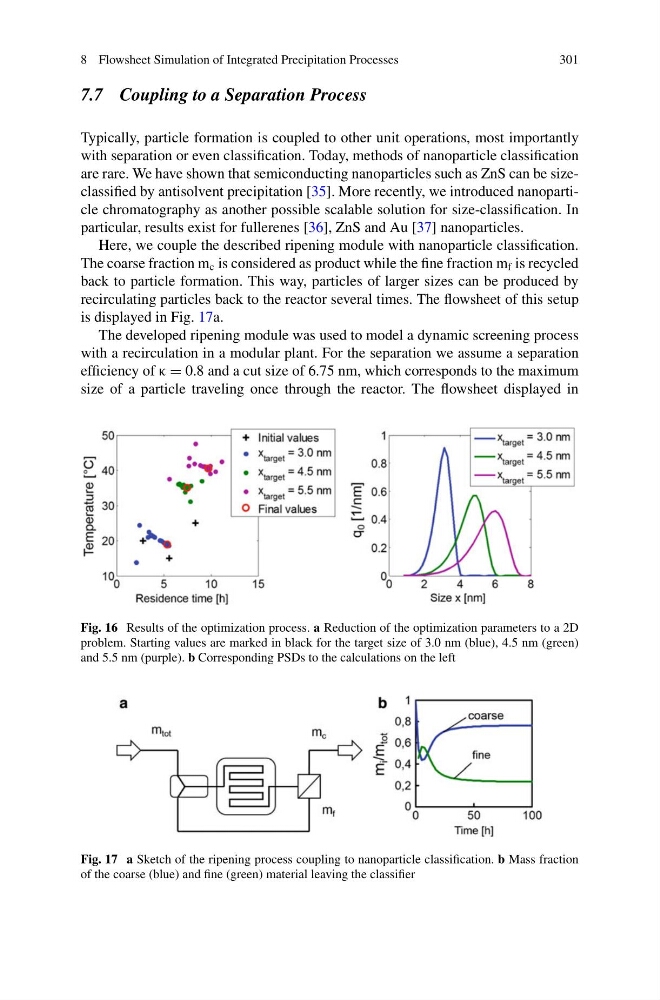
Here, we couple the described ripening module with nanoparticle classification.
The coarse fraction m c is considered as product while the fine fraction m f is recycled
back to particle formation. This way, particles of larger sizes can be produced by
recirculating particles back to the reactor several times. The flowsheet of this setup
is displayed in Fig. 17a.
The developed ripening module was used to model a dynamic screening process
with a recirculation in a modular plant. For the separation we assume a separation
efficiency of κ = 0.8 and a cut size of 6.75 nm, which corresponds to the maximum
size of a particle traveling once through the reactor. The flowsheet displayed in
Fig. 16 Results of the optimization process. a Reduction of the optimization parameters to a 2D
problem. Starting values are marked in black for the target size of 3.0 nm (blue), 4.5 nm (green)
and 5.5 nm (purple). b Corresponding PSDs to the calculations on the left
Fig. 17 a Sketch of the ripening process coupling to nanoparticle classification. b Mass fraction
of the coarse (blue) and fine (green) material leaving the classifier
301
7.7 Coupling to a Separation Process
Typically, particle formation is coupled to other unit operations, most importantly
with separation or even classification. Today, methods of nanoparticle classification
are rare. We have shown that semiconducting nanoparticles such as ZnS can be sizeclassified by antisolvent precipitation [35]. More recently, we introduced nanoparticle chromatography as another possible scalable solution for size-classification. In
particular, results exist for fullerenes [36], ZnS and Au [37] nanoparticles.
Here, we couple the described ripening module with nanoparticle classification.
The coarse fraction m c is considered as product while the fine fraction m f is recycled
back to particle formation. This way, particles of larger sizes can be produced by
recirculating particles back to the reactor several times. The flowsheet of this setup
is displayed in Fig. 17a.
The developed ripening module was used to model a dynamic screening process
with a recirculation in a modular plant. For the separation we assume a separation
efficiency of κ = 0.8 and a cut size of 6.75 nm, which corresponds to the maximum
size of a particle traveling once through the reactor. The flowsheet displayed in
Fig. 16 Results of the optimization process. a Reduction of the optimization parameters to a 2D
problem. Starting values are marked in black for the target size of 3.0 nm (blue), 4.5 nm (green)
and 5.5 nm (purple). b Corresponding PSDs to the calculations on the left
Fig. 17 a Sketch of the ripening process coupling to nanoparticle classification. b Mass fraction
of the coarse (blue) and fine (green) material leaving the classifier