

294
M. Michaud et al.
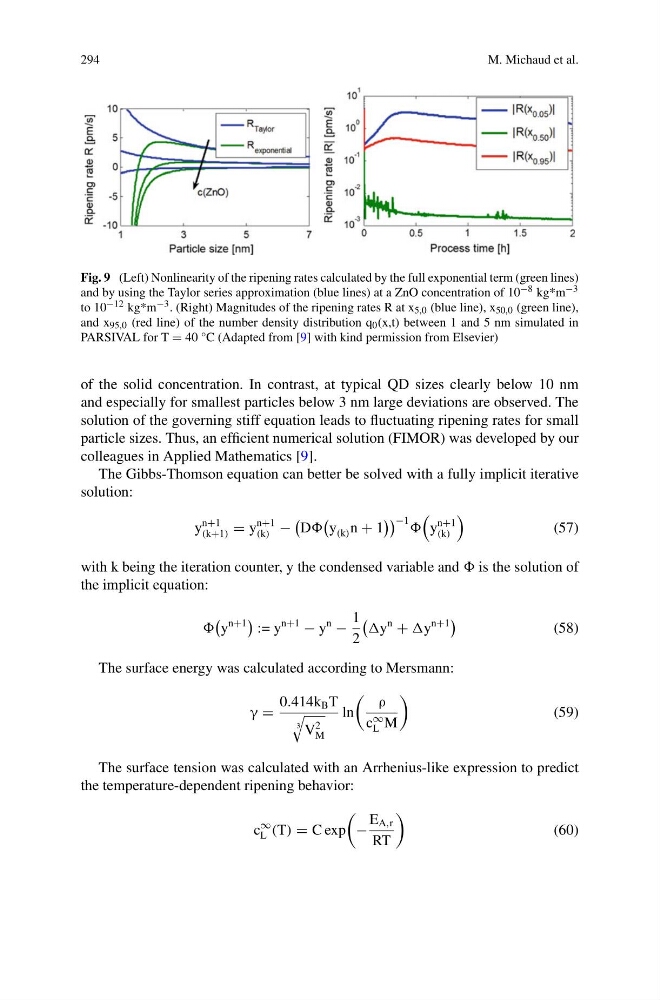
Fig. 9 (Left) Nonlinearity of the ripening rates calculated by the full exponential term (green lines)
and by using the Taylor series approximation (blue lines) at a ZnO concentration of 10 −8 kg*m −3
to 10 −12 kg*m −3 . (Right) Magnitudes of the ripening rates R at x 5,0 (blue line), x 50,0 (green line),
and x 95,0 (red line) of the number density distribution q 0 (x,t) between 1 and 5 nm simulated in
PARSIVAL for T = 40 °C (Adapted from [9] with kind permission from Elsevier)
of the solid concentration. In contrast, at typical QD sizes clearly below 10 nm
and especially for smallest particles below 3 nm large deviations are observed. The
solution of the governing stiff equation leads to fluctuating ripening rates for small
particle sizes. Thus, an efficient numerical solution (FIMOR) was developed by our
colleagues in Applied Mathematics [9].
The Gibbs-Thomson equation can better be solved with a fully implicit iterative
solution:
y
n+1
(k+1) = y
n+1
(k) −
D
y (k) n + 1
−1
y
n+1
(k)
(57)
with k being the iteration counter, y the condensed variable and is the solution of
the implicit equation:
y
n+1
:= y
n+1
− y
n
−
1
2
y
n
+ y
n+1
(58)
The surface energy was calculated according to Mersmann:
γ =
0.414k B T
3
V
2
M
ln
ρ
c
∞
L M
(59)
The surface tension was calculated with an Arrhenius-like expression to predict
the temperature-dependent ripening behavior:
c
∞
L (T) = C exp
−
E A,r
RT
(60)
M. Michaud et al.
Fig. 9 (Left) Nonlinearity of the ripening rates calculated by the full exponential term (green lines)
and by using the Taylor series approximation (blue lines) at a ZnO concentration of 10 −8 kg*m −3
to 10 −12 kg*m −3 . (Right) Magnitudes of the ripening rates R at x 5,0 (blue line), x 50,0 (green line),
and x 95,0 (red line) of the number density distribution q 0 (x,t) between 1 and 5 nm simulated in
PARSIVAL for T = 40 °C (Adapted from [9] with kind permission from Elsevier)
of the solid concentration. In contrast, at typical QD sizes clearly below 10 nm
and especially for smallest particles below 3 nm large deviations are observed. The
solution of the governing stiff equation leads to fluctuating ripening rates for small
particle sizes. Thus, an efficient numerical solution (FIMOR) was developed by our
colleagues in Applied Mathematics [9].
The Gibbs-Thomson equation can better be solved with a fully implicit iterative
solution:
y
n+1
(k+1) = y
n+1
(k) −
D
y (k) n + 1
−1
y
n+1
(k)
(57)
with k being the iteration counter, y the condensed variable and is the solution of
the implicit equation:
y
n+1
:= y
n+1
− y
n
−
1
2
y
n
+ y
n+1
(58)
The surface energy was calculated according to Mersmann:
γ =
0.414k B T
3
V
2
M
ln
ρ
c
∞
L M
(59)
The surface tension was calculated with an Arrhenius-like expression to predict
the temperature-dependent ripening behavior:
c
∞
L (T) = C exp
−
E A,r
RT
(60)