

8 Flowsheet Simulation of Integrated Precipitation Processes
293
the experimental results can be attributed to effects from breakage and aggregation
processes in cases that the attached particles are not properly aligned [30]. This effect
was neglected for the simulation study.
Noteworthy, the extension to non-spherical particles is seen as one of the largest
limitations for solving by PBEs. Here it is shown that the fully bivariate model can be
applied to complex source terms in the case of bivariate aggregation. The extension
to bivariate systems is capable to simulate a large range of particle shapes with
varying source terms in the moment transport equation. This is possible for manifold
different geometries and thus allows addressing increasingly complex structures to
be simulated with the model.
7.4 Reaction-Controlled Systems: zinc oxide (ZnO) Quantum
Dots
An example for a reaction-limited system is the formation and temporal evolution of
ZnO QDs [1]. Modelling of particle formation processes incorporates two distinct
challenges. On the one hand, a high accuracy is desired to ensure outstanding product
quality with respect to narrow PSDs and optical properties, whereas on the other hand
the numerical efficiency limits the feasibility of simulation studies. As described in
the above section the present tool requires repetitive solution of PBEs, which for long
time processes such as ripening, requires small step sizes due to the mathematical
stiffness of the governing Gibbs-Thomson equation, which might lead to prohibitive
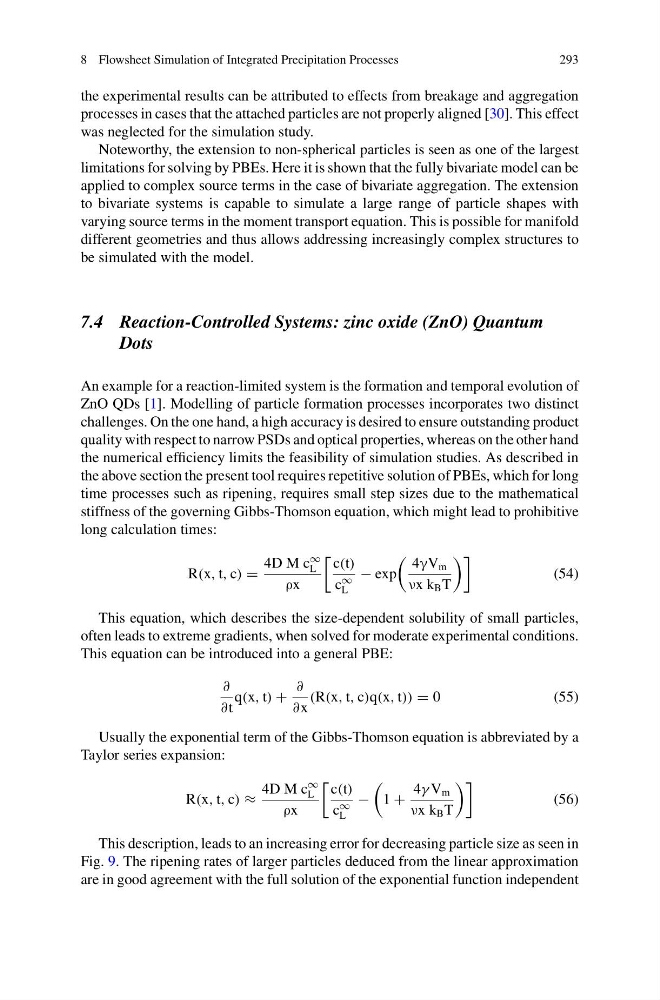
long calculation times:
R(x, t, c) =
4D M c
∞
L
ρx
c(t)
c
∞
L
− exp
4γV m
νx k B T
(54)
This equation, which describes the size-dependent solubility of small particles,
often leads to extreme gradients, when solved for moderate experimental conditions.
This equation can be introduced into a general PBE:
∂
∂t
q(x, t) +
∂
∂x
(R(x, t, c)q(x, t)) = 0
(55)
Usually the exponential term of the Gibbs-Thomson equation is abbreviated by a
Taylor series expansion:
R(x, t, c) ≈
4D M c
∞
L
ρx
c(t)
c
∞
L
−
1 +
4γ V m
νx k B T
(56)
This description, leads to an increasing error for decreasing particle size as seen in
Fig. 9. The ripening rates of larger particles deduced from the linear approximation
are in good agreement with the full solution of the exponential function independent
293
the experimental results can be attributed to effects from breakage and aggregation
processes in cases that the attached particles are not properly aligned [30]. This effect
was neglected for the simulation study.
Noteworthy, the extension to non-spherical particles is seen as one of the largest
limitations for solving by PBEs. Here it is shown that the fully bivariate model can be
applied to complex source terms in the case of bivariate aggregation. The extension
to bivariate systems is capable to simulate a large range of particle shapes with
varying source terms in the moment transport equation. This is possible for manifold
different geometries and thus allows addressing increasingly complex structures to
be simulated with the model.
7.4 Reaction-Controlled Systems: zinc oxide (ZnO) Quantum
Dots
An example for a reaction-limited system is the formation and temporal evolution of
ZnO QDs [1]. Modelling of particle formation processes incorporates two distinct
challenges. On the one hand, a high accuracy is desired to ensure outstanding product
quality with respect to narrow PSDs and optical properties, whereas on the other hand
the numerical efficiency limits the feasibility of simulation studies. As described in
the above section the present tool requires repetitive solution of PBEs, which for long
time processes such as ripening, requires small step sizes due to the mathematical
stiffness of the governing Gibbs-Thomson equation, which might lead to prohibitive
long calculation times:
R(x, t, c) =
4D M c
∞
L
ρx
c(t)
c
∞
L
− exp
4γV m
νx k B T
(54)
This equation, which describes the size-dependent solubility of small particles,
often leads to extreme gradients, when solved for moderate experimental conditions.
This equation can be introduced into a general PBE:
∂
∂t
q(x, t) +
∂
∂x
(R(x, t, c)q(x, t)) = 0
(55)
Usually the exponential term of the Gibbs-Thomson equation is abbreviated by a
Taylor series expansion:
R(x, t, c) ≈
4D M c
∞
L
ρx
c(t)
c
∞
L
−
1 +
4γ V m
νx k B T
(56)
This description, leads to an increasing error for decreasing particle size as seen in
Fig. 9. The ripening rates of larger particles deduced from the linear approximation
are in good agreement with the full solution of the exponential function independent