

8 Flowsheet Simulation of Integrated Precipitation Processes
291
to experimental data [30]. The DQMOM model, however, offers the chance of scaling this simulation to a much larger particle number without the limitation of high
computing time, which is often a limitation for the simulation of discrete particles.
Experimentally, the goethite particles were synthesized by aeration of an alkalized
0.9 M iron sulfate solution at 45 °C. While the mechanism of goethite synthesis is
complex, the present study uses a simplified model developed at our institute to
model the generation of goethite at constant pH [30]:
4Fe
2+
+ O 2 + 8OH
−
→ 4FeOOH + 2H 2 O
( 5 2 )
The oxygen was supplied via bubbling synthetic air through a porous plate with
a constant volume flow rate of 100 ml/min. Samples were taken from the solution
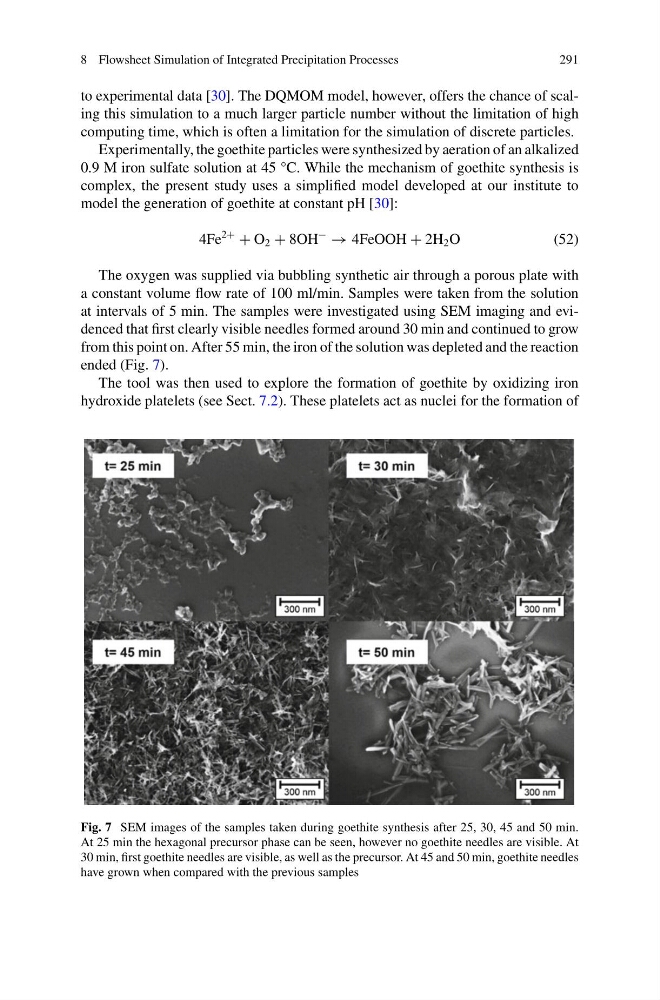
at intervals of 5 min. The samples were investigated using SEM imaging and evidenced that first clearly visible needles formed around 30 min and continued to grow
from this point on. After 55 min, the iron of the solution was depleted and the reaction
ended (Fig. 7).
The tool was then used to explore the formation of goethite by oxidizing iron
hydroxide platelets (see Sect. 7.2). These platelets act as nuclei for the formation of
Fig. 7 SEM images of the samples taken during goethite synthesis after 25, 30, 45 and 50 min.
At 25 min the hexagonal precursor phase can be seen, however no goethite needles are visible. At
30 min, first goethite needles are visible, as well as the precursor. At 45 and 50 min, goethite needles
have grown when compared with the previous samples
291
to experimental data [30]. The DQMOM model, however, offers the chance of scaling this simulation to a much larger particle number without the limitation of high
computing time, which is often a limitation for the simulation of discrete particles.
Experimentally, the goethite particles were synthesized by aeration of an alkalized
0.9 M iron sulfate solution at 45 °C. While the mechanism of goethite synthesis is
complex, the present study uses a simplified model developed at our institute to
model the generation of goethite at constant pH [30]:
4Fe
2+
+ O 2 + 8OH
−
→ 4FeOOH + 2H 2 O
( 5 2 )
The oxygen was supplied via bubbling synthetic air through a porous plate with
a constant volume flow rate of 100 ml/min. Samples were taken from the solution
at intervals of 5 min. The samples were investigated using SEM imaging and evidenced that first clearly visible needles formed around 30 min and continued to grow
from this point on. After 55 min, the iron of the solution was depleted and the reaction
ended (Fig. 7).
The tool was then used to explore the formation of goethite by oxidizing iron
hydroxide platelets (see Sect. 7.2). These platelets act as nuclei for the formation of
Fig. 7 SEM images of the samples taken during goethite synthesis after 25, 30, 45 and 50 min.
At 25 min the hexagonal precursor phase can be seen, however no goethite needles are visible. At
30 min, first goethite needles are visible, as well as the precursor. At 45 and 50 min, goethite needles
have grown when compared with the previous samples