

290
M. Michaud et al.
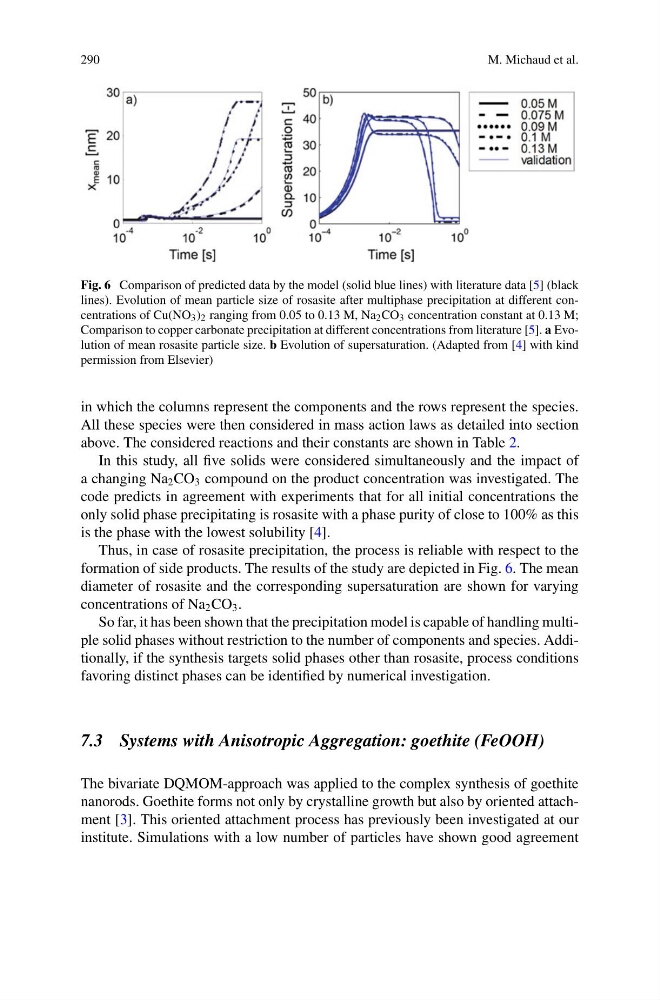
Fig. 6 Comparison of predicted data by the model (solid blue lines) with literature data [5] (black
lines). Evolution of mean particle size of rosasite after multiphase precipitation at different concentrations of Cu(NO 3 ) 2 ranging from 0.05 to 0.13 M, Na 2 CO 3 concentration constant at 0.13 M;
Comparison to copper carbonate precipitation at different concentrations from literature [5]. a Evolution of mean rosasite particle size. b Evolution of supersaturation. (Adapted from [4] with kind
permission from Elsevier)
in which the columns represent the components and the rows represent the species.
All these species were then considered in mass action laws as detailed into section
above. The considered reactions and their constants are shown in Table 2.
In this study, all five solids were considered simultaneously and the impact of
a changing Na 2 CO 3 compound on the product concentration was investigated. The
code predicts in agreement with experiments that for all initial concentrations the
only solid phase precipitating is rosasite with a phase purity of close to 100% as this
is the phase with the lowest solubility [4].
Thus, in case of rosasite precipitation, the process is reliable with respect to the
formation of side products. The results of the study are depicted in Fig. 6. The mean
diameter of rosasite and the corresponding supersaturation are shown for varying
concentrations of Na 2 CO 3 .
So far, it has been shown that the precipitation model is capable of handling multiple solid phases without restriction to the number of components and species. Additionally, if the synthesis targets solid phases other than rosasite, process conditions
favoring distinct phases can be identified by numerical investigation.
7.3 Systems with Anisotropic Aggregation: goethite (FeOOH)
The bivariate DQMOM-approach was applied to the complex synthesis of goethite
nanorods. Goethite forms not only by crystalline growth but also by oriented attachment [3]. This oriented attachment process has previously been investigated at our
institute. Simulations with a low number of particles have shown good agreement
M. Michaud et al.
Fig. 6 Comparison of predicted data by the model (solid blue lines) with literature data [5] (black
lines). Evolution of mean particle size of rosasite after multiphase precipitation at different concentrations of Cu(NO 3 ) 2 ranging from 0.05 to 0.13 M, Na 2 CO 3 concentration constant at 0.13 M;
Comparison to copper carbonate precipitation at different concentrations from literature [5]. a Evolution of mean rosasite particle size. b Evolution of supersaturation. (Adapted from [4] with kind
permission from Elsevier)
in which the columns represent the components and the rows represent the species.
All these species were then considered in mass action laws as detailed into section
above. The considered reactions and their constants are shown in Table 2.
In this study, all five solids were considered simultaneously and the impact of
a changing Na 2 CO 3 compound on the product concentration was investigated. The
code predicts in agreement with experiments that for all initial concentrations the
only solid phase precipitating is rosasite with a phase purity of close to 100% as this
is the phase with the lowest solubility [4].
Thus, in case of rosasite precipitation, the process is reliable with respect to the
formation of side products. The results of the study are depicted in Fig. 6. The mean
diameter of rosasite and the corresponding supersaturation are shown for varying
concentrations of Na 2 CO 3 .
So far, it has been shown that the precipitation model is capable of handling multiple solid phases without restriction to the number of components and species. Additionally, if the synthesis targets solid phases other than rosasite, process conditions
favoring distinct phases can be identified by numerical investigation.
7.3 Systems with Anisotropic Aggregation: goethite (FeOOH)
The bivariate DQMOM-approach was applied to the complex synthesis of goethite
nanorods. Goethite forms not only by crystalline growth but also by oriented attachment [3]. This oriented attachment process has previously been investigated at our
institute. Simulations with a low number of particles have shown good agreement