

286
M. Michaud et al.
S
(N)
kl =
1
2
N
α=1
N
γ =1
ω α ω γ
ξ 1α + ξ 1γ
k ξ 2α + ξ 2γ
l − ξ
k
1α ξ
l
2α
−ξ
k
1γ ξ
l
2γ
β αγ
(50)
Closure of this term is achieved within the framework of DQMOM. Tracking
the absolute value of the mixed order moments for aggregation processes during the
simulation is directly possible via these extended source terms in the central set of
equations, and thus does not require any additional computational steps.
7 Application Examples
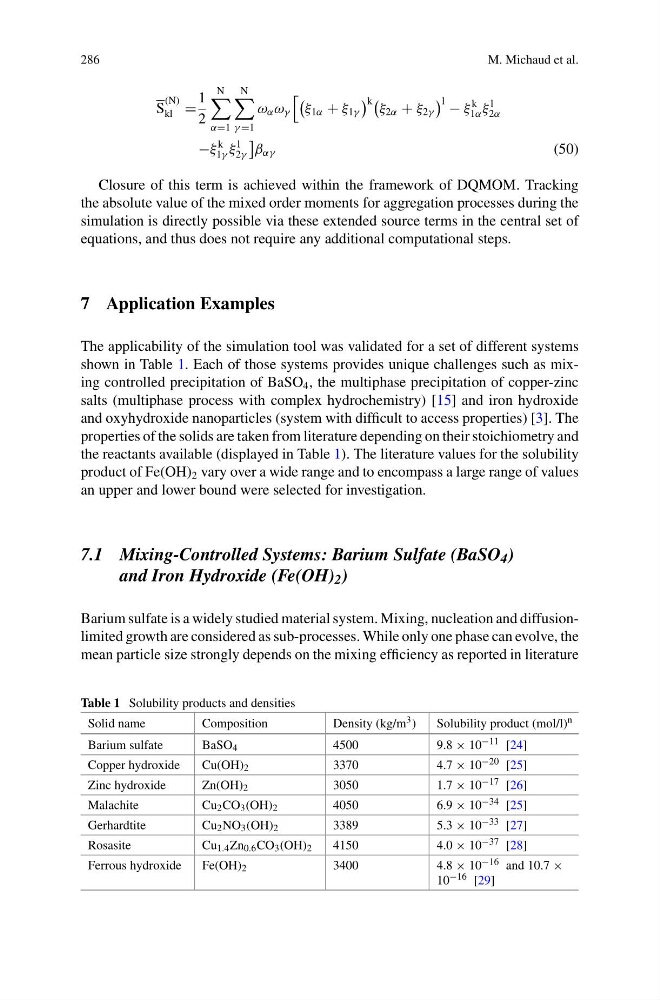
The applicability of the simulation tool was validated for a set of different systems
shown in Table 1. Each of those systems provides unique challenges such as mixing controlled precipitation of BaSO 4 , the multiphase precipitation of copper-zinc
salts (multiphase process with complex hydrochemistry) [15] and iron hydroxide
and oxyhydroxide nanoparticles (system with difficult to access properties) [3]. The
properties of the solids are taken from literature depending on their stoichiometry and
the reactants available (displayed in Table 1). The literature values for the solubility
product of Fe(OH) 2 vary over a wide range and to encompass a large range of values
an upper and lower bound were selected for investigation.
7.1 Mixing-Controlled Systems: Barium Sulfate (BaSO 4 )
and Iron Hydroxide (Fe(OH) 2 )
Barium sulfate is a widely studied material system. Mixing, nucleation and diffusionlimited growth are considered as sub-processes. While only one phase can evolve, the
mean particle size strongly depends on the mixing efficiency as reported in literature
Table 1 Solubility products and densities
Solid name
Composition
Density (kg/m 3 )
Solubility product (mol/l) n
Barium sulfate
BaSO 4
4500
9.8 × 10 −11 [24]
Copper hydroxide
Cu(OH) 2
3370
4.7 × 10 −20 [25]
Zinc hydroxide
Zn(OH) 2
3050
1.7 × 10 −17 [26]
Malachite
Cu 2 CO 3 (OH) 2
4050
6.9 × 10 −34 [25]
Gerhardtite
Cu 2 NO 3 (OH) 2
3389
5.3 × 10 −33 [27]
Rosasite
Cu 1.4 Zn 0.6 CO 3 (OH) 2
4150
4.0 × 10 −37 [28]
Ferrous hydroxide
Fe(OH) 2
3400
4.8 × 10 −16 and 10.7 ×
10 −16 [29]
M. Michaud et al.
S
(N)
kl =
1
2
N
α=1
N
γ =1
ω α ω γ
ξ 1α + ξ 1γ
k ξ 2α + ξ 2γ
l − ξ
k
1α ξ
l
2α
−ξ
k
1γ ξ
l
2γ
β αγ
(50)
Closure of this term is achieved within the framework of DQMOM. Tracking
the absolute value of the mixed order moments for aggregation processes during the
simulation is directly possible via these extended source terms in the central set of
equations, and thus does not require any additional computational steps.
7 Application Examples
The applicability of the simulation tool was validated for a set of different systems
shown in Table 1. Each of those systems provides unique challenges such as mixing controlled precipitation of BaSO 4 , the multiphase precipitation of copper-zinc
salts (multiphase process with complex hydrochemistry) [15] and iron hydroxide
and oxyhydroxide nanoparticles (system with difficult to access properties) [3]. The
properties of the solids are taken from literature depending on their stoichiometry and
the reactants available (displayed in Table 1). The literature values for the solubility
product of Fe(OH) 2 vary over a wide range and to encompass a large range of values
an upper and lower bound were selected for investigation.
7.1 Mixing-Controlled Systems: Barium Sulfate (BaSO 4 )
and Iron Hydroxide (Fe(OH) 2 )
Barium sulfate is a widely studied material system. Mixing, nucleation and diffusionlimited growth are considered as sub-processes. While only one phase can evolve, the
mean particle size strongly depends on the mixing efficiency as reported in literature
Table 1 Solubility products and densities
Solid name
Composition
Density (kg/m 3 )
Solubility product (mol/l) n
Barium sulfate
BaSO 4
4500
9.8 × 10 −11 [24]
Copper hydroxide
Cu(OH) 2
3370
4.7 × 10 −20 [25]
Zinc hydroxide
Zn(OH) 2
3050
1.7 × 10 −17 [26]
Malachite
Cu 2 CO 3 (OH) 2
4050
6.9 × 10 −34 [25]
Gerhardtite
Cu 2 NO 3 (OH) 2
3389
5.3 × 10 −33 [27]
Rosasite
Cu 1.4 Zn 0.6 CO 3 (OH) 2
4150
4.0 × 10 −37 [28]
Ferrous hydroxide
Fe(OH) 2
3400
4.8 × 10 −16 and 10.7 ×
10 −16 [29]