

8 Flowsheet Simulation of Integrated Precipitation Processes
285
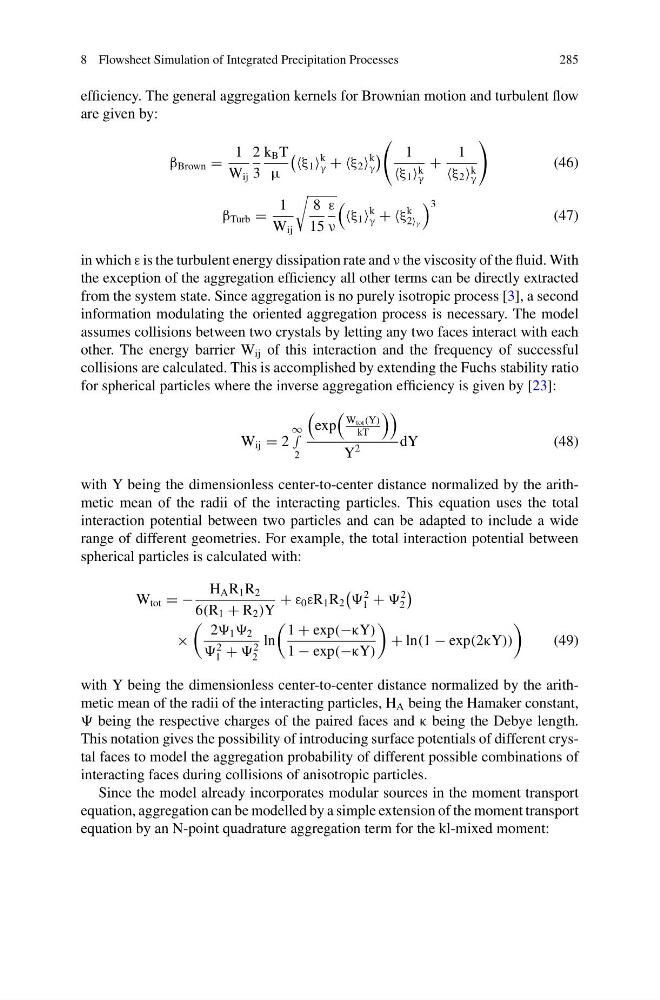
efficiency. The general aggregation kernels for Brownian motion and turbulent flow
are given by:
β Brown =
1
W ij
2
3
k B T
μ
ξ 1
k
γ + +ξ 2
k
γ
1
ξ 1 k
γ
+
1
ξ 2 k
γ
(46)
β Turb =
1
W ij
8
15
ε
ν
ξ 1
k
γ + +ξ
k
2 γ
3
(47)
in which ε is the turbulent energy dissipation rate and ν the viscosity of the fluid. With
the exception of the aggregation efficiency all other terms can be directly extracted
from the system state. Since aggregation is no purely isotropic process [3], a second
information modulating the oriented aggregation process is necessary. The model
assumes collisions between two crystals by letting any two faces interact with each
other. The energy barrier W ij of this interaction and the frequency of successful
collisions are calculated. This is accomplished by extending the Fuchs stability ratio
for spherical particles where the inverse aggregation efficiency is given by [23]:
W ij = 2
∞
∫
2
exp
W tot( Y)
kT
Y
2
dY
(48)
with Y being the dimensionless center-to-center distance normalized by the arithmetic mean of the radii of the interacting particles. This equation uses the total
interaction potential between two particles and can be adapted to include a wide
range of different geometries. For example, the total interaction potential between
spherical particles is calculated with:
W tot = −
H A R 1 R 2
6(R 1 + R 2 )Y
+ ε 0 εR 1 R 2
2
1 +
2
2
×
2 1 2
2
1 +
2
2
ln
1 + exp(−κY)
1 − exp(−κY)
+ ln(1 − exp(2κY))
(49)
with Y being the dimensionless center-to-center distance normalized by the arithmetic mean of the radii of the interacting particles, H A being the Hamaker constant,
being the respective charges of the paired faces and κ being the Debye length.
This notation gives the possibility of introducing surface potentials of different crystal faces to model the aggregation probability of different possible combinations of
interacting faces during collisions of anisotropic particles.
Since the model already incorporates modular sources in the moment transport
equation, aggregation can be modelled by a simple extension of the moment transport
equation by an N-point quadrature aggregation term for the kl-mixed moment:
285
efficiency. The general aggregation kernels for Brownian motion and turbulent flow
are given by:
β Brown =
1
W ij
2
3
k B T
μ
ξ 1
k
γ + +ξ 2
k
γ
1
ξ 1 k
γ
+
1
ξ 2 k
γ
(46)
β Turb =
1
W ij
8
15
ε
ν
ξ 1
k
γ + +ξ
k
2 γ
3
(47)
in which ε is the turbulent energy dissipation rate and ν the viscosity of the fluid. With
the exception of the aggregation efficiency all other terms can be directly extracted
from the system state. Since aggregation is no purely isotropic process [3], a second
information modulating the oriented aggregation process is necessary. The model
assumes collisions between two crystals by letting any two faces interact with each
other. The energy barrier W ij of this interaction and the frequency of successful
collisions are calculated. This is accomplished by extending the Fuchs stability ratio
for spherical particles where the inverse aggregation efficiency is given by [23]:
W ij = 2
∞
∫
2
exp
W tot( Y)
kT
Y
2
dY
(48)
with Y being the dimensionless center-to-center distance normalized by the arithmetic mean of the radii of the interacting particles. This equation uses the total
interaction potential between two particles and can be adapted to include a wide
range of different geometries. For example, the total interaction potential between
spherical particles is calculated with:
W tot = −
H A R 1 R 2
6(R 1 + R 2 )Y
+ ε 0 εR 1 R 2
2
1 +
2
2
×
2 1 2
2
1 +
2
2
ln
1 + exp(−κY)
1 − exp(−κY)
+ ln(1 − exp(2κY))
(49)
with Y being the dimensionless center-to-center distance normalized by the arithmetic mean of the radii of the interacting particles, H A being the Hamaker constant,
being the respective charges of the paired faces and κ being the Debye length.
This notation gives the possibility of introducing surface potentials of different crystal faces to model the aggregation probability of different possible combinations of
interacting faces during collisions of anisotropic particles.
Since the model already incorporates modular sources in the moment transport
equation, aggregation can be modelled by a simple extension of the moment transport
equation by an N-point quadrature aggregation term for the kl-mixed moment: