

8 Flowsheet Simulation of Integrated Precipitation Processes
283
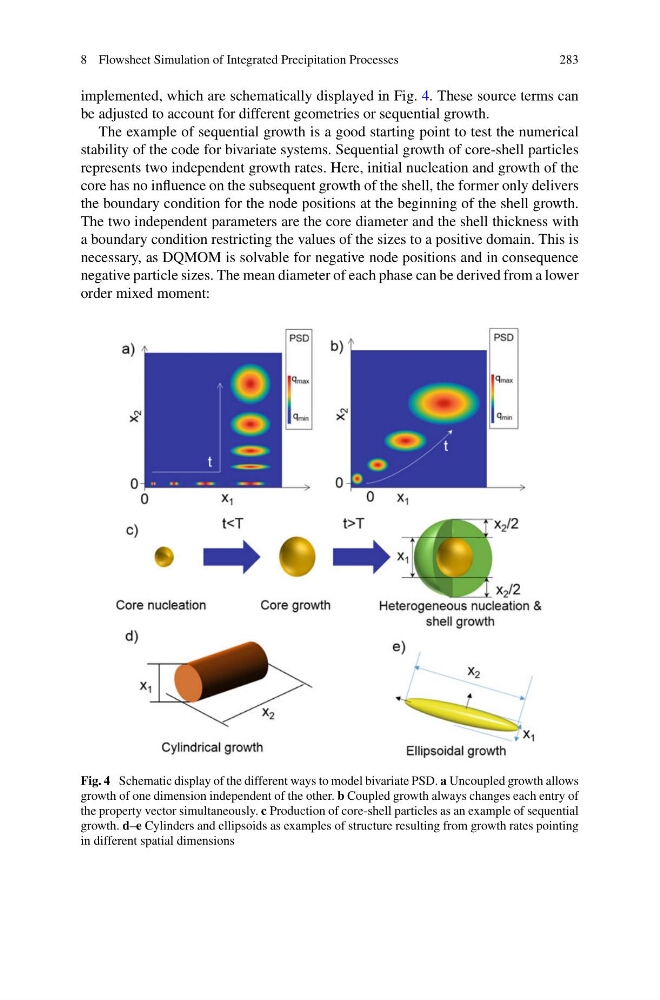
implemented, which are schematically displayed in Fig. 4. These source terms can
be adjusted to account for different geometries or sequential growth.
The example of sequential growth is a good starting point to test the numerical
stability of the code for bivariate systems. Sequential growth of core-shell particles
represents two independent growth rates. Here, initial nucleation and growth of the
core has no influence on the subsequent growth of the shell, the former only delivers
the boundary condition for the node positions at the beginning of the shell growth.
The two independent parameters are the core diameter and the shell thickness with
a boundary condition restricting the values of the sizes to a positive domain. This is
necessary, as DQMOM is solvable for negative node positions and in consequence
negative particle sizes. The mean diameter of each phase can be derived from a lower
order mixed moment:
Fig. 4 Schematic display of the different ways to model bivariate PSD. a Uncoupled growth allows
growth of one dimension independent of the other. b Coupled growth always changes each entry of
the property vector simultaneously. c Production of core-shell particles as an example of sequential
growth. d–e Cylinders and ellipsoids as examples of structure resulting from growth rates pointing
in different spatial dimensions
283
implemented, which are schematically displayed in Fig. 4. These source terms can
be adjusted to account for different geometries or sequential growth.
The example of sequential growth is a good starting point to test the numerical
stability of the code for bivariate systems. Sequential growth of core-shell particles
represents two independent growth rates. Here, initial nucleation and growth of the
core has no influence on the subsequent growth of the shell, the former only delivers
the boundary condition for the node positions at the beginning of the shell growth.
The two independent parameters are the core diameter and the shell thickness with
a boundary condition restricting the values of the sizes to a positive domain. This is
necessary, as DQMOM is solvable for negative node positions and in consequence
negative particle sizes. The mean diameter of each phase can be derived from a lower
order mixed moment:
Fig. 4 Schematic display of the different ways to model bivariate PSD. a Uncoupled growth allows
growth of one dimension independent of the other. b Coupled growth always changes each entry of
the property vector simultaneously. c Production of core-shell particles as an example of sequential
growth. d–e Cylinders and ellipsoids as examples of structure resulting from growth rates pointing
in different spatial dimensions