

282
M. Michaud et al.
with a critical size x c , which is calculated by the Gibbs-Thomson equation which is
derived from the assumption of energy equilibrium between free Gibbs enthalpy of
volume versus free Gibbs enthalpy of surface:
x c =
4V M γ
k B Tln(S)
(36)
For a detailed derivation of these equations the reader is directed to [22]. The
second step in solid formation is growth of nucleated particles. Growth is calculated
in each time step depending on the system state. The growth rates used for fast
precipitation processes are assumed to be diffusion-limited:
G i = 4D
K SP
M i
ρ
S − 1
x
(37)
M refers to the molar mass, ρ is the density of the solid phase and x is the current
diameter of the growing particle. This source term can mathematically be described
as adding a layer of solid material to an existing particle during each time step t
during the simulation. The term is closed by the mass balance which removes the
corresponding amount of mass from the solution that is needed to grow the particle
of size ξ:
V Growth =
N S
i
f A,i ξ
2
i G i t
(38)
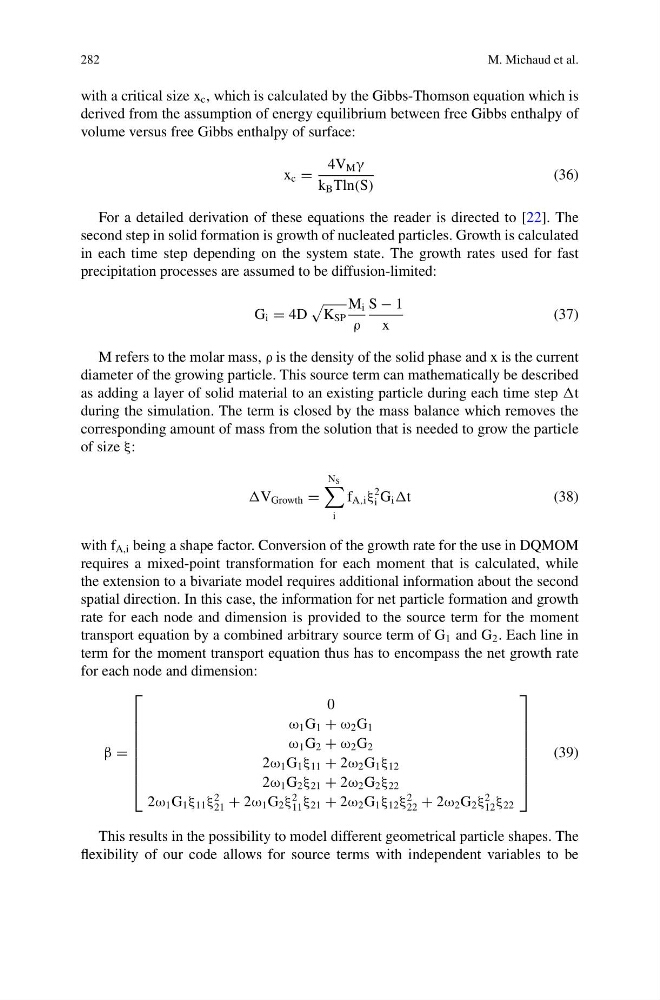
with f A,i being a shape factor. Conversion of the growth rate for the use in DQMOM
requires a mixed-point transformation for each moment that is calculated, while
the extension to a bivariate model requires additional information about the second
spatial direction. In this case, the information for net particle formation and growth
rate for each node and dimension is provided to the source term for the moment
transport equation by a combined arbitrary source term of G 1 and G 2 . Each line in
term for the moment transport equation thus has to encompass the net growth rate
for each node and dimension:
β =
⎡
⎢
⎢
⎢
⎢
⎢
⎢
⎢
⎣
0
ω 1 G 1 + ω 2 G 1
ω 1 G 2 + ω 2 G 2
2ω 1 G 1 ξ 11 + 2ω 2 G 1 ξ 12
2ω 1 G 2 ξ 21 + 2ω 2 G 2 ξ 22
2ω 1 G 1 ξ 11 ξ
2
21 + 2ω 1 G 2 ξ
2
11 ξ 21 + 2ω 2 G 1 ξ 12 ξ
2
22 + 2ω 2 G 2 ξ
2
12 ξ 22
⎤
⎥
⎥
⎥
⎥
⎥
⎥
⎥
⎦
(39)
This results in the possibility to model different geometrical particle shapes. The
flexibility of our code allows for source terms with independent variables to be
M. Michaud et al.
with a critical size x c , which is calculated by the Gibbs-Thomson equation which is
derived from the assumption of energy equilibrium between free Gibbs enthalpy of
volume versus free Gibbs enthalpy of surface:
x c =
4V M γ
k B Tln(S)
(36)
For a detailed derivation of these equations the reader is directed to [22]. The
second step in solid formation is growth of nucleated particles. Growth is calculated
in each time step depending on the system state. The growth rates used for fast
precipitation processes are assumed to be diffusion-limited:
G i = 4D
K SP
M i
ρ
S − 1
x
(37)
M refers to the molar mass, ρ is the density of the solid phase and x is the current
diameter of the growing particle. This source term can mathematically be described
as adding a layer of solid material to an existing particle during each time step t
during the simulation. The term is closed by the mass balance which removes the
corresponding amount of mass from the solution that is needed to grow the particle
of size ξ:
V Growth =
N S
i
f A,i ξ
2
i G i t
(38)
with f A,i being a shape factor. Conversion of the growth rate for the use in DQMOM
requires a mixed-point transformation for each moment that is calculated, while
the extension to a bivariate model requires additional information about the second
spatial direction. In this case, the information for net particle formation and growth
rate for each node and dimension is provided to the source term for the moment
transport equation by a combined arbitrary source term of G 1 and G 2 . Each line in
term for the moment transport equation thus has to encompass the net growth rate
for each node and dimension:
β =
⎡
⎢
⎢
⎢
⎢
⎢
⎢
⎢
⎣
0
ω 1 G 1 + ω 2 G 1
ω 1 G 2 + ω 2 G 2
2ω 1 G 1 ξ 11 + 2ω 2 G 1 ξ 12
2ω 1 G 2 ξ 21 + 2ω 2 G 2 ξ 22
2ω 1 G 1 ξ 11 ξ
2
21 + 2ω 1 G 2 ξ
2
11 ξ 21 + 2ω 2 G 1 ξ 12 ξ
2
22 + 2ω 2 G 2 ξ
2
12 ξ 22
⎤
⎥
⎥
⎥
⎥
⎥
⎥
⎥
⎦
(39)
This results in the possibility to model different geometrical particle shapes. The
flexibility of our code allows for source terms with independent variables to be