

8 Flowsheet Simulation of Integrated Precipitation Processes
281
be applied to many different systems. Secondly, the integration of different mixing
models in separate equations allows the application in different mixing regimes or
reactor geometries. Lastly, the establishment of individual sets of equations for each
mixing zone and each solid phase allows the parallelization of the solution and thus
reduces the computational effort.
The solid formation process is condensed into a source term within the moment
transport equations by a sum of the N-point quadrature moment sources, which
govern physical phenomena such as nucleation, growth and aggregation. The central
equation can be reduced to a set of four independent differential equations, whose
solution allows tracking the first four moments of the solid phases inside each mixing
zone in the aforementioned mixing model.
6 Solid Formation
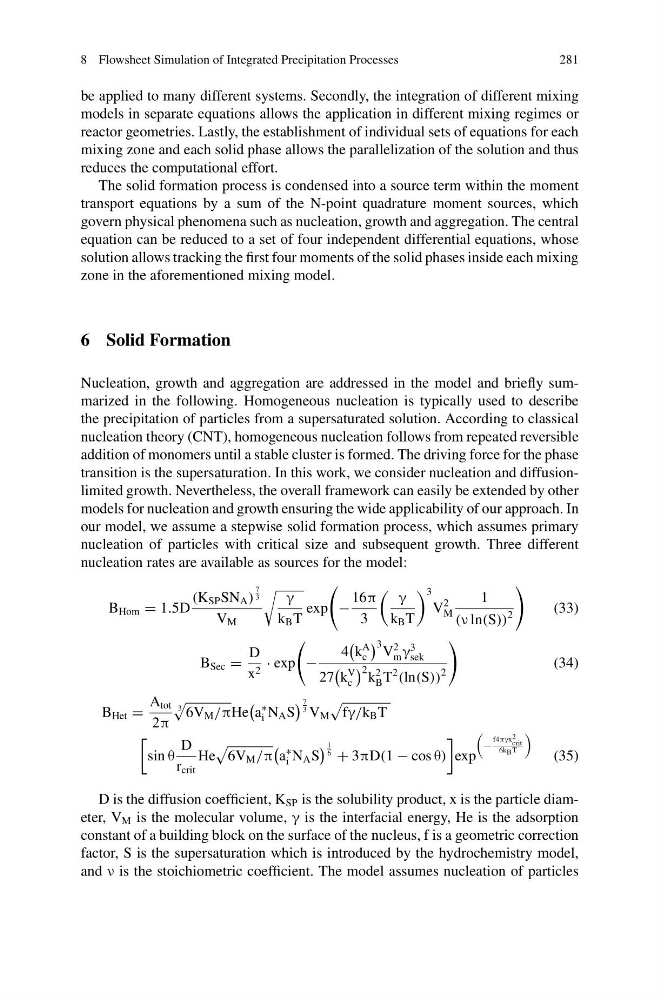
Nucleation, growth and aggregation are addressed in the model and briefly summarized in the following. Homogeneous nucleation is typically used to describe
the precipitation of particles from a supersaturated solution. According to classical
nucleation theory (CNT), homogeneous nucleation follows from repeated reversible
addition of monomers until a stable cluster is formed. The driving force for the phase
transition is the supersaturation. In this work, we consider nucleation and diffusionlimited growth. Nevertheless, the overall framework can easily be extended by other
models for nucleation and growth ensuring the wide applicability of our approach. In
our model, we assume a stepwise solid formation process, which assumes primary
nucleation of particles with critical size and subsequent growth. Three different
nucleation rates are available as sources for the model:
B Hom = 1.5D
(K SP SN A )
7
3
V M
γ
k B T
exp
−
16π
3
γ
k B T
3
V
2
M
1
(ν ln(S))
2
(33)
B Sec =
D
x 2 · exp
−
4
k
A
c
3 V
2
m γ
3
sek
27
k
V
c
2 k
2
B T
2
(ln(S))
2
(34)
B Het =
A tot
2π
3
6V M /πHe
a
∗
i N A S
7
3 V M
fγ/k B T
sin θ
D
r crit
He
6V M /π
a
∗
i N A S
1
6
+ 3πD(1 − cos θ)
exp
−
f4πγx 2
crit
6k B T
(35)
D is the diffusion coefficient, K SP is the solubility product, x is the particle diameter, V M is the molecular volume, γ is the interfacial energy, He is the adsorption
constant of a building block on the surface of the nucleus, f is a geometric correction
factor, S is the supersaturation which is introduced by the hydrochemistry model,
and ν is the stoichiometric coefficient. The model assumes nucleation of particles
281
be applied to many different systems. Secondly, the integration of different mixing
models in separate equations allows the application in different mixing regimes or
reactor geometries. Lastly, the establishment of individual sets of equations for each
mixing zone and each solid phase allows the parallelization of the solution and thus
reduces the computational effort.
The solid formation process is condensed into a source term within the moment
transport equations by a sum of the N-point quadrature moment sources, which
govern physical phenomena such as nucleation, growth and aggregation. The central
equation can be reduced to a set of four independent differential equations, whose
solution allows tracking the first four moments of the solid phases inside each mixing
zone in the aforementioned mixing model.
6 Solid Formation
Nucleation, growth and aggregation are addressed in the model and briefly summarized in the following. Homogeneous nucleation is typically used to describe
the precipitation of particles from a supersaturated solution. According to classical
nucleation theory (CNT), homogeneous nucleation follows from repeated reversible
addition of monomers until a stable cluster is formed. The driving force for the phase
transition is the supersaturation. In this work, we consider nucleation and diffusionlimited growth. Nevertheless, the overall framework can easily be extended by other
models for nucleation and growth ensuring the wide applicability of our approach. In
our model, we assume a stepwise solid formation process, which assumes primary
nucleation of particles with critical size and subsequent growth. Three different
nucleation rates are available as sources for the model:
B Hom = 1.5D
(K SP SN A )
7
3
V M
γ
k B T
exp
−
16π
3
γ
k B T
3
V
2
M
1
(ν ln(S))
2
(33)
B Sec =
D
x 2 · exp
−
4
k
A
c
3 V
2
m γ
3
sek
27
k
V
c
2 k
2
B T
2
(ln(S))
2
(34)
B Het =
A tot
2π
3
6V M /πHe
a
∗
i N A S
7
3 V M
fγ/k B T
sin θ
D
r crit
He
6V M /π
a
∗
i N A S
1
6
+ 3πD(1 − cos θ)
exp
−
f4πγx 2
crit
6k B T
(35)
D is the diffusion coefficient, K SP is the solubility product, x is the particle diameter, V M is the molecular volume, γ is the interfacial energy, He is the adsorption
constant of a building block on the surface of the nucleus, f is a geometric correction
factor, S is the supersaturation which is introduced by the hydrochemistry model,
and ν is the stoichiometric coefficient. The model assumes nucleation of particles