

280
M. Michaud et al.
b 2α =
∂(ξ 2 α ω α )
∂t
+
∂
x i
(u i ξ 2 α ω α ) −
∂
∂x i
D x
∂ξ 2 α ω α
∂x i
(26)
C βγα = ω α D x
∂
ξ β α
∂x i
∂
ξ γ α
∂x i
(27)
S
(N)
kl =
+∞
∫
−∞
+∞
∫
−∞
ξ
k
1 ξ
l
2 S ξ (ξ)dξ 1 dξ 2
(28)
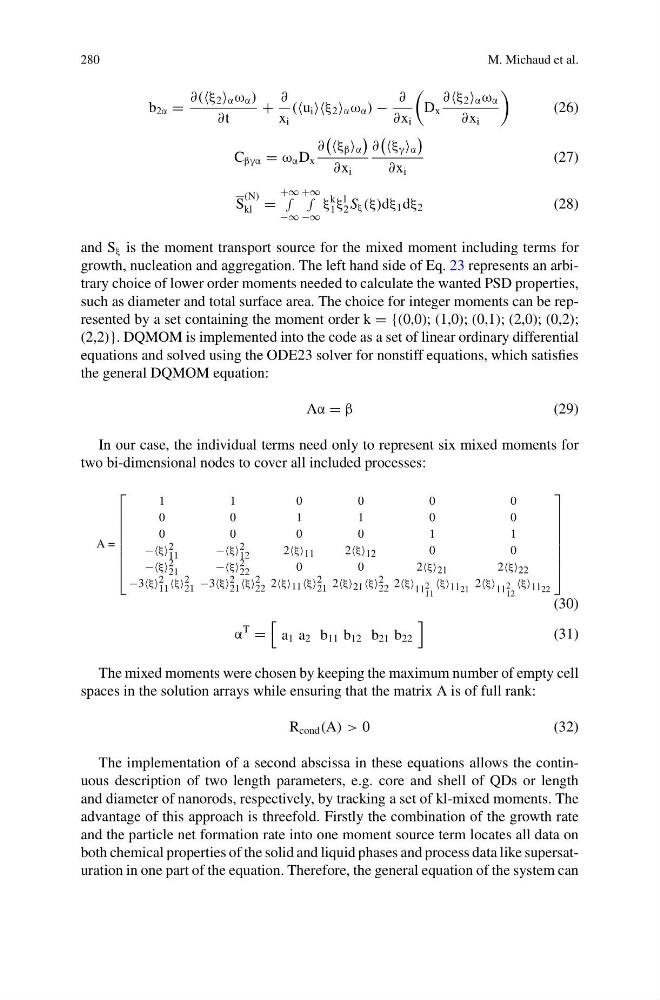
and S ξ is the moment transport source for the mixed moment including terms for
growth, nucleation and aggregation. The left hand side of Eq. 23 represents an arbitrary choice of lower order moments needed to calculate the wanted PSD properties,
such as diameter and total surface area. The choice for integer moments can be represented by a set containing the moment order k = {(0,0); (1,0); (0,1); (2,0); (0,2);
(2,2)}. DQMOM is implemented into the code as a set of linear ordinary differential
equations and solved using the ODE23 solver for nonstiff equations, which satisfies
the general DQMOM equation:
Aα = β
(29)
In our case, the individual terms need only to represent six mixed moments for
two bi-dimensional nodes to cover all included processes:
A =
⎡
⎢
⎢
⎢
⎢
⎢
⎢
⎢
⎢
⎣
1
1
0
0
0
0
0
0
1
1
0
0
0
0
0
0
1
1
−ξ 2
11
−ξ 2
12
2ξ 11
2ξ 12
0
0
−ξ 2
21
−ξ 2
22
0
0
2 ξ 21
2ξ 22
−3ξ 2
11 ξ 2
21 −3ξ 2
21 ξ 2
22 2ξ 11 ξ 2
21 2ξ 21 ξ 2
22 2ξ 11 2
11
ξ 11 21 2ξ 11 2
12
ξ 11 22
⎤
⎥
⎥
⎥
⎥
⎥
⎥
⎥
⎥
⎦
(30)
α
T
=
a 1 a 2 b 11 b 12 b 21 b 22
(31)
The mixed moments were chosen by keeping the maximum number of empty cell
spaces in the solution arrays while ensuring that the matrix A is of full rank:
R cond (A) > 0
( 3 2 )
The implementation of a second abscissa in these equations allows the continuous description of two length parameters, e.g. core and shell of QDs or length
and diameter of nanorods, respectively, by tracking a set of kl-mixed moments. The
advantage of this approach is threefold. Firstly the combination of the growth rate
and the particle net formation rate into one moment source term locates all data on
both chemical properties of the solid and liquid phases and process data like supersaturation in one part of the equation. Therefore, the general equation of the system can
M. Michaud et al.
b 2α =
∂(ξ 2 α ω α )
∂t
+
∂
x i
(u i ξ 2 α ω α ) −
∂
∂x i
D x
∂ξ 2 α ω α
∂x i
(26)
C βγα = ω α D x
∂
ξ β α
∂x i
∂
ξ γ α
∂x i
(27)
S
(N)
kl =
+∞
∫
−∞
+∞
∫
−∞
ξ
k
1 ξ
l
2 S ξ (ξ)dξ 1 dξ 2
(28)
and S ξ is the moment transport source for the mixed moment including terms for
growth, nucleation and aggregation. The left hand side of Eq. 23 represents an arbitrary choice of lower order moments needed to calculate the wanted PSD properties,
such as diameter and total surface area. The choice for integer moments can be represented by a set containing the moment order k = {(0,0); (1,0); (0,1); (2,0); (0,2);
(2,2)}. DQMOM is implemented into the code as a set of linear ordinary differential
equations and solved using the ODE23 solver for nonstiff equations, which satisfies
the general DQMOM equation:
Aα = β
(29)
In our case, the individual terms need only to represent six mixed moments for
two bi-dimensional nodes to cover all included processes:
A =
⎡
⎢
⎢
⎢
⎢
⎢
⎢
⎢
⎢
⎣
1
1
0
0
0
0
0
0
1
1
0
0
0
0
0
0
1
1
−ξ 2
11
−ξ 2
12
2ξ 11
2ξ 12
0
0
−ξ 2
21
−ξ 2
22
0
0
2 ξ 21
2ξ 22
−3ξ 2
11 ξ 2
21 −3ξ 2
21 ξ 2
22 2ξ 11 ξ 2
21 2ξ 21 ξ 2
22 2ξ 11 2
11
ξ 11 21 2ξ 11 2
12
ξ 11 22
⎤
⎥
⎥
⎥
⎥
⎥
⎥
⎥
⎥
⎦
(30)
α
T
=
a 1 a 2 b 11 b 12 b 21 b 22
(31)
The mixed moments were chosen by keeping the maximum number of empty cell
spaces in the solution arrays while ensuring that the matrix A is of full rank:
R cond (A) > 0
( 3 2 )
The implementation of a second abscissa in these equations allows the continuous description of two length parameters, e.g. core and shell of QDs or length
and diameter of nanorods, respectively, by tracking a set of kl-mixed moments. The
advantage of this approach is threefold. Firstly the combination of the growth rate
and the particle net formation rate into one moment source term locates all data on
both chemical properties of the solid and liquid phases and process data like supersaturation in one part of the equation. Therefore, the general equation of the system can