

8 Flowsheet Simulation of Integrated Precipitation Processes
277
k i =
j
γ j c j
ν ij
(9)
c i =
j
μ ij c j
(10)
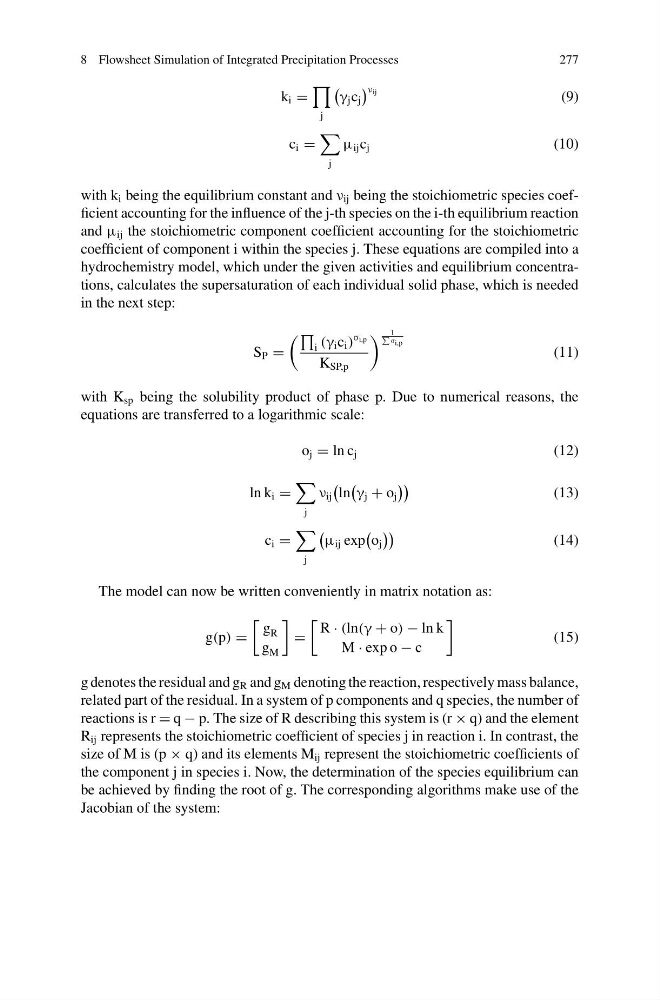
with k i being the equilibrium constant and ν ij being the stoichiometric species coefficient accounting for the influence of the j-th species on the i-th equilibrium reaction
and μ ij the stoichiometric component coefficient accounting for the stoichiometric
coefficient of component i within the species j. These equations are compiled into a
hydrochemistry model, which under the given activities and equilibrium concentrations, calculates the supersaturation of each individual solid phase, which is needed
in the next step:
S P =
i (γ i c i )
σ i,p
K SP,p
1
σ i,p
(11)
with K sp being the solubility product of phase p. Due to numerical reasons, the
equations are transferred to a logarithmic scale:
o j = ln c j
(12)
ln k i =
j
ν ij
ln
γ j + o j
(13)
c i =
j
μ ij exp
o j
(14)
The model can now be written conveniently in matrix notation as:
g(p) =
g R
g M
=
R · (ln(γ + o) − ln k
M · exp o − c
(15)
g denotes the residual and g R and g M denoting the reaction, respectively mass balance,
related part of the residual. In a system of p components and q species, the number of
reactions is r = q − p. The size of R describing this system is (r × q) and the element
R ij represents the stoichiometric coefficient of species j in reaction i. In contrast, the
size of M is (p × q) and its elements M ij represent the stoichiometric coefficients of
the component j in species i. Now, the determination of the species equilibrium can
be achieved by finding the root of g. The corresponding algorithms make use of the
Jacobian of the system:
277
k i =
j
γ j c j
ν ij
(9)
c i =
j
μ ij c j
(10)
with k i being the equilibrium constant and ν ij being the stoichiometric species coefficient accounting for the influence of the j-th species on the i-th equilibrium reaction
and μ ij the stoichiometric component coefficient accounting for the stoichiometric
coefficient of component i within the species j. These equations are compiled into a
hydrochemistry model, which under the given activities and equilibrium concentrations, calculates the supersaturation of each individual solid phase, which is needed
in the next step:
S P =
i (γ i c i )
σ i,p
K SP,p
1
σ i,p
(11)
with K sp being the solubility product of phase p. Due to numerical reasons, the
equations are transferred to a logarithmic scale:
o j = ln c j
(12)
ln k i =
j
ν ij
ln
γ j + o j
(13)
c i =
j
μ ij exp
o j
(14)
The model can now be written conveniently in matrix notation as:
g(p) =
g R
g M
=
R · (ln(γ + o) − ln k
M · exp o − c
(15)
g denotes the residual and g R and g M denoting the reaction, respectively mass balance,
related part of the residual. In a system of p components and q species, the number of
reactions is r = q − p. The size of R describing this system is (r × q) and the element
R ij represents the stoichiometric coefficient of species j in reaction i. In contrast, the
size of M is (p × q) and its elements M ij represent the stoichiometric coefficients of
the component j in species i. Now, the determination of the species equilibrium can
be achieved by finding the root of g. The corresponding algorithms make use of the
Jacobian of the system: