

274
M. Michaud et al.
integration of the underlying system of ordinary differential equations delivers the
system state at the next time step in an explicit Eulerian approach. Particle formation
is sub-divided into reaction-limited and transport-limited systems, i.e. for the former
the influence of the mixing module can be neglected. In both cases, the thermodynamic driving force, i.e. the local distribution of supersaturation controls space- and
time-dependent nucleation and growth.
3 Mixing Model
Precipitation processes can be classified into being either reaction-controlled or
mixing-controlled. The former process can be easily modelled by assuming driving
forces at each point of the reactor. The latter is strongly influenced by the preceding
mixing of the reactants and will yield results depending on the mixing history [13,
14]. CFD simulations including direct numerical simulation would allow for a precise calculation of the mixing behavior, however this kind approach is numerically
too expensive for flowsheet simulation [6, 15]. Therefore, we use the EngulfmentDeformation-Diffusion model (EDD model) which was originally developed for
stirred tank reactors and later extended to various other types of mixers [16, 17]. In
particular, the asymmetric Baldyga model was adapted and improved by the development of the symmetric engulfment model (SEM) to closer represent the symmetric
Y- and T-mixers by Haderlein et al. [4], based on an earlier model of [14, 18].
The SEM divides the mixer into four compartments of individual composition,
namely the two compartments with pure A and B whose compositions equal the
composition of the feed, and two compartments A’ and B’ in the contact area. Each
compartment is considered to be ideally mixed. The SEM assumes bidirectional
fluxes between A’ and B’ allowing for reactive mixtures in both compartments. The
compartments interact with each other, the mass transport from one compartment to
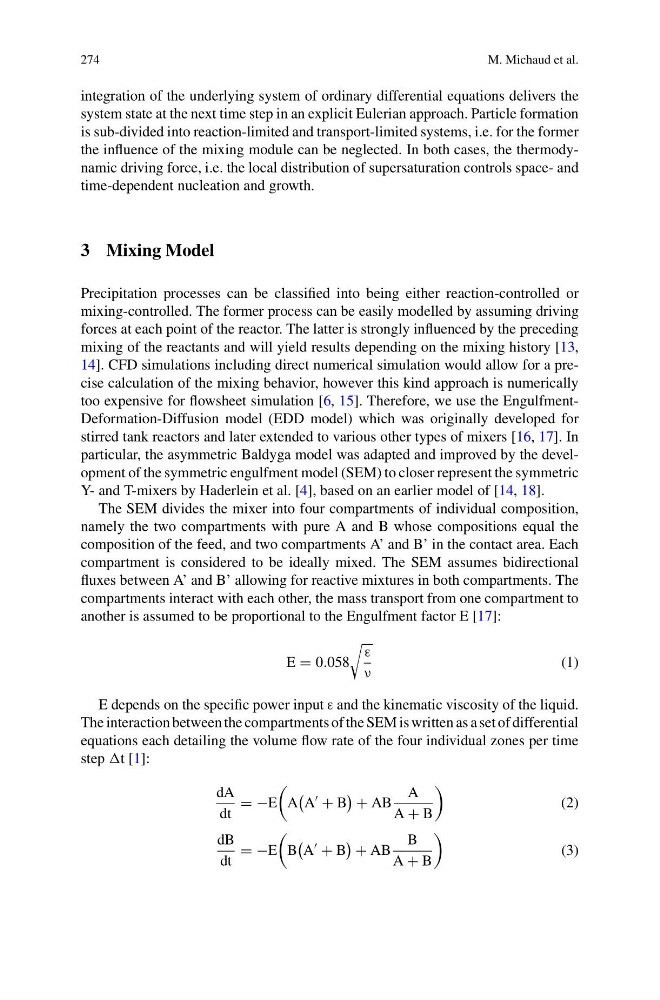
another is assumed to be proportional to the Engulfment factor E [17]:
E = 0.058
ε
ν
(1)
E depends on the specific power input ε and the kinematic viscosity of the liquid.
The interaction between the compartments of the SEM is written as a set of differential
equations each detailing the volume flow rate of the four individual zones per time
step t [1]:
dA
dt
= −E
A
A
+ B
+ AB
A
A + B
(2)
dB
dt
= −E
B
A
+ B
+ AB
B
A + B
(3)
M. Michaud et al.
integration of the underlying system of ordinary differential equations delivers the
system state at the next time step in an explicit Eulerian approach. Particle formation
is sub-divided into reaction-limited and transport-limited systems, i.e. for the former
the influence of the mixing module can be neglected. In both cases, the thermodynamic driving force, i.e. the local distribution of supersaturation controls space- and
time-dependent nucleation and growth.
3 Mixing Model
Precipitation processes can be classified into being either reaction-controlled or
mixing-controlled. The former process can be easily modelled by assuming driving
forces at each point of the reactor. The latter is strongly influenced by the preceding
mixing of the reactants and will yield results depending on the mixing history [13,
14]. CFD simulations including direct numerical simulation would allow for a precise calculation of the mixing behavior, however this kind approach is numerically
too expensive for flowsheet simulation [6, 15]. Therefore, we use the EngulfmentDeformation-Diffusion model (EDD model) which was originally developed for
stirred tank reactors and later extended to various other types of mixers [16, 17]. In
particular, the asymmetric Baldyga model was adapted and improved by the development of the symmetric engulfment model (SEM) to closer represent the symmetric
Y- and T-mixers by Haderlein et al. [4], based on an earlier model of [14, 18].
The SEM divides the mixer into four compartments of individual composition,
namely the two compartments with pure A and B whose compositions equal the
composition of the feed, and two compartments A’ and B’ in the contact area. Each
compartment is considered to be ideally mixed. The SEM assumes bidirectional
fluxes between A’ and B’ allowing for reactive mixtures in both compartments. The
compartments interact with each other, the mass transport from one compartment to
another is assumed to be proportional to the Engulfment factor E [17]:
E = 0.058
ε
ν
(1)
E depends on the specific power input ε and the kinematic viscosity of the liquid.
The interaction between the compartments of the SEM is written as a set of differential
equations each detailing the volume flow rate of the four individual zones per time
step t [1]:
dA
dt
= −E
A
A
+ B
+ AB
A
A + B
(2)
dB
dt
= −E
B
A
+ B
+ AB
B
A + B
(3)