

8 Flowsheet Simulation of Integrated Precipitation Processes
273
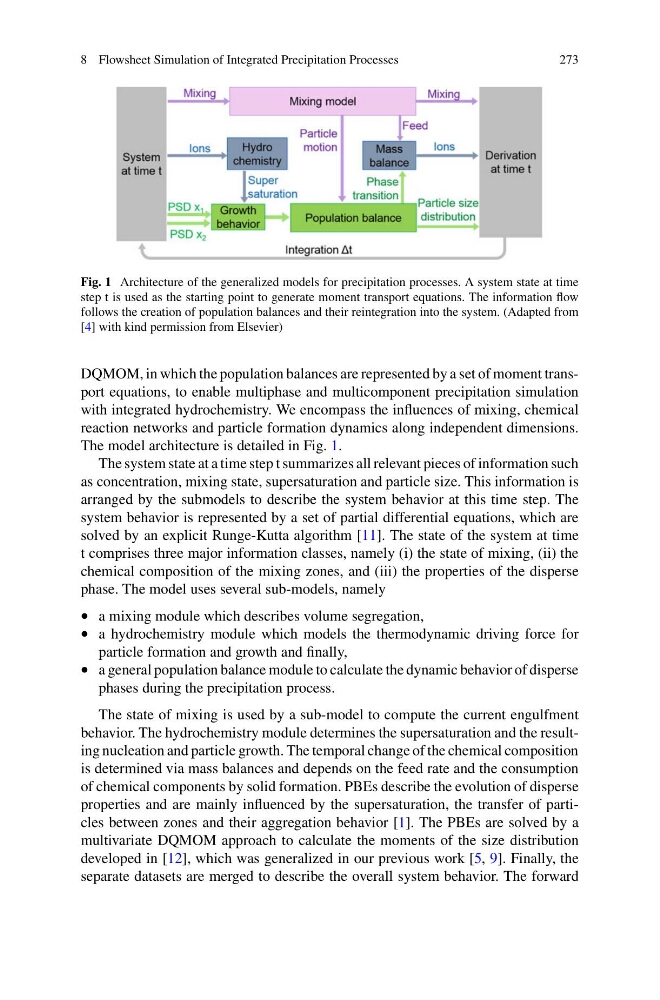
Fig. 1 Architecture of the generalized models for precipitation processes. A system state at time
step t is used as the starting point to generate moment transport equations. The information flow
follows the creation of population balances and their reintegration into the system. (Adapted from
[4] with kind permission from Elsevier)
DQMOM, in which the population balances are represented by a set of moment transport equations, to enable multiphase and multicomponent precipitation simulation
with integrated hydrochemistry. We encompass the influences of mixing, chemical
reaction networks and particle formation dynamics along independent dimensions.
The model architecture is detailed in Fig. 1.
The system state at a time step t summarizes all relevant pieces of information such
as concentration, mixing state, supersaturation and particle size. This information is
arranged by the submodels to describe the system behavior at this time step. The
system behavior is represented by a set of partial differential equations, which are
solved by an explicit Runge-Kutta algorithm [11]. The state of the system at time
t comprises three major information classes, namely (i) the state of mixing, (ii) the
chemical composition of the mixing zones, and (iii) the properties of the disperse
phase. The model uses several sub-models, namely
• a mixing module which describes volume segregation,
• a hydrochemistry module which models the thermodynamic driving force for
particle formation and growth and finally,
• a general population balance module to calculate the dynamic behavior of disperse
phases during the precipitation process.
The state of mixing is used by a sub-model to compute the current engulfment
behavior. The hydrochemistry module determines the supersaturation and the resulting nucleation and particle growth. The temporal change of the chemical composition
is determined via mass balances and depends on the feed rate and the consumption
of chemical components by solid formation. PBEs describe the evolution of disperse
properties and are mainly influenced by the supersaturation, the transfer of particles between zones and their aggregation behavior [1]. The PBEs are solved by a
multivariate DQMOM approach to calculate the moments of the size distribution
developed in [12], which was generalized in our previous work [5, 9]. Finally, the
separate datasets are merged to describe the overall system behavior. The forward
273
Fig. 1 Architecture of the generalized models for precipitation processes. A system state at time
step t is used as the starting point to generate moment transport equations. The information flow
follows the creation of population balances and their reintegration into the system. (Adapted from
[4] with kind permission from Elsevier)
DQMOM, in which the population balances are represented by a set of moment transport equations, to enable multiphase and multicomponent precipitation simulation
with integrated hydrochemistry. We encompass the influences of mixing, chemical
reaction networks and particle formation dynamics along independent dimensions.
The model architecture is detailed in Fig. 1.
The system state at a time step t summarizes all relevant pieces of information such
as concentration, mixing state, supersaturation and particle size. This information is
arranged by the submodels to describe the system behavior at this time step. The
system behavior is represented by a set of partial differential equations, which are
solved by an explicit Runge-Kutta algorithm [11]. The state of the system at time
t comprises three major information classes, namely (i) the state of mixing, (ii) the
chemical composition of the mixing zones, and (iii) the properties of the disperse
phase. The model uses several sub-models, namely
• a mixing module which describes volume segregation,
• a hydrochemistry module which models the thermodynamic driving force for
particle formation and growth and finally,
• a general population balance module to calculate the dynamic behavior of disperse
phases during the precipitation process.
The state of mixing is used by a sub-model to compute the current engulfment
behavior. The hydrochemistry module determines the supersaturation and the resulting nucleation and particle growth. The temporal change of the chemical composition
is determined via mass balances and depends on the feed rate and the consumption
of chemical components by solid formation. PBEs describe the evolution of disperse
properties and are mainly influenced by the supersaturation, the transfer of particles between zones and their aggregation behavior [1]. The PBEs are solved by a
multivariate DQMOM approach to calculate the moments of the size distribution
developed in [12], which was generalized in our previous work [5, 9]. Finally, the
separate datasets are merged to describe the overall system behavior. The forward