

7 Dynamic Simulation of Mechanical Fluid Separation in Solid …
255
R max = R d − U max (R d − R w ).
(24)
It is assumed that a maximum filling degree of U max = 0.95 occurs in decanter
centrifuges [28]. The reason for this behavior is that a fast-flowing layer forms on the
sediment surface which results in equilibrium between settling and lift of particles.
For a detailed description of the dynamic modeling of the cake compression behavior
of finely disperse particles, please refer to Gleiss [20].
4.3 Validation of the Dynamic Model for Decanter
Centrifuges
This subsection shows selected results for the experimental validation of the dynamic
model for a pilot-scale decanter centrifuge. The basis of dynamic simulations is the
mathematical modeling presented in Sects. 4.1 and 4.2. Limestone-water and PVCwater slurries were used for the validation trials of the presented approach for decanter
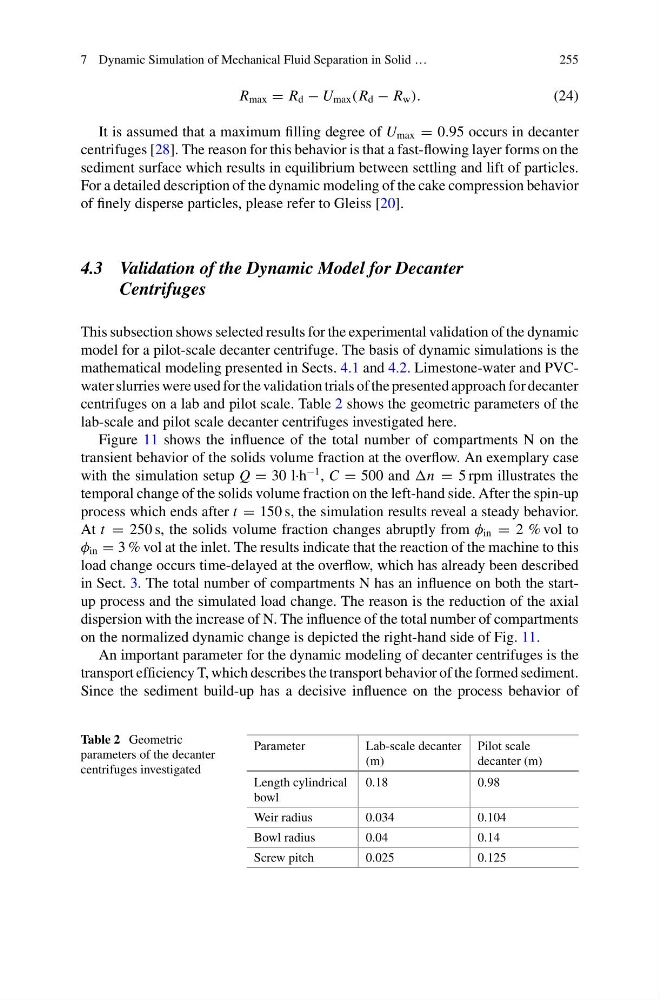
centrifuges on a lab and pilot scale. Table 2 shows the geometric parameters of the
lab-scale and pilot scale decanter centrifuges investigated here.
Figure 11 shows the influence of the total number of compartments N on the
transient behavior of the solids volume fraction at the overflow. An exemplary case
with the simulation setup Q = 30 l·h
−1 , C = 500 and n = 5 rpm illustrates the
temporal change of the solids volume fraction on the left-hand side. After the spin-up
process which ends after t = 150 s, the simulation results reveal a steady behavior.
At t = 250 s, the solids volume fraction changes abruptly from φ in = 2 % vol to
φ in = 3 % vol at the inlet. The results indicate that the reaction of the machine to this
load change occurs time-delayed at the overflow, which has already been described
in Sect. 3. The total number of compartments N has an influence on both the startup process and the simulated load change. The reason is the reduction of the axial
dispersion with the increase of N. The influence of the total number of compartments
on the normalized dynamic change is depicted the right-hand side of Fig. 11.
An important parameter for the dynamic modeling of decanter centrifuges is the
transport efficiency T, which describes the transport behavior of the formed sediment.
Since the sediment build-up has a decisive influence on the process behavior of
Table 2 Geometric
parameters of the decanter
centrifuges investigated
Parameter
Lab-scale decanter
(m)
Pilot scale
decanter (m)
Length cylindrical
bowl
0.18
0.98
Weir radius
0.034
0.104
Bowl radius
0.04
0.14
Screw pitch
0.025
0.125
255
R max = R d − U max (R d − R w ).
(24)
It is assumed that a maximum filling degree of U max = 0.95 occurs in decanter
centrifuges [28]. The reason for this behavior is that a fast-flowing layer forms on the
sediment surface which results in equilibrium between settling and lift of particles.
For a detailed description of the dynamic modeling of the cake compression behavior
of finely disperse particles, please refer to Gleiss [20].
4.3 Validation of the Dynamic Model for Decanter
Centrifuges
This subsection shows selected results for the experimental validation of the dynamic
model for a pilot-scale decanter centrifuge. The basis of dynamic simulations is the
mathematical modeling presented in Sects. 4.1 and 4.2. Limestone-water and PVCwater slurries were used for the validation trials of the presented approach for decanter
centrifuges on a lab and pilot scale. Table 2 shows the geometric parameters of the
lab-scale and pilot scale decanter centrifuges investigated here.
Figure 11 shows the influence of the total number of compartments N on the
transient behavior of the solids volume fraction at the overflow. An exemplary case
with the simulation setup Q = 30 l·h
−1 , C = 500 and n = 5 rpm illustrates the
temporal change of the solids volume fraction on the left-hand side. After the spin-up
process which ends after t = 150 s, the simulation results reveal a steady behavior.
At t = 250 s, the solids volume fraction changes abruptly from φ in = 2 % vol to
φ in = 3 % vol at the inlet. The results indicate that the reaction of the machine to this
load change occurs time-delayed at the overflow, which has already been described
in Sect. 3. The total number of compartments N has an influence on both the startup process and the simulated load change. The reason is the reduction of the axial
dispersion with the increase of N. The influence of the total number of compartments
on the normalized dynamic change is depicted the right-hand side of Fig. 11.
An important parameter for the dynamic modeling of decanter centrifuges is the
transport efficiency T, which describes the transport behavior of the formed sediment.
Since the sediment build-up has a decisive influence on the process behavior of
Table 2 Geometric
parameters of the decanter
centrifuges investigated
Parameter
Lab-scale decanter
(m)
Pilot scale
decanter (m)
Length cylindrical
bowl
0.18
0.98
Weir radius
0.034
0.104
Bowl radius
0.04
0.14
Screw pitch
0.025
0.125