

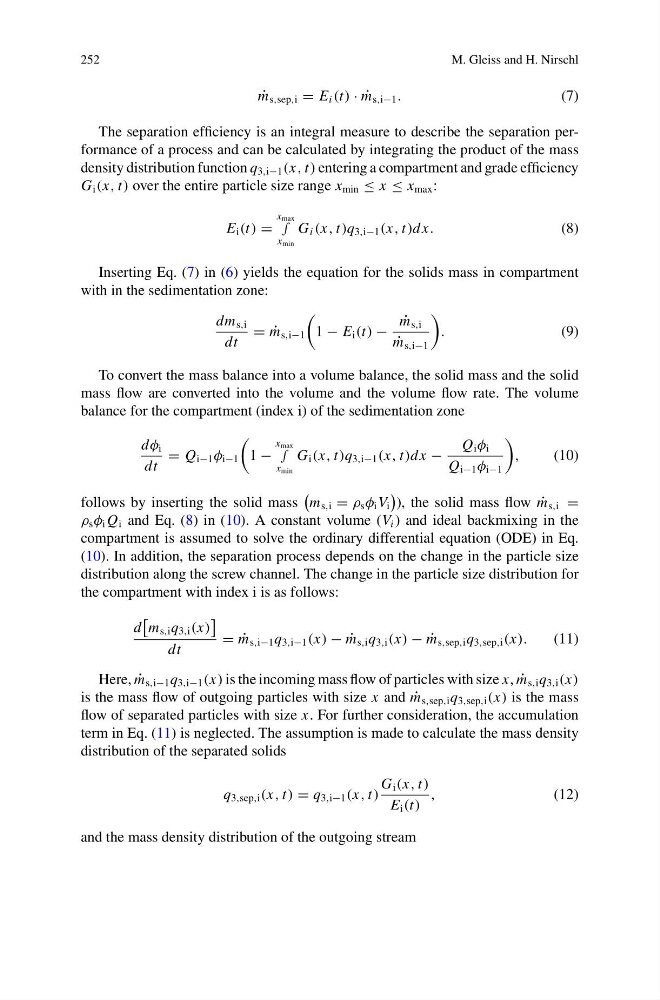
252
M. Gleiss and H. Nirschl
˙
m s,sep,i = E i (t) · ˙
m s,i−1 .
(7)
The separation efficiency is an integral measure to describe the separation performance of a process and can be calculated by integrating the product of the mass
density distribution function q 3,i−1 (x, t) entering a compartment and grade efficiency
G i (x, t) over the entire particle size range x min ≤ x ≤ x max :
E i (t) =
x max
∫
x min
G i (x, t)q 3,i−1 (x, t)dx.
(8)
Inserting Eq. (7) in (6) yields the equation for the solids mass in compartment
with in the sedimentation zone:
dm s,i
dt
= ˙
m s,i−1
1 − E i (t) −
˙
m s,i
˙
m s,i−1
.
(9)
To convert the mass balance into a volume balance, the solid mass and the solid
mass flow are converted into the volume and the volume flow rate. The volume
balance for the compartment (index i) of the sedimentation zone
dφ i
dt
= Q i−1 φ i−1
1 −
x max
∫
x min
G i (x, t)q 3,i−1 (x, t)dx −
Q i φ i
Q i−1 φ i−1
,
(10)
follows by inserting the solid mass
m s,i = ρ s φ i V i
), the solid mass flow ˙
m s,i =
ρ s φ i Q i and Eq. (8) in (10). A constant volume (V i ) and ideal backmixing in the
compartment is assumed to solve the ordinary differential equation (ODE) in Eq.
(10). In addition, the separation process depends on the change in the particle size
distribution along the screw channel. The change in the particle size distribution for
the compartment with index i is as follows:
d
m s,i q 3,i (x)
dt
= ˙
m s,i−1 q 3,i−1 (x) − ˙
m s,i q 3,i (x) − ˙
m s,sep,i q 3,sep,i (x).
(11)
Here, ˙
m s,i−1 q 3,i−1 (x) is the incoming mass flow of particles with size x, ˙
m s,i q 3,i (x)
is the mass flow of outgoing particles with size x and ˙
m s,sep,i q 3,sep,i (x) is the mass
flow of separated particles with size x. For further consideration, the accumulation
term in Eq. (11) is neglected. The assumption is made to calculate the mass density
distribution of the separated solids
q 3,sep,i (x, t) = q 3,i−1 (x, t)
G i (x, t)
E i (t)
,
(12)
and the mass density distribution of the outgoing stream
M. Gleiss and H. Nirschl
˙
m s,sep,i = E i (t) · ˙
m s,i−1 .
(7)
The separation efficiency is an integral measure to describe the separation performance of a process and can be calculated by integrating the product of the mass
density distribution function q 3,i−1 (x, t) entering a compartment and grade efficiency
G i (x, t) over the entire particle size range x min ≤ x ≤ x max :
E i (t) =
x max
∫
x min
G i (x, t)q 3,i−1 (x, t)dx.
(8)
Inserting Eq. (7) in (6) yields the equation for the solids mass in compartment
with in the sedimentation zone:
dm s,i
dt
= ˙
m s,i−1
1 − E i (t) −
˙
m s,i
˙
m s,i−1
.
(9)
To convert the mass balance into a volume balance, the solid mass and the solid
mass flow are converted into the volume and the volume flow rate. The volume
balance for the compartment (index i) of the sedimentation zone
dφ i
dt
= Q i−1 φ i−1
1 −
x max
∫
x min
G i (x, t)q 3,i−1 (x, t)dx −
Q i φ i
Q i−1 φ i−1
,
(10)
follows by inserting the solid mass
m s,i = ρ s φ i V i
), the solid mass flow ˙
m s,i =
ρ s φ i Q i and Eq. (8) in (10). A constant volume (V i ) and ideal backmixing in the
compartment is assumed to solve the ordinary differential equation (ODE) in Eq.
(10). In addition, the separation process depends on the change in the particle size
distribution along the screw channel. The change in the particle size distribution for
the compartment with index i is as follows:
d
m s,i q 3,i (x)
dt
= ˙
m s,i−1 q 3,i−1 (x) − ˙
m s,i q 3,i (x) − ˙
m s,sep,i q 3,sep,i (x).
(11)
Here, ˙
m s,i−1 q 3,i−1 (x) is the incoming mass flow of particles with size x, ˙
m s,i q 3,i (x)
is the mass flow of outgoing particles with size x and ˙
m s,sep,i q 3,sep,i (x) is the mass
flow of separated particles with size x. For further consideration, the accumulation
term in Eq. (11) is neglected. The assumption is made to calculate the mass density
distribution of the separated solids
q 3,sep,i (x, t) = q 3,i−1 (x, t)
G i (x, t)
E i (t)
,
(12)
and the mass density distribution of the outgoing stream