

7 Dynamic Simulation of Mechanical Fluid Separation in Solid …
251
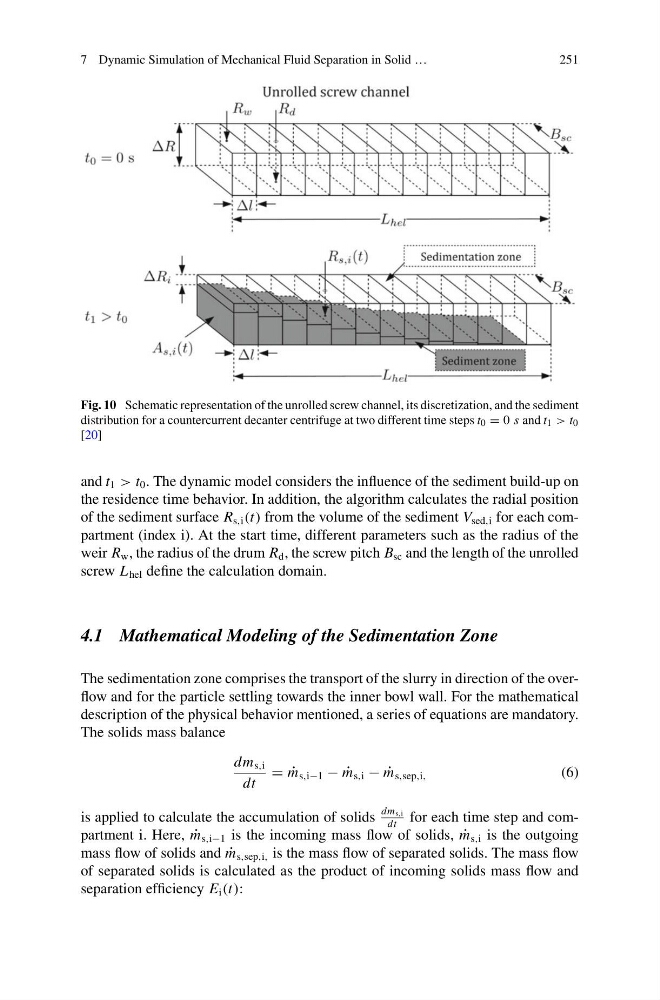
Fig. 10 Schematic representation of the unrolled screw channel, its discretization, and the sediment
distribution for a countercurrent decanter centrifuge at two different time steps t 0 = 0 s and t 1 > t 0
[20]
and t 1 > t 0 . The dynamic model considers the influence of the sediment build-up on
the residence time behavior. In addition, the algorithm calculates the radial position
of the sediment surface R s,i (t) from the volume of the sediment V sed,i for each compartment (index i). At the start time, different parameters such as the radius of the
weir R w , the radius of the drum R d , the screw pitch B sc and the length of the unrolled
screw L hel define the calculation domain.
4.1 Mathematical Modeling of the Sedimentation Zone
The sedimentation zone comprises the transport of the slurry in direction of the overflow and for the particle settling towards the inner bowl wall. For the mathematical
description of the physical behavior mentioned, a series of equations are mandatory.
The solids mass balance
dm s,i
dt
= ˙
m s,i−1 − ˙
m s,i − ˙
m s,sep,i,
(6)
is applied to calculate the accumulation of solids
dm s,i
dt
for each time step and compartment i. Here, ˙
m s,i−1 is the incoming mass flow of solids, ˙
m s,i is the outgoing
mass flow of solids and ˙
m s,sep,i, is the mass flow of separated solids. The mass flow
of separated solids is calculated as the product of incoming solids mass flow and
separation efficiency E i (t):
251
Fig. 10 Schematic representation of the unrolled screw channel, its discretization, and the sediment
distribution for a countercurrent decanter centrifuge at two different time steps t 0 = 0 s and t 1 > t 0
[20]
and t 1 > t 0 . The dynamic model considers the influence of the sediment build-up on
the residence time behavior. In addition, the algorithm calculates the radial position
of the sediment surface R s,i (t) from the volume of the sediment V sed,i for each compartment (index i). At the start time, different parameters such as the radius of the
weir R w , the radius of the drum R d , the screw pitch B sc and the length of the unrolled
screw L hel define the calculation domain.
4.1 Mathematical Modeling of the Sedimentation Zone
The sedimentation zone comprises the transport of the slurry in direction of the overflow and for the particle settling towards the inner bowl wall. For the mathematical
description of the physical behavior mentioned, a series of equations are mandatory.
The solids mass balance
dm s,i
dt
= ˙
m s,i−1 − ˙
m s,i − ˙
m s,sep,i,
(6)
is applied to calculate the accumulation of solids
dm s,i
dt
for each time step and compartment i. Here, ˙
m s,i−1 is the incoming mass flow of solids, ˙
m s,i is the outgoing
mass flow of solids and ˙
m s,sep,i, is the mass flow of separated solids. The mass flow
of separated solids is calculated as the product of incoming solids mass flow and
separation efficiency E i (t):