

250
M. Gleiss and H. Nirschl
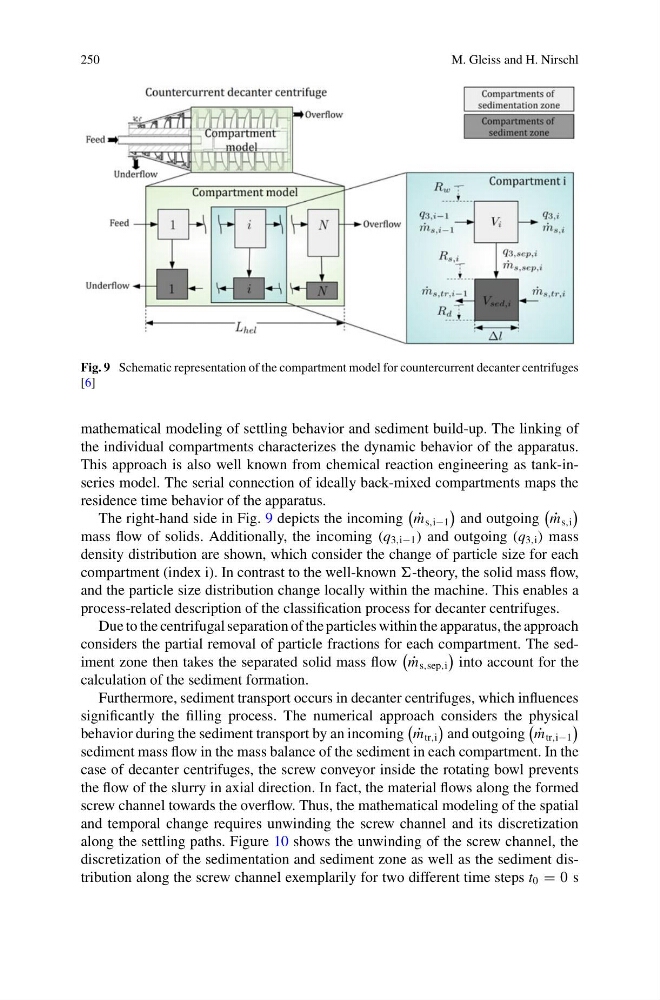
Fig. 9 Schematic representation of the compartment model for countercurrent decanter centrifuges
[6]
mathematical modeling of settling behavior and sediment build-up. The linking of
the individual compartments characterizes the dynamic behavior of the apparatus.
This approach is also well known from chemical reaction engineering as tank-inseries model. The serial connection of ideally back-mixed compartments maps the
residence time behavior of the apparatus.
The right-hand side in Fig. 9 depicts the incoming
˙
m s,i−1
and outgoing
˙
m s,i
mass flow of solids. Additionally, the incoming (q 3,i−1 ) and outgoing (q 3,i ) mass
density distribution are shown, which consider the change of particle size for each
compartment (index i). In contrast to the well-known -theory, the solid mass flow,
and the particle size distribution change locally within the machine. This enables a
process-related description of the classification process for decanter centrifuges.
Due to the centrifugal separation of the particles within the apparatus, the approach
considers the partial removal of particle fractions for each compartment. The sediment zone then takes the separated solid mass flow
˙
m s,sep,i
into account for the
calculation of the sediment formation.
Furthermore, sediment transport occurs in decanter centrifuges, which influences
significantly the filling process. The numerical approach considers the physical
behavior during the sediment transport by an incoming
˙
m tr,i
and outgoing
˙
m tr,i−1
sediment mass flow in the mass balance of the sediment in each compartment. In the
case of decanter centrifuges, the screw conveyor inside the rotating bowl prevents
the flow of the slurry in axial direction. In fact, the material flows along the formed
screw channel towards the overflow. Thus, the mathematical modeling of the spatial
and temporal change requires unwinding the screw channel and its discretization
along the settling paths. Figure 10 shows the unwinding of the screw channel, the
discretization of the sedimentation and sediment zone as well as the sediment distribution along the screw channel exemplarily for two different time steps t 0 = 0 s
M. Gleiss and H. Nirschl
Fig. 9 Schematic representation of the compartment model for countercurrent decanter centrifuges
[6]
mathematical modeling of settling behavior and sediment build-up. The linking of
the individual compartments characterizes the dynamic behavior of the apparatus.
This approach is also well known from chemical reaction engineering as tank-inseries model. The serial connection of ideally back-mixed compartments maps the
residence time behavior of the apparatus.
The right-hand side in Fig. 9 depicts the incoming
˙
m s,i−1
and outgoing
˙
m s,i
mass flow of solids. Additionally, the incoming (q 3,i−1 ) and outgoing (q 3,i ) mass
density distribution are shown, which consider the change of particle size for each
compartment (index i). In contrast to the well-known -theory, the solid mass flow,
and the particle size distribution change locally within the machine. This enables a
process-related description of the classification process for decanter centrifuges.
Due to the centrifugal separation of the particles within the apparatus, the approach
considers the partial removal of particle fractions for each compartment. The sediment zone then takes the separated solid mass flow
˙
m s,sep,i
into account for the
calculation of the sediment formation.
Furthermore, sediment transport occurs in decanter centrifuges, which influences
significantly the filling process. The numerical approach considers the physical
behavior during the sediment transport by an incoming
˙
m tr,i
and outgoing
˙
m tr,i−1
sediment mass flow in the mass balance of the sediment in each compartment. In the
case of decanter centrifuges, the screw conveyor inside the rotating bowl prevents
the flow of the slurry in axial direction. In fact, the material flows along the formed
screw channel towards the overflow. Thus, the mathematical modeling of the spatial
and temporal change requires unwinding the screw channel and its discretization
along the settling paths. Figure 10 shows the unwinding of the screw channel, the
discretization of the sedimentation and sediment zone as well as the sediment distribution along the screw channel exemplarily for two different time steps t 0 = 0 s