

7 Dynamic Simulation of Mechanical Fluid Separation in Solid …
245
the existing yield point on the solids pressure, the experimental determination of the
rheological material properties is very challenging. Here, the yield point increases
with the reduction of porosity. Moreover, the material is either dilatant or shear thinning. Since no measurement methods are currently available to determine the rheological material properties, an adjusting parameter is defined to describe the sediment
transport. The influence of this parameter is shown in more detail in Sect. 4.2.
3 System and Residence Time Behavior
In addition to the material behavior of the suspension, the flow conditions have
a considerable influence on the operation of solid bowl centrifuges. For tubular
and decanter centrifuges, for example, the residence time limits particle separation.
Knowledge about the residence time behavior is therefore essential for the design of
these centrifuge types. One possibility for the description of the flow conditions is the
determination of the residence time and system behavior by means of experimental
or numerical investigations. This approach considers the integral output response
after a sudden change at the inlet. Dead zones and vortices create a dispersion in the
system. This means that a step response at the outlet does not follow from a step
change at the inlet.
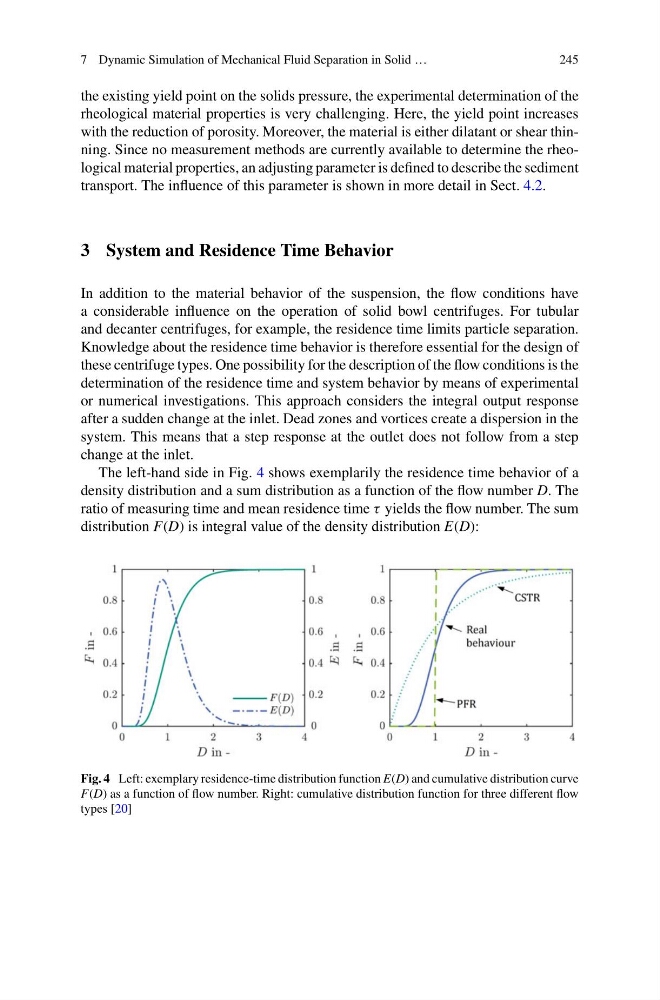
The left-hand side in Fig. 4 shows exemplarily the residence time behavior of a
density distribution and a sum distribution as a function of the flow number D. The
ratio of measuring time and mean residence time τ yields the flow number. The sum
distribution F(D) is integral value of the density distribution E(D):
Fig. 4 Left: exemplary residence-time distribution function E(D) and cumulative distribution curve
F(D) as a function of flow number. Right: cumulative distribution function for three different flow
types [20]
245
the existing yield point on the solids pressure, the experimental determination of the
rheological material properties is very challenging. Here, the yield point increases
with the reduction of porosity. Moreover, the material is either dilatant or shear thinning. Since no measurement methods are currently available to determine the rheological material properties, an adjusting parameter is defined to describe the sediment
transport. The influence of this parameter is shown in more detail in Sect. 4.2.
3 System and Residence Time Behavior
In addition to the material behavior of the suspension, the flow conditions have
a considerable influence on the operation of solid bowl centrifuges. For tubular
and decanter centrifuges, for example, the residence time limits particle separation.
Knowledge about the residence time behavior is therefore essential for the design of
these centrifuge types. One possibility for the description of the flow conditions is the
determination of the residence time and system behavior by means of experimental
or numerical investigations. This approach considers the integral output response
after a sudden change at the inlet. Dead zones and vortices create a dispersion in the
system. This means that a step response at the outlet does not follow from a step
change at the inlet.
The left-hand side in Fig. 4 shows exemplarily the residence time behavior of a
density distribution and a sum distribution as a function of the flow number D. The
ratio of measuring time and mean residence time τ yields the flow number. The sum
distribution F(D) is integral value of the density distribution E(D):
Fig. 4 Left: exemplary residence-time distribution function E(D) and cumulative distribution curve
F(D) as a function of flow number. Right: cumulative distribution function for three different flow
types [20]